
 E-Paper



Labour staring at the end of the road in UK? | Number Theory
The issues UK voters say matter most to them are almost exactly the ones on which they think the government is performing the worst.
Updated on: May 11, 2026, 07:00:16 IST

 Prefer HTon Google
Share via


Copy link

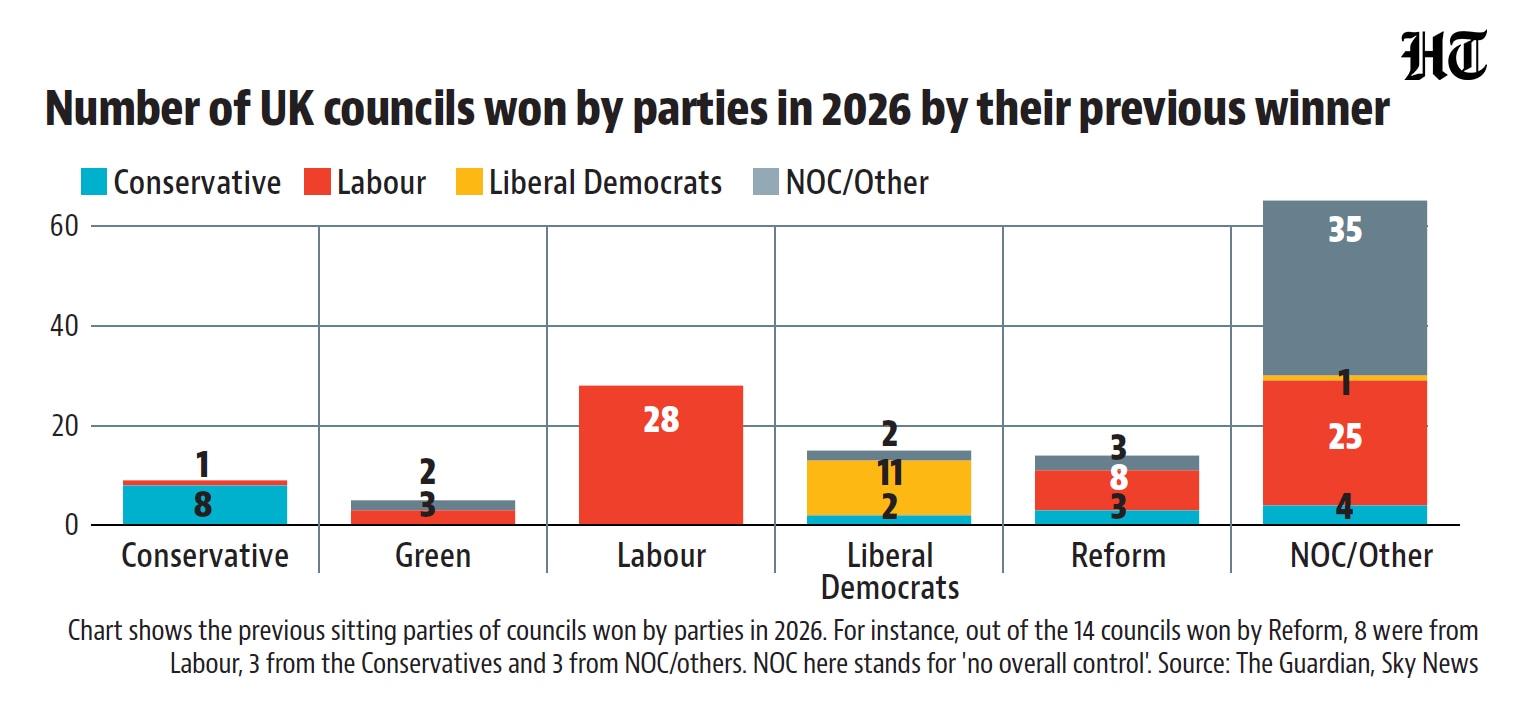
The 2026 local elections were the first large-scale test of Keir Starmer’s Labour government, and the verdict was brutal. Across 136 English councils where elections took place, Labour was left controlling just 28. Reforms won 14 councils, the Liberal Democrats 15, the Conservatives 9 and the Greens 5, while most councils ending in no overall control. The wider picture was no kinder to Labour: it suffered heavy losses in England, was routed in Wales and lost ground in Scotland. Here’s a closer look at what these results mean for politics in the UK.

Labour staring at the end of the road in UK?
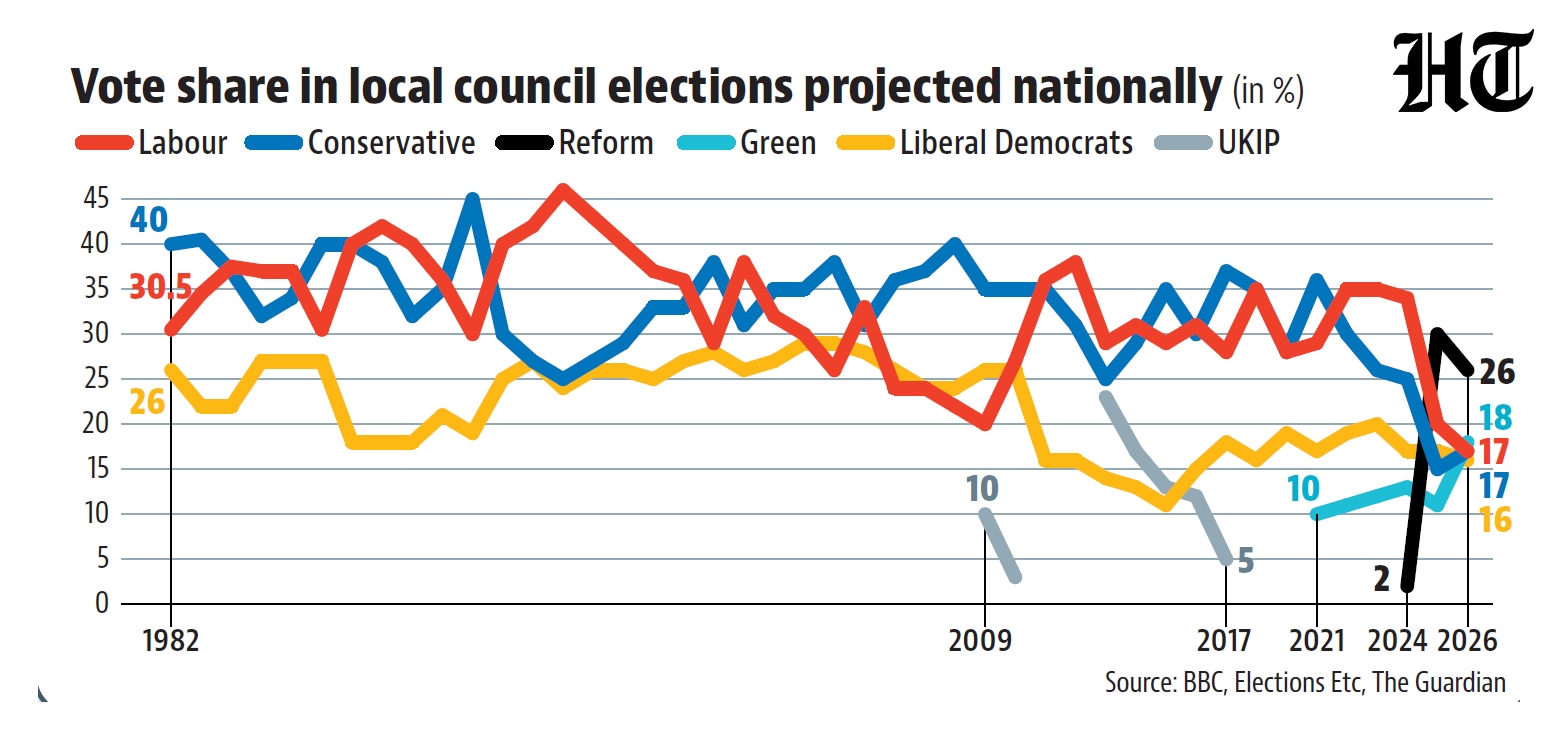
 Labour’s modern lowLabour’s performance is understood through the projected national share (PNS), which adjusts for the uneven geography of local elections and estimates what the vote would have looked like had contests been held across Britain. Labour’s PNS stood at 17%—its lowest since at least 1982, the earliest year for which comparable data is readily available. That is below the 20% it recorded in 2009 during the final phase of the Gordon Brown government, and far below the mid-30s it managed as recently as 2022-24. To be sure, this year’s projection comes from a more fragmented five-party contest. But that also makes the result harder, not easier, to dismiss.
- Reform and Greens gain from the churnOf the 14 councils won by Reform, eight had previously been run by Labour, three by the Conservative and three were under no overall control or others. The Greens’ advance was smaller but still telling: three of their five council wins came from Labour, and two came from no overall control or others. The Conservatives have also been weakened. They held only eight of their councils and gained just one from Labour, while losing ground to Reform and the Liberal Democrats. The results fit a longer trend in councillor strength. Labour’s share of councillors in England has fallen from 35.4% in 2024 to 24.7% in 2026, while the Conservatives have dropped from 29.7% to 21.8%. Reform, almost absent from local government two years ago, now has 13.9% of councillors, while the Greens have risen from 4.9% to 7.6%. Labour’s problem, therefore, is not only incumbency fatigue, but that its local base is being eaten into by Reform on one side and the Greens on another, while the Conservatives no longer look strong enough to absorb the protest vote themselves.
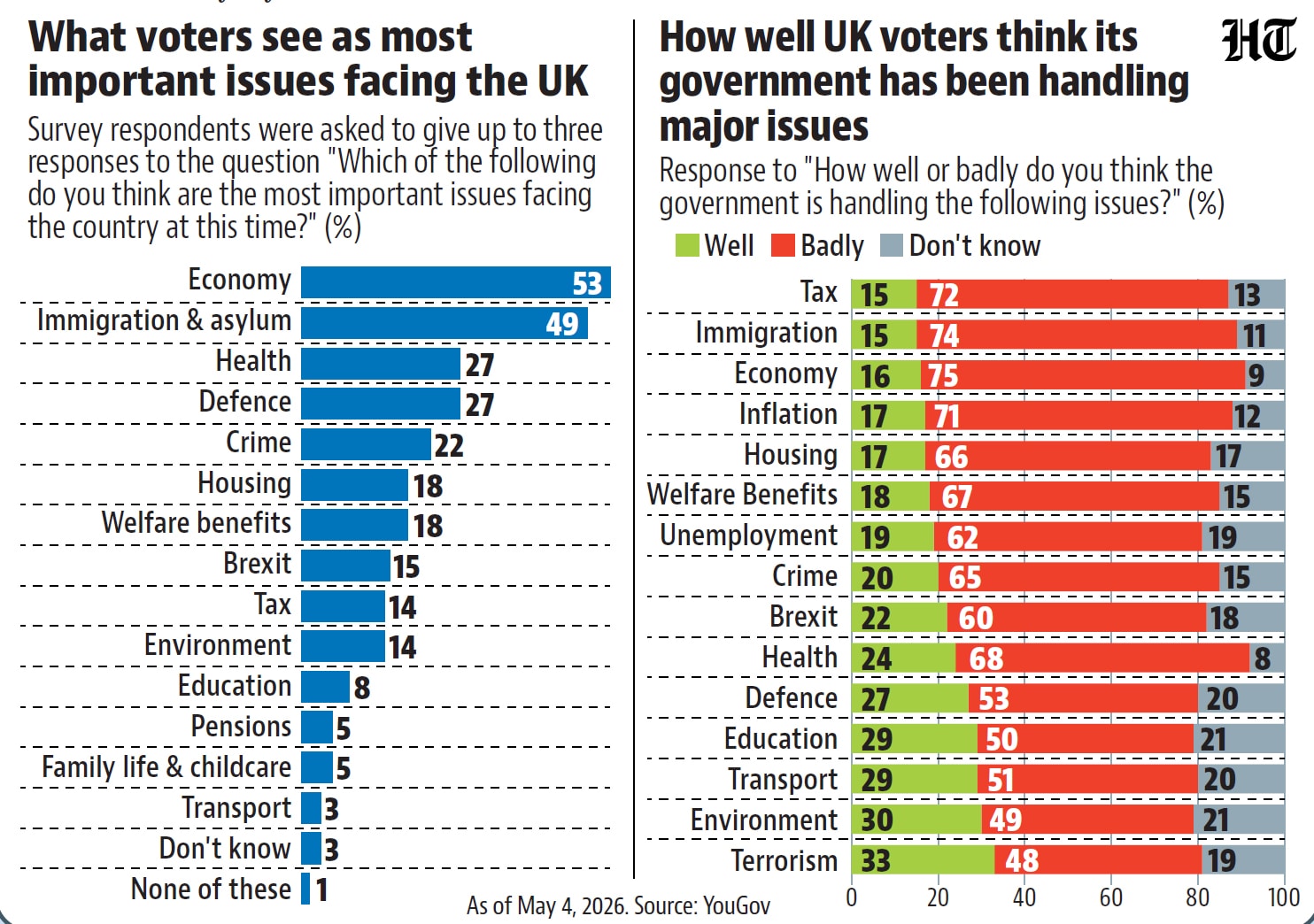
- Voters do not trust Labour on the issues that matter mostThe issues UK voters say matter most to them are almost exactly the ones on which they think the government is performing the worst. Surveys show that the economy is their top concern, named by 53% of voters, followed by immigration and asylum at 49%. Health, defence, crime and housing also feature prominently. But when asked how the government is handling major issues, three-fourths say it is doing badly on the economy and immigration, while seven in 10 say the same on tax and inflation. Even on health, one of Labour’s traditional strengths, 68% think the government is handling the issue badly. This does not mean voters have fully embraced alternatives. Reform still faces doubts over competence and the Greens over credibility. But the anti-incumbency mood has been sharpened by a sense that the social contract is broken, with voters frustrated by high costs, weak services, housing pressures and immigration. The result is that Labour is being punished not just for unpopular decisions, but for failing to convince voters that it can make everyday life better.
- The old two-party system is now a five-way contestBritain has seen third-party surges before, but the present fragmentation is broader, with support splintering across five major parties. As the Guardian’s notes after the local election, “fragmentation is no longer the future of British politics. In many places it is its present.” And this makes the country’s politics far less predictable.


Unlock a world of Benefits with HT! From insightful newsletters to real-time news alerts and a personalized news feed – it's all here, just a click away! -Login Now!


