
 E-Paper



Number Theory: After Delhi, Bihar next in India's diverse poll arena
.
Updated on: Feb 6, 2025, 08:33:33 IST

 Prefer HTon Google
Share via


Copy link

2025 will see only two assembly elections in India. Voting in the first, the Union Territory of Delhi is now over. The second one, in Bihar, will take place towards the end of the year. In 2020, the Bihar elections took place between 28 October and 7 November. These two elections also capture the huge diversity in state-level contests in India. Here are three charts which explain this in detail.
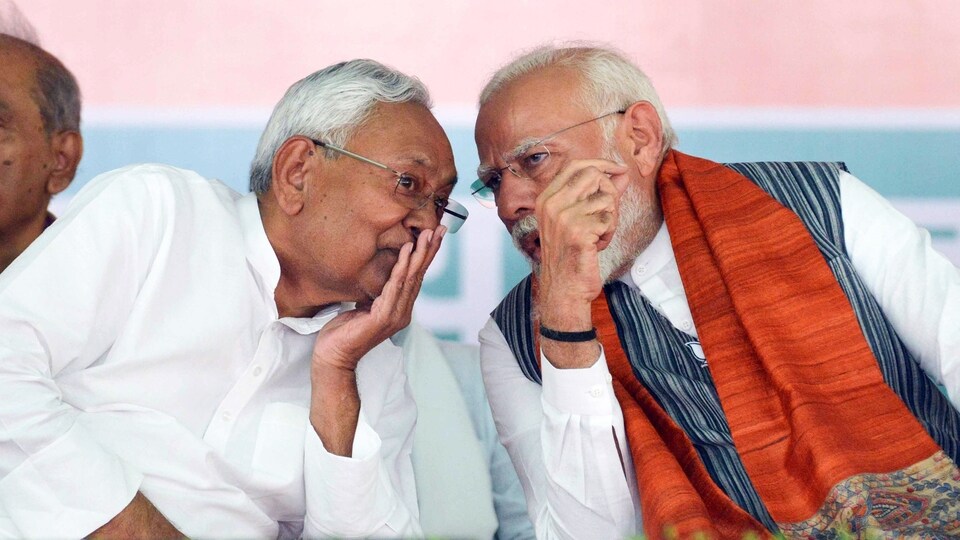
After Delhi, Bihar next in India's diverse poll arena
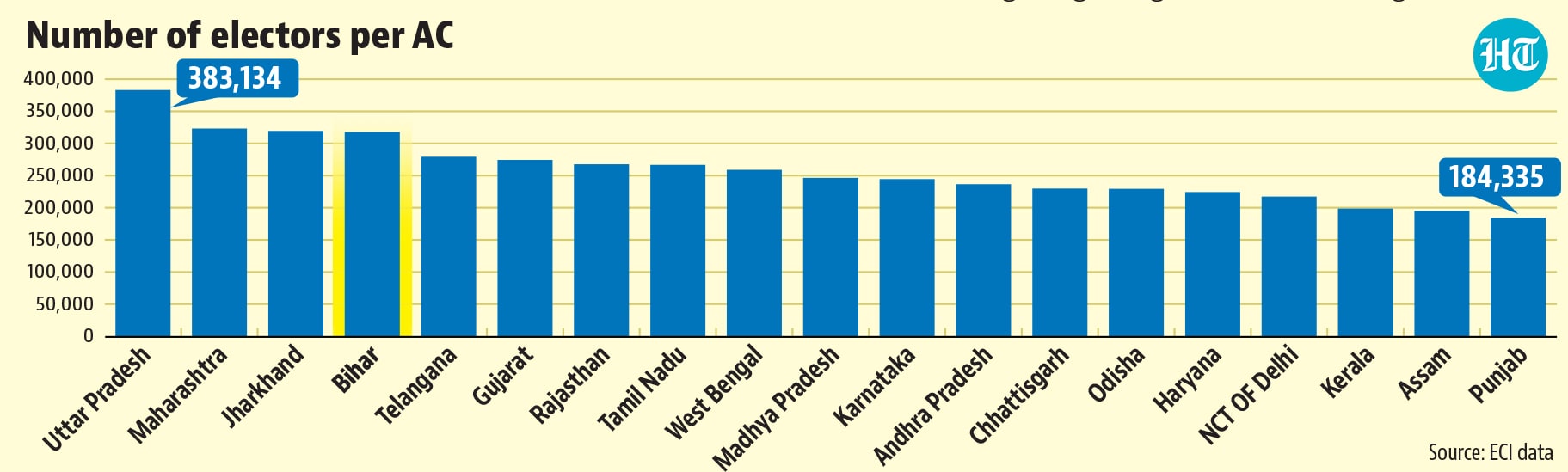
 There is a large variation in number of electors per AC in India…While it is a given that the number of electors will not be identical in different assembly constituencies (ACs), the divergence in average number of electors (registered voters) per AC is very large in India. Even if one were to set aside smaller, hilly or remote states, the difference is still far from insignificant. For example, the number of voters per AC in Delhi is 2,17,352, which is just above two-third of the 3,17,941 voters per AC in Bihar. Uttar Pradesh has the highest number of electors per AC which is 3,83,134. For the sake of consistency, we have used 2024 Lok Sabha election electoral count numbers to make these calculations. While the difference in number of voters per Lok Sabha constituency is often commented upon in India, it is important to underline the asymmetry in number of voters per AC, which has serious consequences for representative politics at the level of states. The more voters an MLA has to tend to, the bigger will be their challenge in getting elected and being effective.
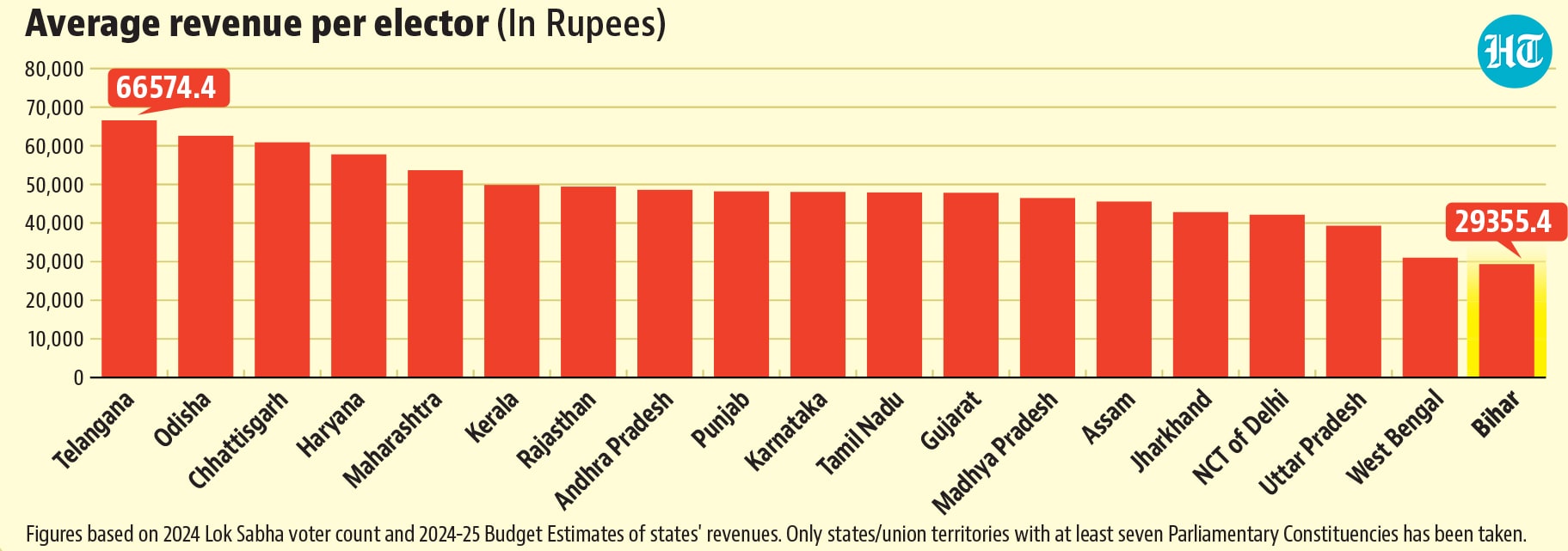
- A similar variation exists when it comes to states’ revenue per electorAbility to do justice to the representation challenge is not just a question of number of voters. It is also contingent on the amount of revenue a state has for a given number of voters. Indian states differ significantly on this count as well, although the difference is not as large as the number of electors per AC. Among states with at lest seven parliamentary constituencies (PCs), Telangana has the highest total revenue per elector of ₹66574.4 and Bihar the lowest at ₹29,355.4. Delhi, surprisingly, with an average revenue of ₹42,158 per elector of is ranked among the states and UTs with lower average revenue per elector , only above Uttar Pradesh, West Bengal and Bihar. To be sure, Delhi has both an advantage and a disadvantage. Because the Union government takes care of a lot of spending heads such as policing in Delhi, the latter gets a revenue cushion. On the other hand, Delhi not being a state also means that it does not receive any share of the Centre’s tax revenues.
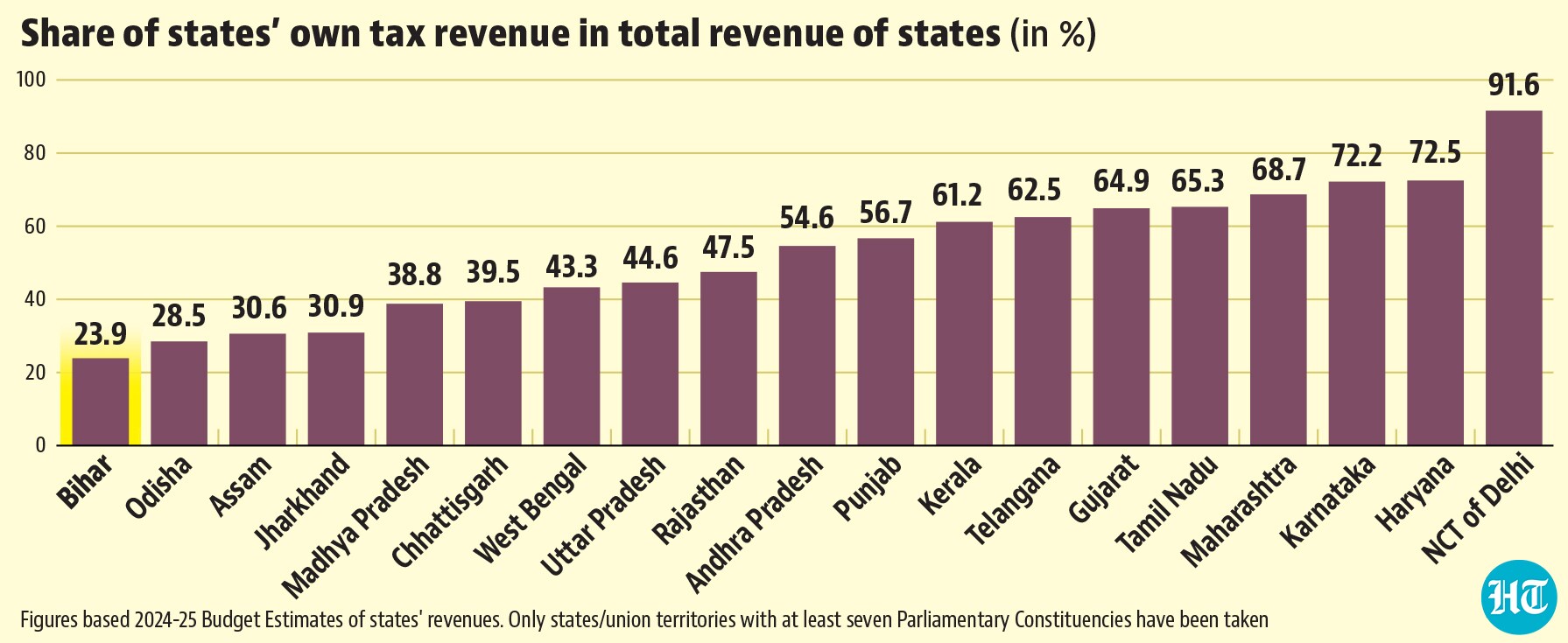
- Even more important is the divergence between states’ overall revenue and own tax revenueThis is perhaps the most controversial political fallout of asymmetry in India’s state-level political competition. It is one thing to make an argument that a state should be spending more on heads such as capital expenditure or revenue spending targeted at long-term benefits instead of allocating it to populist schemes targeted at winning elections. While there is some economic merit in such a line of reasoning, what is also true is that sovereign governments – state governments are sovereign in matters of spending – are free to decide how to spend their money. However, what makes this sovereignty debatable, if not complicated, is the fact that not all of the money spent by the states is actually raised from revenue within the state. Under India’s fiscal federalism framework, poorer states get a higher share in the Centre’s revenues to promote equality. This comes at the cost of richer states which actually see a transfer of central taxes raised in their states to others. This divergence can be clearly seen in the share of own tax revenue in total revenue of states and union territories. Among the larger states, this number is just 23.9% for Bihar, while it is more than 72% for states like Karnataka and Haryana. This debate will likely peak between the Delhi and Bihar election, which is when the 16th Finance Commission is expected to submit its report.


Unlock a world of Benefits with HT! From insightful newsletters to real-time news alerts and a personalized news feed – it's all here, just a click away! -Login Now!


