E-Paper



Number Theory: Decoding India's council of ministers, 1952 to 2024
HT has built a caste database of all persons who have ever been a part of the Union council of ministers.

 Prefer HTon Google


In 1950, India adopted a universal adult franchise despite deep-rooted social and economic inequalities. How successful has Indian democracy been in dealing with these inequalities when it comes to political representation? We know that India’s legislatures have been becoming increasingly richer than the universe of voters. But what about social inequalities?
The Constitution provided for legislative reservations for Scheduled Caste (SC) and Scheduled Tribe (ST) communities in keeping with the spirit of the 1932 Poona Pact. Other backward classes (OBCs), who account for almost half of India’s population today, did not exist as a constitutional nationwide category until the adoption of the Mandal Commission report in 1990. The share of OBCs in the legislative has been increasing thanks to their numerical strength. But legislative representation need not always translate into equal sharing of power. How has India performed when it comes to social representation in the executive?
HT has built a caste database of all persons who have ever been a part of the Union council of ministers to answer this question. This list includes 3,278 persons and covers all Union governments that have held office since the first general election of 1952 in India.
This four-part data journalism series will evaluate the social representativeness or lack of it in all councils of ministers in India. The first part of this series will summarise the methodology of this analysis and the general evolution of India’s council of ministers over time. The second part will have an overall cumulative social break-up of the council of ministers. The third part will examine at the state-wise inequality in the council of ministers and the final part will look at the relation between political parties and caste inequality in the council of ministers.
- How the database was builtThe Parliament Digital Library has a publication Names and Portfolios of the Members of the Union Council of Ministers (https://tinyurl.com/yaw7s9pr). Press Information Bureau (PIB) archives and the Cabinet Secretariat, Government of India have updated each reshuffle in the council of ministers from 1952 onwards. The caste, religion and state details of the ministers have been collected from multiple sources including digital archives of the parliament and state assemblies, news reports and other academic works. As far as the state of the persons in this database is concerned, it has been designated on the basis of the constituencies they represent rather than their place of birth or usual residence. This means that Manmohan Singh as the Prime Minister would be seen as being from Assam and Narendra Modi would be recorded as being from Uttar Pradesh and not Gujarat. In case a minister has more than one portfolio, they have been counted as many times. Ministers who were not in office for the entire duration of the government have also been included. Because caste identities are often not part of official records and their broad classification into SC/ST/OBC and others varies across states, multiple rounds of cross-checks have been done with various sources.
 India’s council of ministers have become bigger over timeAt present, the council of ministers has three kinds of ministers: Cabinet, ministers of state with independent charge, and ministers of state. However, there were two more categories which existed in the past: Parliament secretaries and deputy ministers. These two categories ceased to exist in 1991 and 1996. If one were to compare the number of members in the council of ministers, they show an increase over time. The number of unique Cabinet portfolios in the council of ministers has increased significantly over time, primarily due to the creation of new portfolios and ministries, some of which have been created after bifurcating existing ones. The first council of ministers in independent India had 18 unique Cabinet portfolios; this has increased to 49 in the most recent council of ministers that was appointed on June 10, 2024. It is difficult to count the number of designated ministers of state and other categories because their numbers can vary in the same individual portfolio in different governments. This means that comparing the number of total members in the council of ministers can technically be misleading because each member can hold more than one portfolio. Having said that the size of council of ministers in a government does give an idea about the distribution of power or lack of it in the executive.
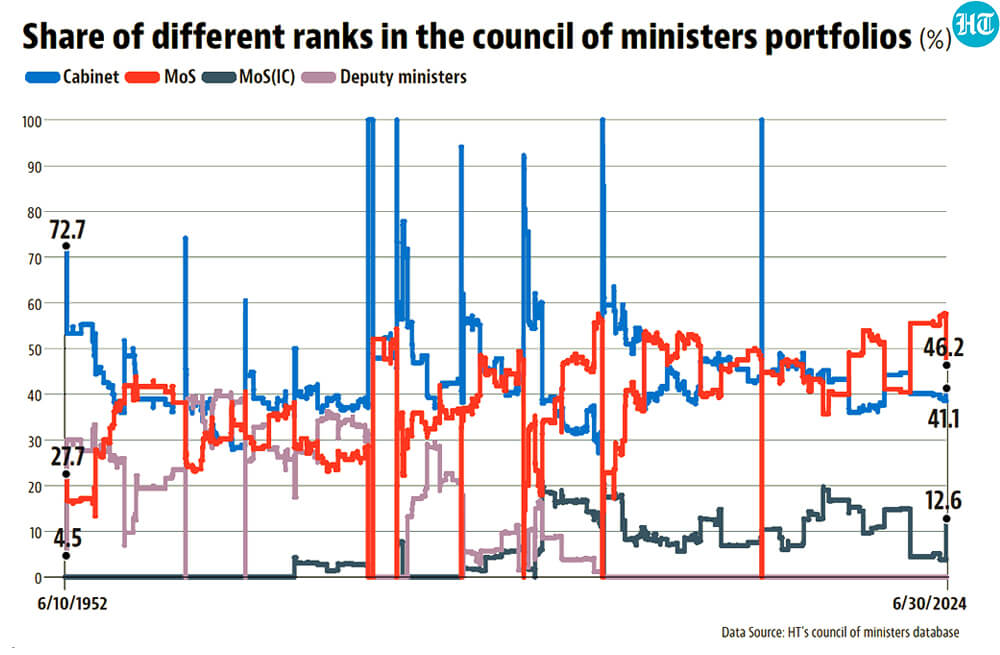
- 44% of the names in the database are Cabinet ministersAmong the 3,278 people in the database, 1,451 are Cabinet ministers, 1291 are ministers of state, and 234 are ministers of state with independent charge. There are 302 persons who were either deputy ministers or Parliament secretaries. These two have been clubbed as deputy ministers throughout this series. A historical disaggregation of the database shows that the share of cabinet ministers in the council of ministers has been falling over time. The chart shown below shows sudden spikes because the council of ministers was really small or just the Prime Minister with a few Cabinet ministers when some governments first assumed office.