E-Paper



Number Theory: Decoding the scale of economic challenges confronting Starmer
The 2008 Global Financial Crisis and 2016 Brexit have been the two most important blows for the UK economy, seriously eroding its economic might in the world.
Published on: Jul 10, 2024, 08:48:55 IST

 Prefer HTon Google
Share via


Copy link

The Labour Party under the leadership of Keir Starmer has won a landslide victory in the United Kingdom (UK) elections. However, the road ahead, both for the Labour Party and the UK, will be anything but smooth. Even if one were to ignore the now deep-rooted social and ethnic fault lines in British and European politics at large, the economic challenges facing the country are perhaps the most difficult they have ever been in the history of the country. Here are four charts which summarise the enormity of economic problems facing United Kingdom.
Decoding the scale of economic challenges confronting Keir Starmer
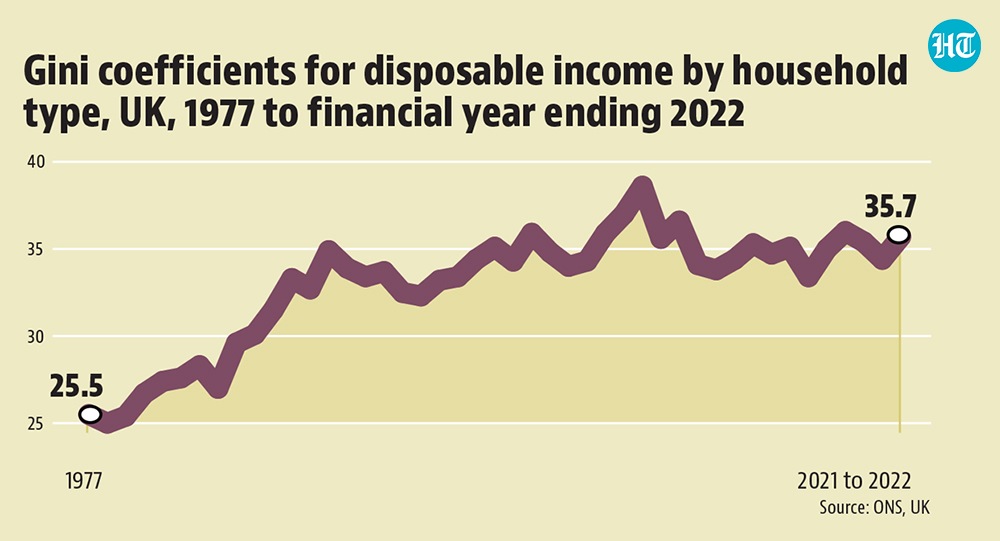
 Economic inequality in Britain is a legacy of the neoliberal project unleashed by ThatcherMargaret Thatcher, who along with her US counterpart Ronald Reagan, is credited with unleashing the neoliberal revolution (or counter-revolution) in modern capitalism presided over the dilution of welfare capitalism, also known as the golden age of capitalism, which came into being in advanced capitalist countries after the end of the Second World War. While the neoliberal turnaround helped protect macroeconomic stability in the advanced capitalist world – failure to do this was a major factor behind the collapse of the Soviet Union led socialist camp – it led to a huge increase in income inequality in these countries. Data from Office for National Statistics (ONS) from UK shows this clearly. The Gini coefficient of income inequality increased by ten percentage points between 1979 and 1990 – the years of Thatcher’s prime ministership – in the UK. This number has largely stayed in this ballpark in the last three decades
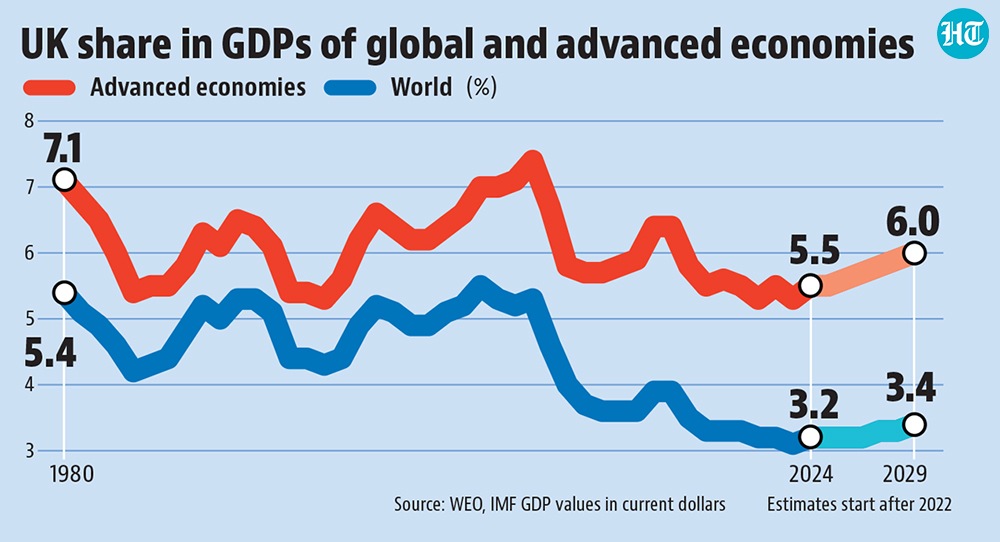
- And the collapse in GDP growth has made things worse for everyoneEconomic growth is an important determinant of well-being even at similar levels of inequality. Data from IMF’s World Economic Outlook (WEO) database shows UK’s economic growth predicament clearly. Compound annual growth rate (CAGR) of UK GDP was 2.8% between 1980-90, 2.5% between 1990-2000, 1.5% between 2000-10, 1.9% between 2010-10 and is expected to be just 1% between 2019-29. When seen from the perspective of UK’s share in global GDP, the 2008 Global Financial Crisis and 2016 Brexit have been the two most important blows for the UK economy which have seriously eroded its economic might in the world.
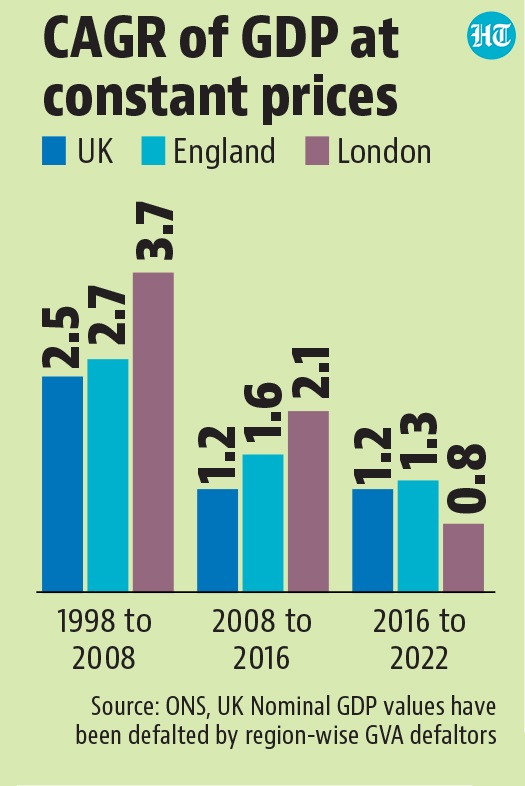
- Brexit: An act of economic schadenfreude for the UK“Brexit did reduce regional inequality, but did so by “levelling down” — that is, damaging — prosperous regions more than less prosperous ones”, Martin Wolf wrote in his Financial Times column published on July 8. A comparison of ONS data on regional GDP of UK for the periods between 1998-2008 (pre GFC), 2008-2016 (pre-Brexit) and 2016-22 (post-Brexit) shows this clearly. While the CAGR of GDP growth for United Kingdom, England and London has fallen continuously between these periods, what makes the post-Brexit period unique is that the London region lost is growth advantage over both United Kingdom and England during this interval unlike the earlier two time-periods. Given the fact that London region now accounts for almost one-quarter of UK’s overall GDP -- its population share is just 13% -- any government trying for an economic revival will have to focus on boosting the finance, high value services dominated London economy. But its political popularity will depend on whether the non-rich parts of the country see such a policy as economically just.
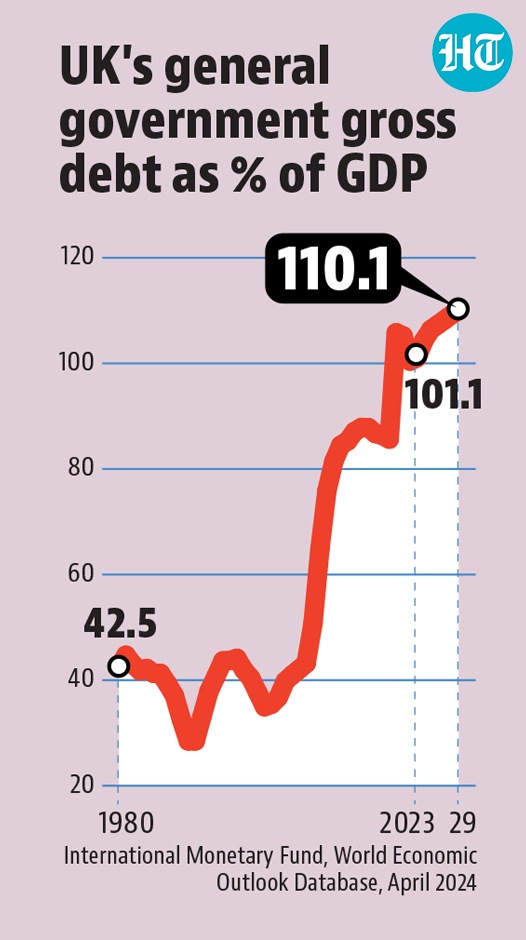
- Unless growth revives, the debt burden will keep inching towards becoming unsustainableUK’s gross national debt as a share of GDP breached the 100% mark in 2020, the year the pandemic erupted. IMF’s WEO projections suggest that this is likely to cross 110% by 2029, the latest year for which these projections are available. A long-term look at the UK’s debt-GDP ratio clearly shows the role played by the GFC in worsening the debt burden before the pandemic threw it off the rails. This number increased by 1.7 times between 2008 and 2016 when it stabilized for a while before showing a sharp spike during the pandemic once again. The only feasible way to reduce the national debt burden without triggering a democratic backlash or an economic crisis is to increase GDP growth rather than unleash austerity or unhinged fiscal profligacy which can derail growth or fiscal balance further worsening the debt problem. It was the hara-kiri by Rishi Sunak’s predecessor Liz Truss on this front that dealt the biggest blow to the governance credentials of the Conservative Party in the eyes of both the rich and poor electors in UK, which has culminated in its worst ever election defeat in the country. It remains to be seen whether Starmer can find a balance between the financial markets and UK’s real economy to solve this problem and rescue it from tis biggest economic crisis.