E-Paper



Number Theory: How Congress lost the plot and slumped to its lowest Maharashtra tally
.
Published on: Nov 26, 2024, 09:52:52 IST

 Prefer HTon Google
Share via


Copy link

The Congress now has just 16 MLAs in the new Maharashtra assembly, its lowest every tally in India’s second largest state by number of Lok Sabha MPs. The Congress’s decimation in Maharashtra -- there is no other way to describe this performance -- comes on the back of a long-term process of marginalisation of India’s grand old party in the western state. Here are three charts which explain this in detail and why recovering from here will not be an easy task.
How Congress lost the plot and slumped to its lowest Maharashtra tally
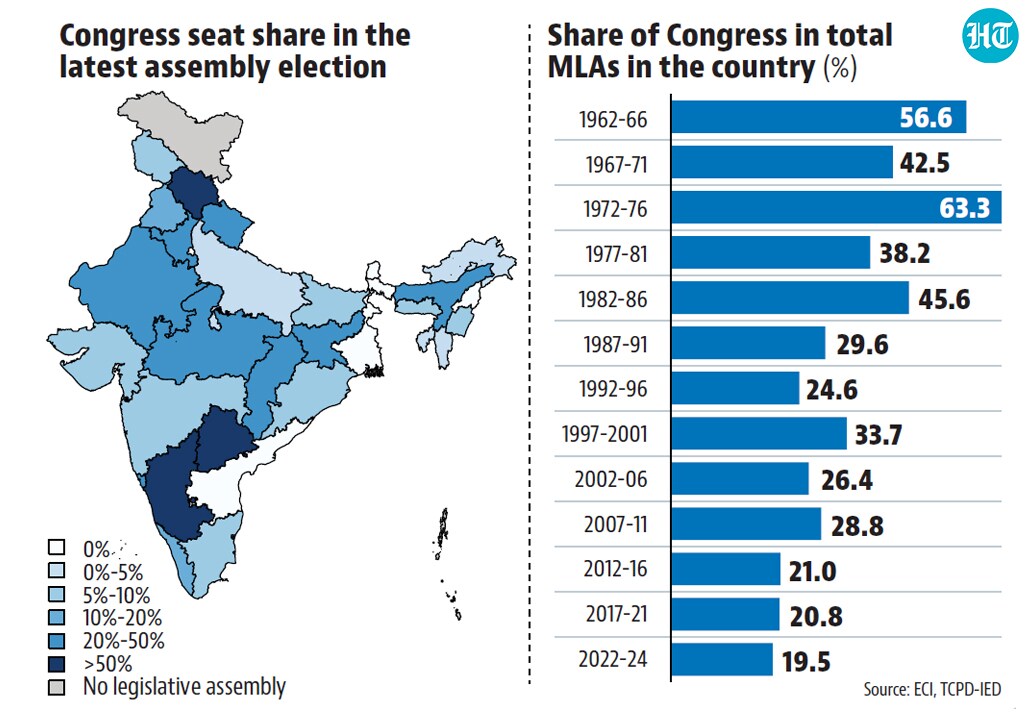
 Maharashtra is the 17th legislative assembly in India where the Congress has less than 10% of MLAs todayWith just 16 MLAs in an assembly of 288, the Congress has just 5.55% of the seat share in Maharashtra assembly now. This is the party’s lowest ever seat share in the Maharashtra assembly since 1962, the earliest period for which data is available in the Trivedi Center for Political Data (TCPD) database. As of today, the Congress has less than 10% of MLAs – it is the threshold below which a party cannot even claim the leader of opposition’s position in the assembly – in 17 out of the 31 legislative assemblies in 28 states and three union territories of Delhi, Jammu and Kashmir and Puducherry. Among 18 states with at least 10 Lok Sabha constituencies, the Congress has less than 10% of the MLAs in seven states now. What is an even more worrying trend for the Congress is that its share of MLAs in the country has been coming down almost continuously.
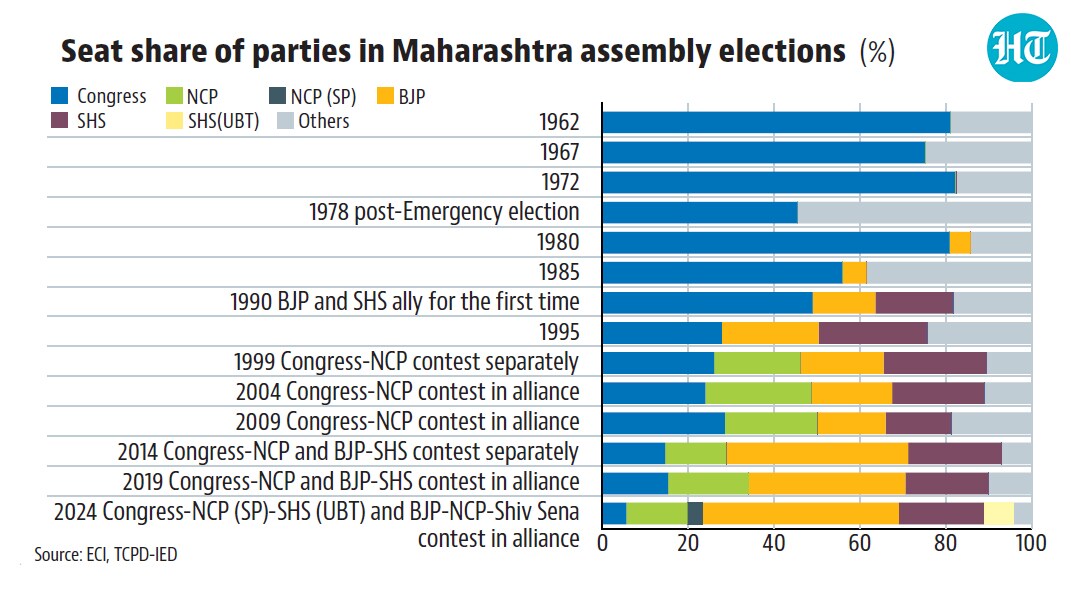
- Congress has been losing ground in Maharashtra over a long timeThis is the most important aspect of the story. The Congress’s political marginalisation in Maharashtra is a story which has continued since the 1980s. A look at party-wise seat shares in the Maharashtra assembly confirms this. Congress had a majority of its own in the Maharashtra assembly in the 1962, 1967 and 1972 elections. While it lost the post-emergency 1978 assembly election, it regained its majority in the 1980 and 1985 elections. Its slide began after the BJP and the Shiv Sena first joined hands in the 1990 assembly elections and its losses widened in the 1995 assembly election when the Shiv Sena and BJP alliance first formed a government in Maharashtra. Congress’s own seat share in the state never went above the 30% mark after 1995 even though it did form two governments in the state in an alliance with the Nationalist Congress Party (NCP) which came out a split in the Congress in 1999. The 2014, 2019 and 2024 elections saw the Congress’s seat share first fall below the 20% mark and then 10%, primarily on account of a rising BJP. The short point is that the 2024 results are only a new low for the Congress which has been in a historical tailspin.
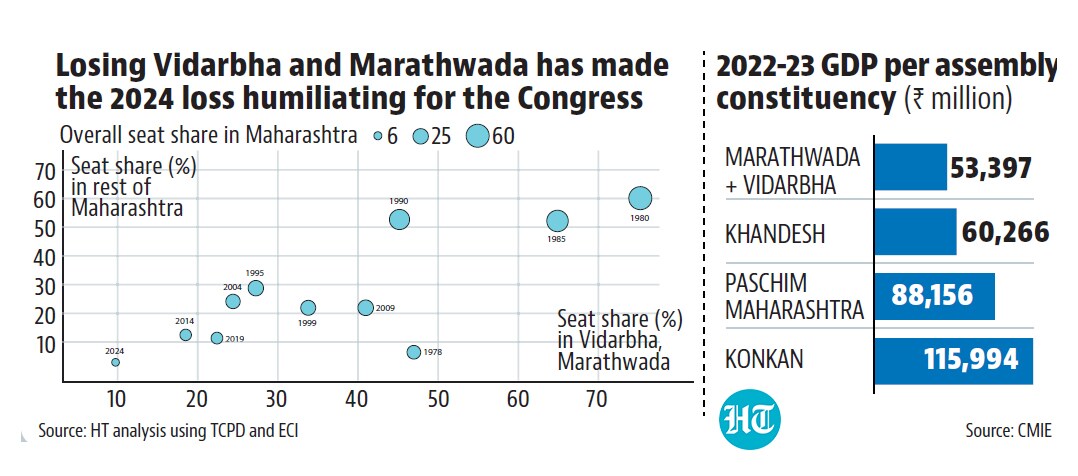
- But its complete decimation is a result of losing the poorest and most rural part of MaharashtraThis is an interesting point which emerges from a long-term analysis of the Congress’s performance across regions in Maharashtra. According to 2022 Global Human Settlement Layer (GHSL) data compiled by Shamindra Nath Roy, the Vidarbha and Marathwada sub-regions -- they have 62 and 46 assembly constituencies (ACs) respectively -- are the most rural in Maharashtra. They are also the poorest if one were look at GDP per AC in the state. If one were to look at sub-region wise breakup of Congress MLAs, then ten out of the Congress’s 16 MLAs have come from the Marathwada and Vidarbha sub-regions (which have 108 ACs) and the remaining seven have come from the rest of the state, which has 180 MLAs in the assembly. A long-term comparison of the Congress’s sub-region wise performance shows that it has fallen below the 10% seat share threshold in the state once more if one were to exclude the Vidarbha and Marathwada sub-regions. However, what saved it was a better performance in the two most rural and poor parts of the state. In 2024, it slipped below the 10% seat share mark even in these two sub-regions. The Congress likes to attribute its losses against the BJP to the latter’s disproportionate advantage in terms of resources. Its humiliation in Maharashtra is on account of losing support from the poorest voters in the state, who had not deserted it until now despite a continuous decline in both the country and the state. This is exactly why the Congress must introspect deeply on its loss.