E-Paper



Number Theory: State of the economy – The opportunities and challenges
IMF projections suggest that India will account for 7% of the global GDP growth between 2020 and 2029.
Published on: Jun 3, 2024, 09:30:17 IST

 Prefer HTon Google
Share via


Copy link

With a GDP growth rate of 8.2% in 2023-24 India was the world’s fastest growing major economy by a distance. The fact that this growth has come largely on back of a fiscal consolidation – GVA growth is a full percentage point lower – even in an election year, makes it all the more important. If the exit poll predictions of Saturday hold true, the Narendra Modi government is set to return to power with an even bigger mandate. This would continue the sweet spot of macroeconomic and political stability in India. What does this mean for the Indian economy in the medium term beyond annual and quarterly GDP growth numbers? Here are four charts which describe this challenge.
State of the economy – The opportunities and challenges
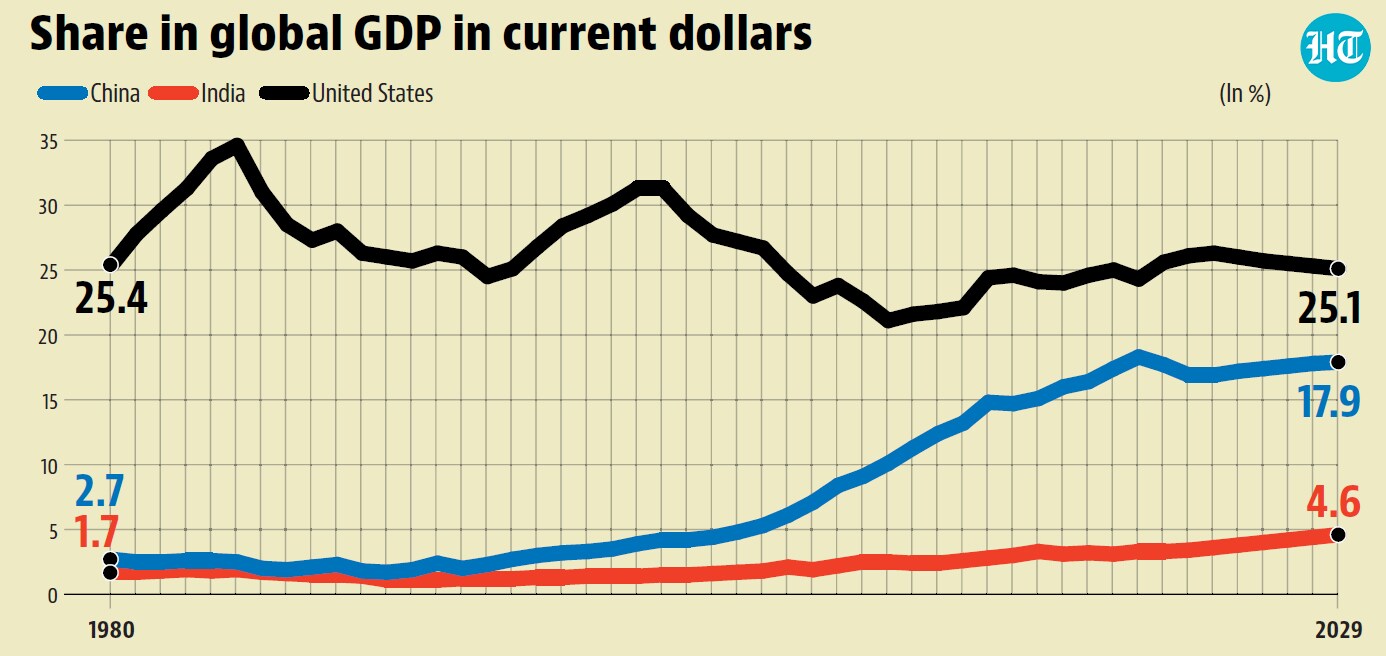
 India is still a small player when it comes to its weight in the global economyOne of the recurring themes in Narendra Modi’s election campaign was the ‘guarantee’ that India will become the third largest economy; behind the United States and China, in the world under the third term of his government. Its political importance of lack of it in the campaign notwithstanding, India climbing to the third spot in the global GDP rankings has been a known fact for some time now. To be sure, projection given in the IMF’s World Economic Outlook database also show that India’s overall share in global GDP in current dollars will still be significantly smaller than that of China and US by 2029, which is when the third Modi government, if elected, will complete its third term.
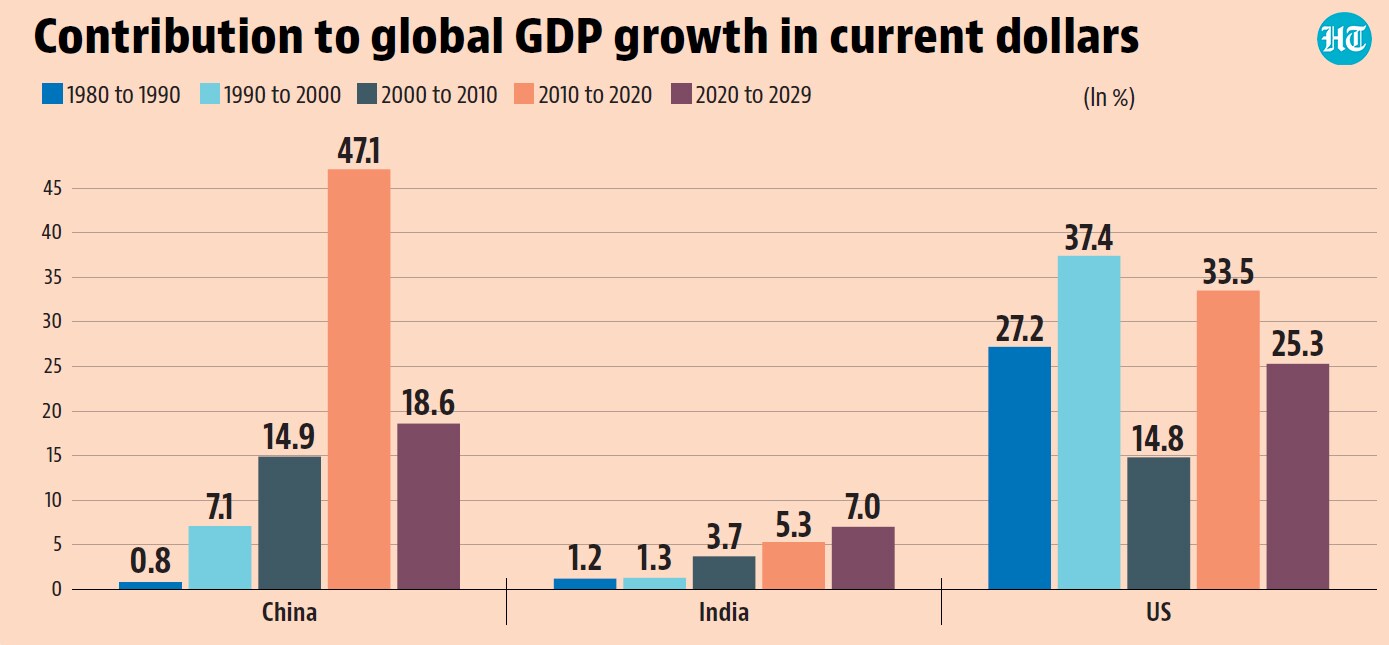
- But India’s role as a global driver of growth will become more importantTo be sure, a country’s share in global GDP at a given point in time is determined more its past growth than current or future growth. Only when a country experiences a sustained period of high growth, such as China in the in the decade after its accession to the World Trade Organisation (WTO) in 2001, does it see a significant increase in its global GDP shares. What also needs to be kept in mind is the fact that overall global economic environment itself keeps changing at different period in time generating tailwinds or headwinds for growth potential of a particular country. For example, export to advanced economies was a much bigger growth driver when Asian Tigers and China experienced their high growth phase. These opportunities are significantly more today. A better metric to measure a country’s importance in the global economy in the present is to look at its contribution to global economic growth in a given period. It is on this count that India’s economic importance seems to be rising and that of US and China seems to be falling. IMF projections suggest that India will account for 7% of global GDP growth between 2020 and 2029, which is more than the 5.3% number between 2010 and 2020. In China’s case this number is likely to fall from 47.1% in the 2010s to just 18.6% between 2020 and 2029.
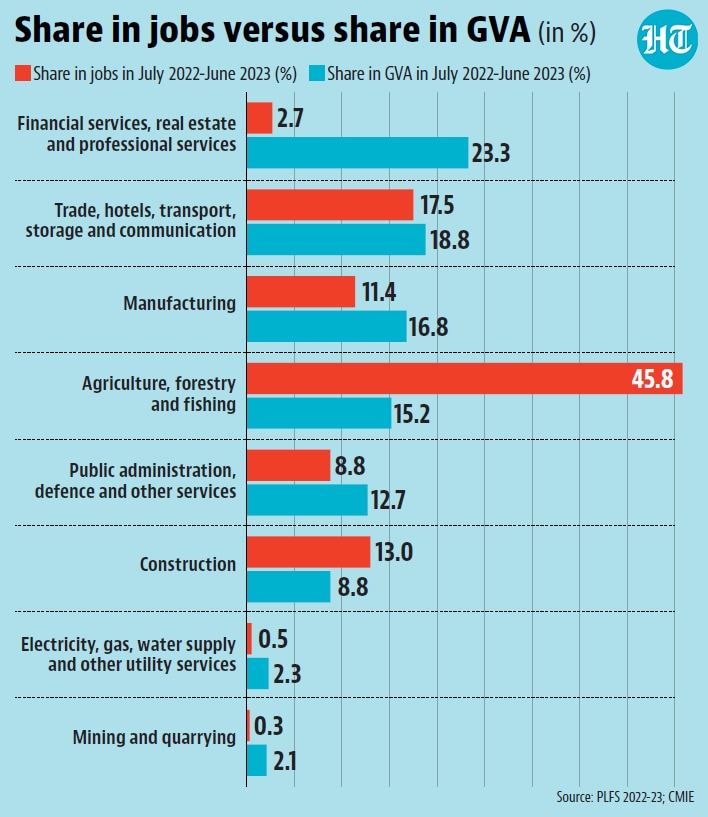
- But fruits of growth continue to be unevenly distributed in IndiaNot all sector of any economy grow at the same pace and the changing sector-wise composition of growth plays an important role in distribution of fruits of growth. More than half of India’s Gross Value Added (GVA) came from agriculture and allied activities in 1970. This number has been falling steadily and stood at just 14.5% in 2023-24. The share of sectors such as manufacturing and public administration, defense and other services; the latter being an indicator of the employment in government, has shown only a small increase in these five decades. The share of financial services, real estate and professional services, on the other hand has more than doubled from 10.7% to 23.3% between 1970-71 and 2023-24. This shows that private white-collar services have been a very big driver of India’s economic growth in the recent past. However, when read with sector-wise employment share from the latest Periodic Labour Force Survey (PLFS), it can also be seen that the sectors such as financial services have a very small share in overall employment in India. It is this employment-income asymmetry that will continue to be the biggest policy challenge for the Indian economy going forward.