E-Paper



Number Theory: STs and their importance in Jharkhand politics — 2
.
Published on: Nov 6, 2024, 08:52:23 IST

 Prefer HTon Google
Share via


Copy link

The first part of this series looked at data that underlined the importance of scheduled tribes (STs) in the Jharkhand Mukti Morcha’s (JMM) 2019 victory and pointed out that STs are not distributed evenly in the state. The second and concluding part looks at the social and geographical spread of STs in the state and the political implications of these.
STs and their importance in Jharkhand politics — 2
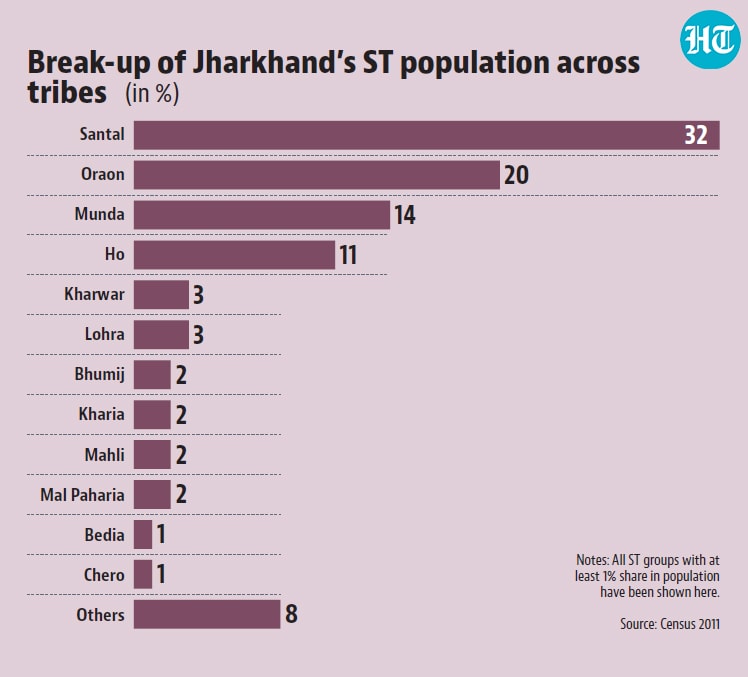
 Four ST groups account for more than three-fourths of Jharkhand’s ST populationBecause census data gives a caste-tribe break-up of the SC/ST population, it is possible to disaggregate Jharkhand’s ST population of 8.6 million in the 2011 census into different ST groups. The data shows that Santhals are the biggest ST group by population with a share of 32% in the state’s ST population. If one adds another three ST groups — Oraon, Munda and Ho — to the Santhals, they together account for almost 77% of the state’s ST population. The remaining 23% of the ST population is distributed across 29 groups. The fact that four out of Jharkhand’s seven chief ministers — Babulal Marandi, Shibu Soren, Hemant Soren and Champai Soren — are from the Santhal tribe underlines their dominance in the state’s politics. Among the other two ST chief ministers, Arjun Munda comes from the Munda tribe while Madhu Koda is from the Ho tribe.
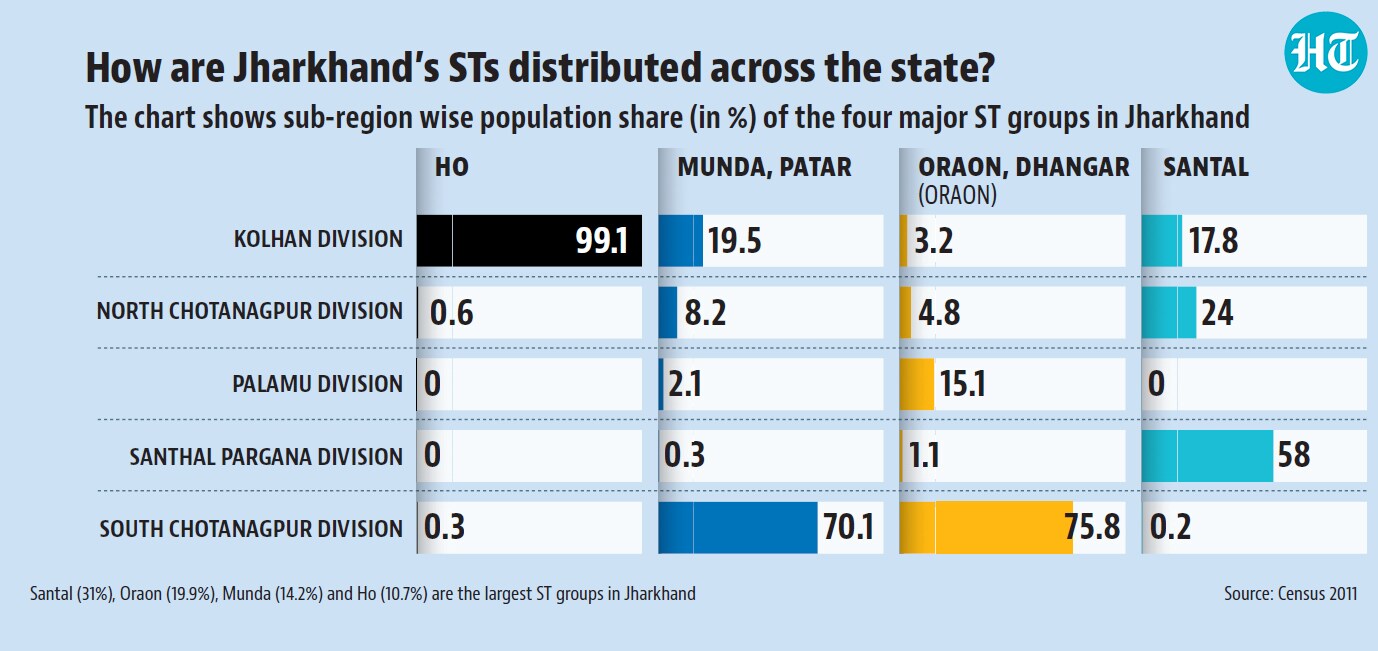
- Major ST groups are concentrated in different sub-regions of the stateA subregion-wise analysis of the ST population shows this clearly. 58% of the Santhal population is concentrated in the Santhal Pargana subregion of the state while the Oraon and Munda tribes are primarily concentrated in the South Chhotanagpur subregion of the state. Reading these demographic details with the political weight of each subregion in the Jharkhand assembly makes the importance of each ST group in Jharkhand’s politics clearer. The North Chhotanagpur subregion, which has the largest number of ACs, has the lowest ST population and no ST-reserved ACs. In terms of number of ACs, Santhal Pargana is the second largest subregion in the state followed by the South Chhotanagpur subregion. In terms of ST-reserved ACs, however, Santhal Pargana (7 ACs) is behind South Chhotanagpur (11 ACs).
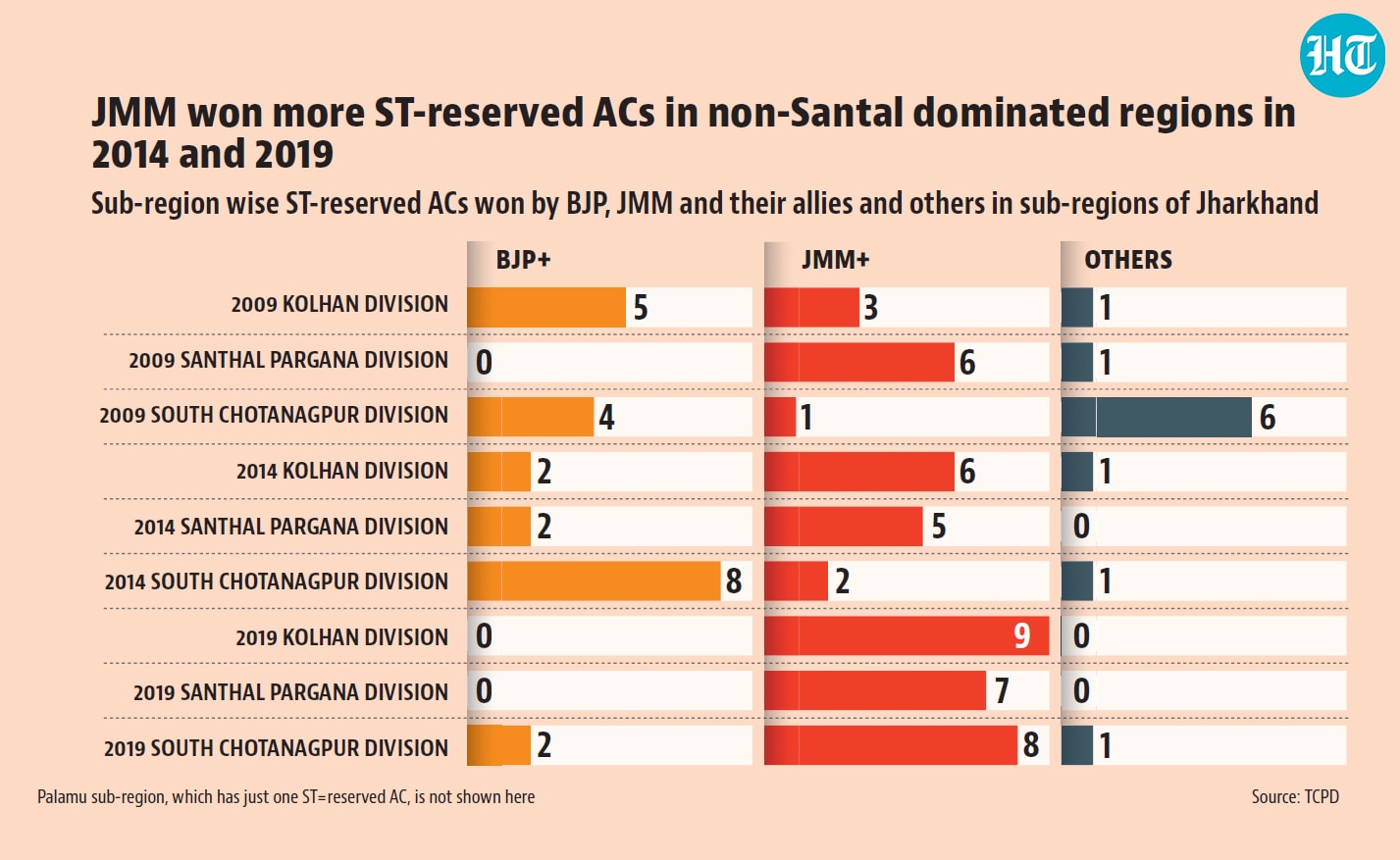
- In the 2019 elections, the JMM broke new ground among regions with non-Santhal ST populationThe JMM alliance winning 8 out of the 11 ST-reserved ACs in the South Chhotanagpur subregion in the 2019 elections was primarily why the BJP ended up losing Jharkhand. In 2014, it was the BJP-AJSU alliance which won 8 of these 11 ACs. Given the fact that the JMM never won more than 2 ST-reserved ACs in this region between the 1980 and 2014 elections (with 1995 as an exception when it won 4 ACs in the region) and the BJP never got less than 5 ACs between 2000 and 2014 (with 2009 the exception when it won 3 ACs in the region), the 2019 results were a big upset in the established politics of the region. Since the South Chhotanagpur subregion has a negligible population of Santhals, the JMM’s good showing in this region meant it had broken ground in a new section of ST voters in the state. Given the backdrop of the BJP appointing a non-ST chief minister in 2014 and widespread agitation among STs in the state, this signified a new turn in the state’s politics. With the JMM alliance winning all 5 ST reserved parliamentary constituencies (PCs) in the 2024 Lok Sabha elections and the BJP-led NDA winning the rest, the ST versus non-ST polarisation appears to be continuing.
- So, will JMM’s growing popularity among STs alienate non-ST voters?While more than 50% of the JMM-Congress-RJD alliance seats (25 out of 47) came from ST-reserved ACs in 2019, it would have been nowhere near power without the remaining MLAs, of which 10 came from the North Chhotanagpur subregion which has less than 10% ST population. The JMM has been trying to keep the poll narrative focused on two issues — one, Hemant Soren’s arrest as a question of persecution of an ST leader; and two, the cash transfer scheme to women as a key welfare plank which would appeal to both STs and non-STs. While the BJP has steered clear of declaring a chief ministerial face so far, a move that could give an edge to the JMM among STs, it has tried to chip away some of JMM’s advantage among STs by inducting leaders such as Champai Soren and Madhu Koda. Seen another way, not investing in a strong ST leader in the state could give the BJP an edge among non-ST voters. If these trends continue till the elections, Jharkhand could very well be in a position where the state’s politics moves towards a sharper polarisation between STs and non-STs, even though STs as a whole are becoming less politically fragmented compared to the past.