E-Paper



Number Theory: The Indian economy — Equality, sentiment and growth realities
.

 Prefer HTon Google


The 2025-26 Union Budget has given a huge tax relief -- ₹1 lakh crore, by the government’s own calculations. In an interview to HT this week, finance minister Nirmala Sitharaman expressed a guarded optimism about its potential demand boost. “Discretionary spending may happen. We don’t know, but our intent and the primary motive was to make sure we honour the taxpayer,” she said.
The 2024-25 Economic Survey, which was presented a day before the budget, set out a goal of sustained 8% GDP growth for India for at least a decade. This, the survey said, will take an investment-GDP ratio of 35%. What will it take to achieve these goals? Here are three charts that capture the reality of growth, inequality and sentiment challenges in the Indian economy.
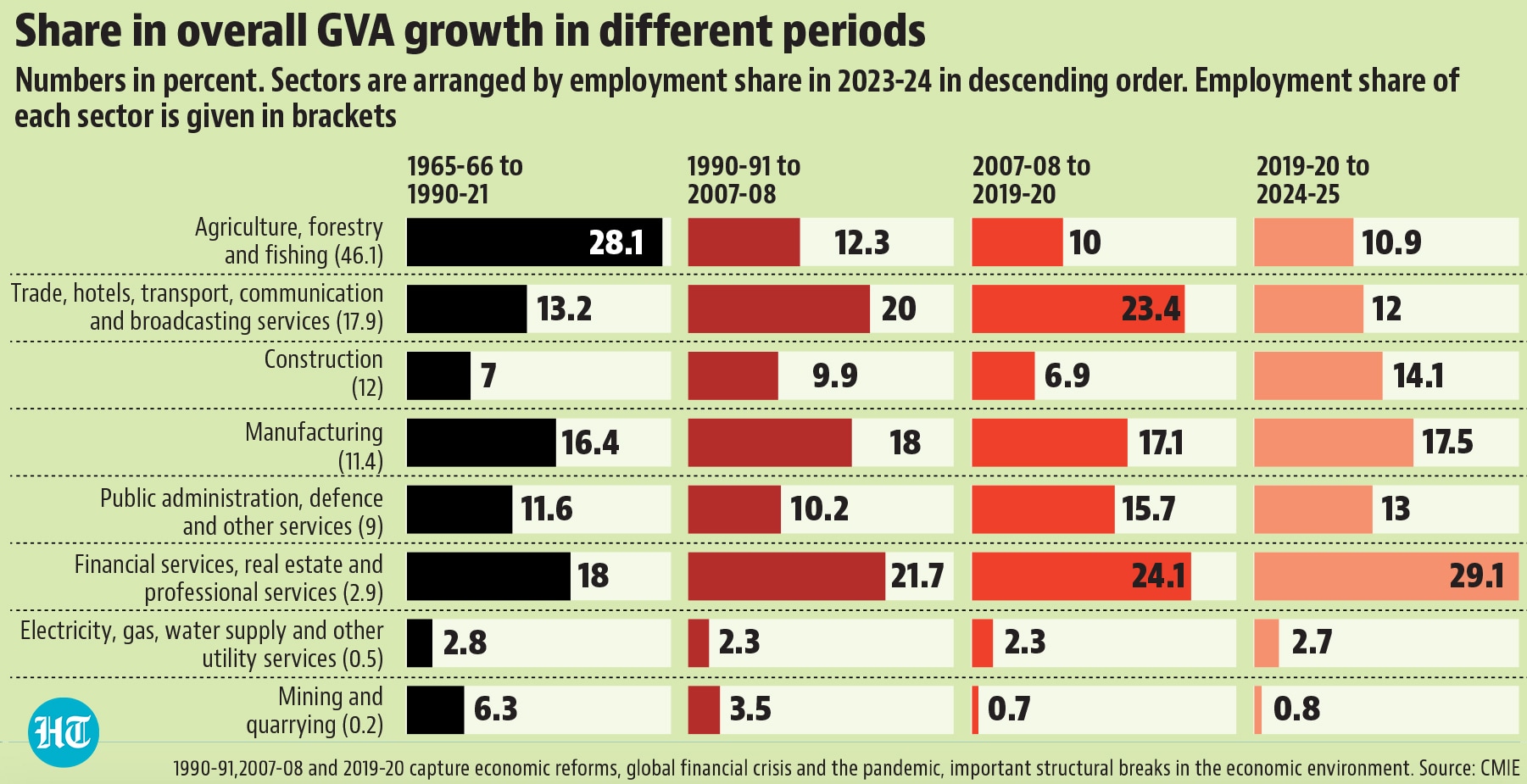
 India’s economic growth has a narrow baseThis is the most important aspect of the Indian economy. A good way to understand this is to look at sector-wise contribution to Gross Value Added (GVA) growth across a longer time period. Using data from the Centre for Monitoring Indian Economy (CMIE), HT looked at this trend across four broad time periods which coincide with economic reforms, the global financial crisis, and the pandemic -- events that led to important structural disruptions. While growth has been driven by non-farm sectors post-reform despite agriculture still having a large employment share, even within the non-farm sector, the recent period has seen a shift towards less employment-intensive sectors. Unless this balance improves, inequality will continue to be a problem. To be sure, there is bound to be some inequality as not all sectors are equally value generating in a modern economy and the challenge is to reduce employment share in low value share sectors.
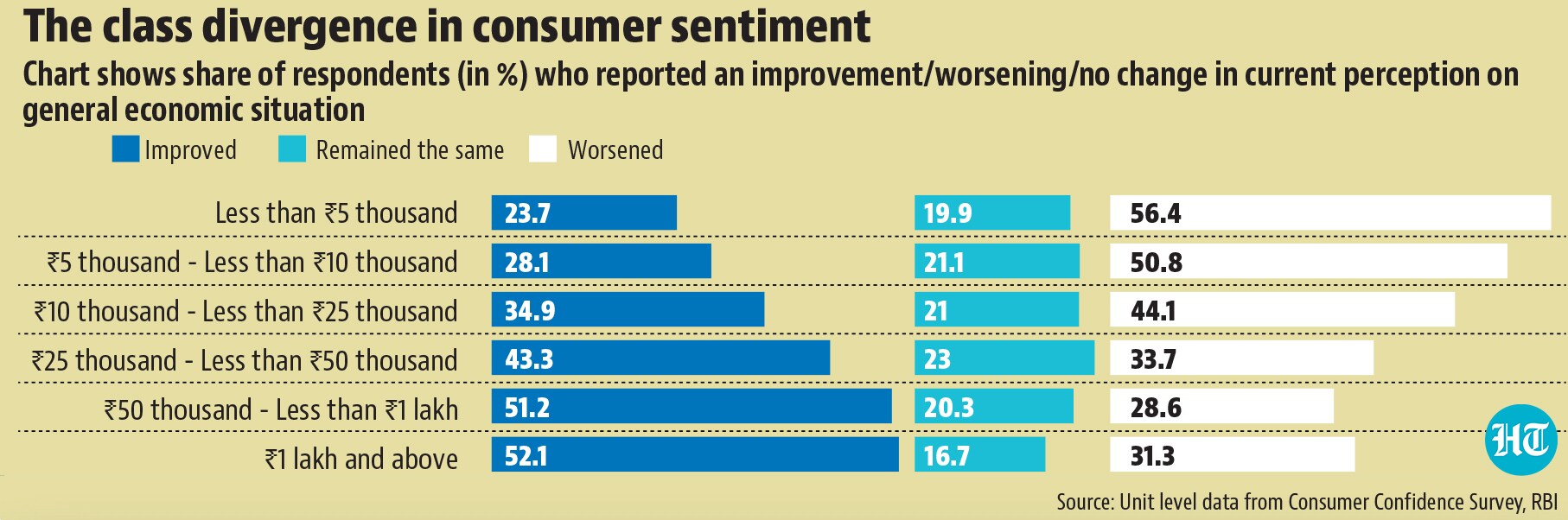
- This is also reflected in the class divide in consumer sentimentThe class divide can be clearly seen in RBI’s Consumer Confidence Survey (CCS). CCS is an urban survey, so it does not take into account the fam sector. Because RBI releases unit-level data from CCS, it is possible to look at the class divide in it by comparing numbers for different income categories. Data for the November 2024 round, the latest available , shows that the worst current perception on the general economic situation – it asks respondents whether things are better than last year – was for income categories with annual income of less than ₹3 lakh per annum, which was exempt from income tax even before this year’s budget. It also means that the budget may not do much to their consumer sentiment. To be sure, there could be an indirect effect from greater spending from the relatively rich.
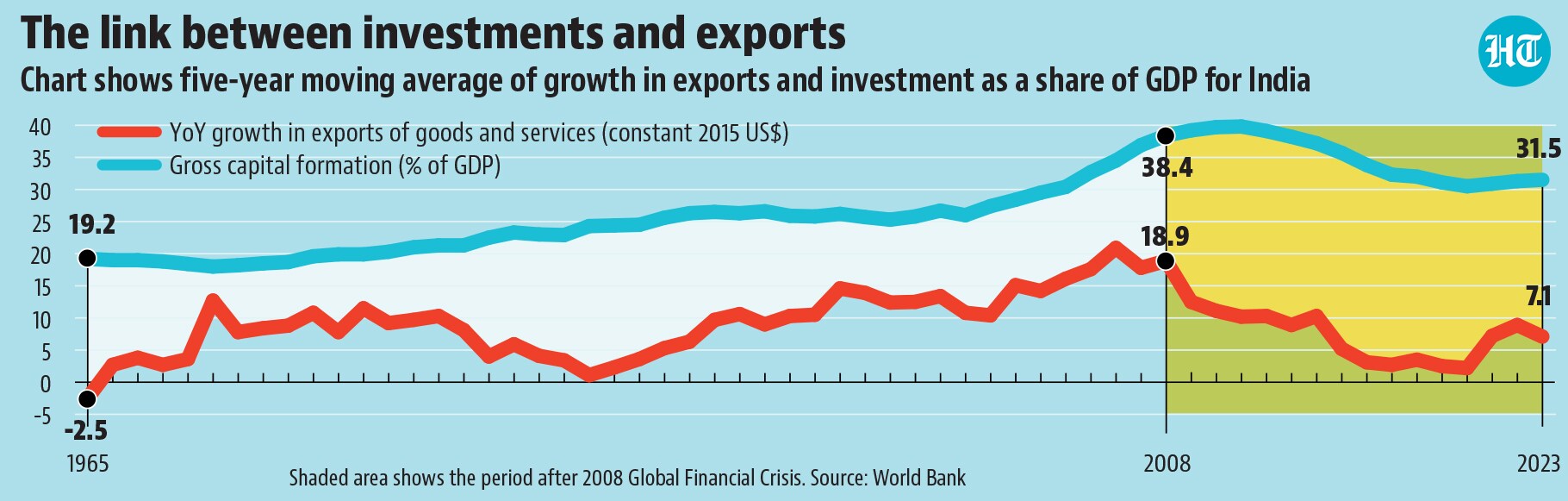
- Exports can compensate for inequality-driven domestic headwindsElementary macroeconomics says that if the domestic growth base is extremely narrow, which is what it is in India, and policy or markets cannot do much to correct it, and the only way for boosting growth in that scenario has to be via exports. This is what many countries, including India, accuse China of doing. A 2020 book by Matthew C. Klein and Michael Pettis, Trade Wars are Class Wars, has explained this argument in detail. India’s own experience supports this theory. Its best growth (and investment reaching up to 40% of GDP) phase came in a period when the country saw a big growth in its export earnings. However, this phase ended with the 2008 Global Financial Crisis. The period after that has seen a moderation in both export growth and investment share in the Indian economy. The Economic Survey 2024-25 has clearly said that export drivers to growth would weaken going forward. This underlines the need for broadening the domestic growth drivers of the economy. That may need more than the tax reduction boost in this year’s budget to fix.