E-Paper



Number Theory: The Model Code, and its governance impact
How significant is the direct disruption because of holding state and national elections separately?

 Prefer HTon Google


Among the key arguments for holding national and state elections together is that it will minimise the economic disruption from elections. Economic disruptions from elections can happen due to both direct and indirect effects of elections, as has been pointed out in a June 2024 paper by N K Singh and Prachi Mishra published on the Social Science Research Network. The paper argues in detail that “perennial elections increase uncertainty for all economic agents, this can directly affect choices and decisions and bear on macroeconomic outcomes like economic growth or indirectly through intermediate channels such as investment” and “synchronicity of election cycles can have far-reaching economic effects, beyond simply looking at administrative costs and logistics of conducting elections”.
The direct economic disruption due to elections is on account of a freeze on policy decisions because of the Model Code of Conduct (MCC). The MCC stays in effect from the date of announcement of elections to the announcement of results and prohibits governments from taking anything apart from routine decisions and aims to keep campaign, polling and counting orderly and peaceful; and check any abuse of state machinery and finances by the party in power. Also, no new infrastructural projects can be launched during the period MCC is in force. The indirect effects aside, how significant is the direct disruption because of holding state and national elections separately? HT has looked at the duration of MCC in India’s recent electoral history – MCC has evolved over time and implemented far more strictly today than it was in the past – to answer this question.
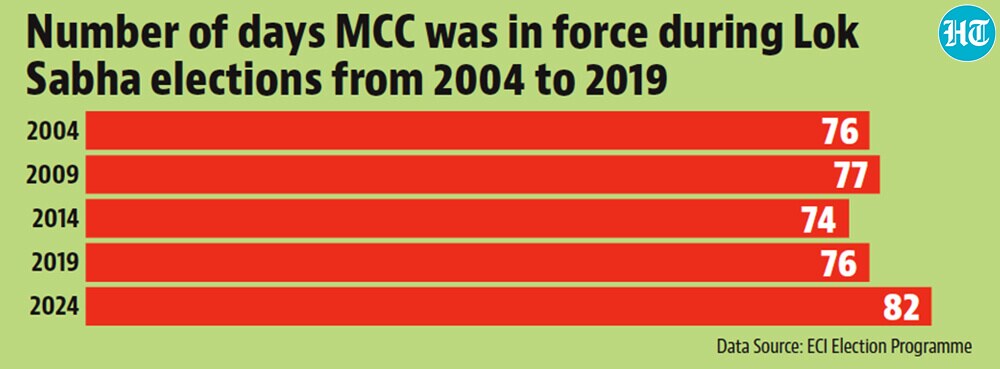
 The 2024 Lok Sabha election saw the longest enforcement of MCCThe Lok Sabha elections 2024 were conducted in seven phases. The Election Commission announced the election schedule on March 16 2024 and the counting day was on June 4 2024. This means that MCC remained in force for 82 days during the 2024 Lok Sabha elections. This is the highest number of days the MCC has been in effect since at least the 2004 elections (data before that is not available) in a national election. The 2019 Lok Sabha elections were also conducted in seven phases and MCC remained in force for 76 days. It took 10 phases to complete the 2014 Lok Sabha elections and MCC was enforceable for 74 days.
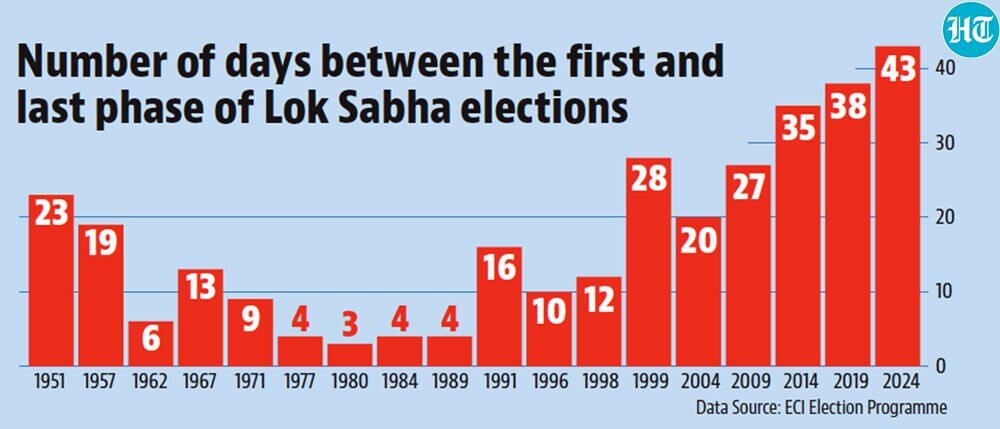
- The MCC period for Lok Sabha elections has increased in the last three decadesWhile the MCC first came into effect in the 1960 assembly elections in Kerala, its form and effect have evolved gradually and it was only in 1990 when T N Sheshan was the Chief Election Commissioner that the MCC really acquired teeth. Before 1996, the election announcement date and counting date were not included in the published election programme. Since then, the Model Code of Conduct (MCC) has been in effect from the election announcement date until the counting of votes, and it applies to both state assembly and Lok Sabha elections. Because the length of Lok Sabha elections has increased since the 1990s, the period for which the MCC is in effect has also increased in India.
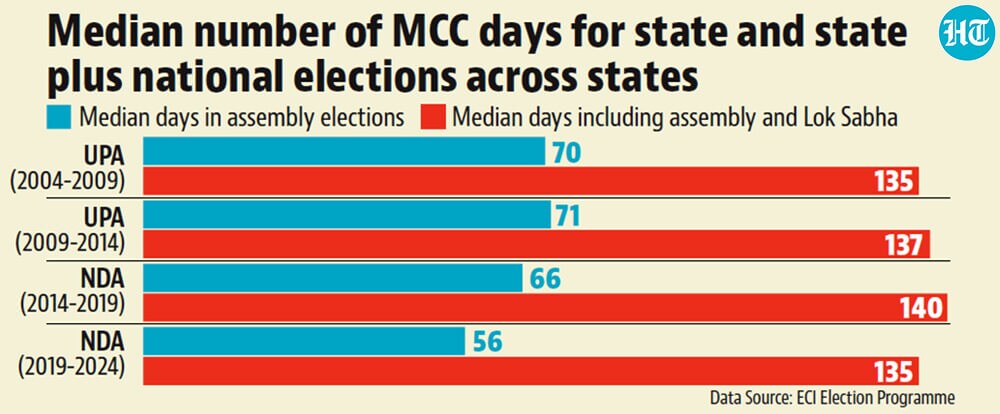
- This has led to an increase in the median period of overall MCCA comparison of MCC period in terms of number of days in state and national elections across states shows that while the former has seen a fall in its median value (for all states) between 2004-2009 to 2019-24 cycles, a rising trend in the latter has led to the number of median MCC days for state and national elections remaining largely unchanged.
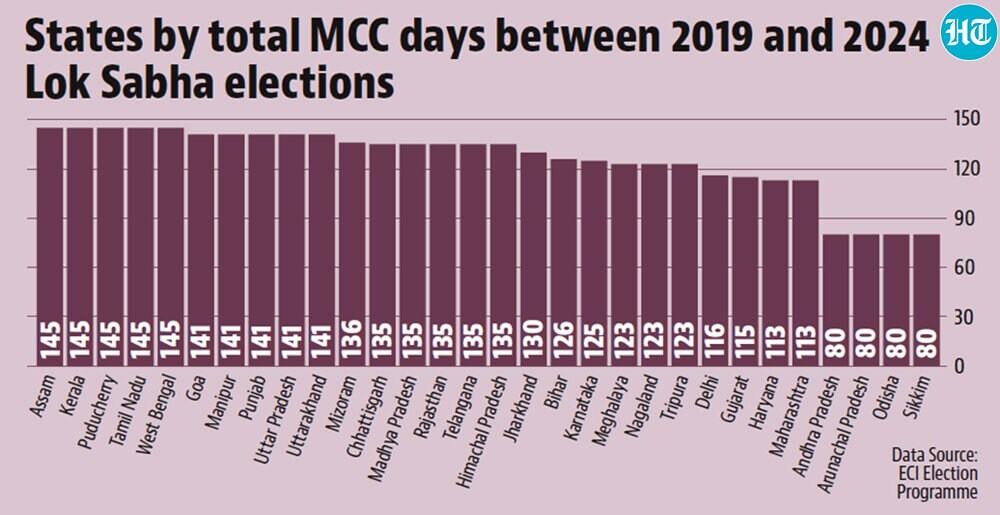
- The kicker? Non-synchronous state elections inflate the MCC durationBecause not all states hold their assembly elections with Lok Sabha elections – only four states had simultaneous assembly and Lok Sabha elections in 2024 – the number of days when MCC is in force varies across states and UTs. A comparison of the number of days for which the MCC was in effect between the 2019 and 2024 Lok Sabha elections in Indian states – this will be the sum of MCC days for Lok Sabha and assembly elections – shows that its duration was highest (145 days) in West Bengal, Assam, Tamil Nadu, Kerala and Puducherry which had assembly elections in 2021. The states with the lowest MCC days, of course, are the ones which had simultaneous national and state elections.