
 E-Paper



Number Theory: The state of the markets before the Budget
.
Updated on: Jan 31, 2025, 10:51:06 IST

 Prefer HTon Google
Share via


Copy link

Indian equity markets have seen a considerable decline over recent weeks. Will this change after the Budget? Answering this question requires understanding the larger macroeconomic context, both global and domestic, in which Indian equity markets have been operating. Ahead of the presentation of the budget day, here are four charts which puts this into perspective.

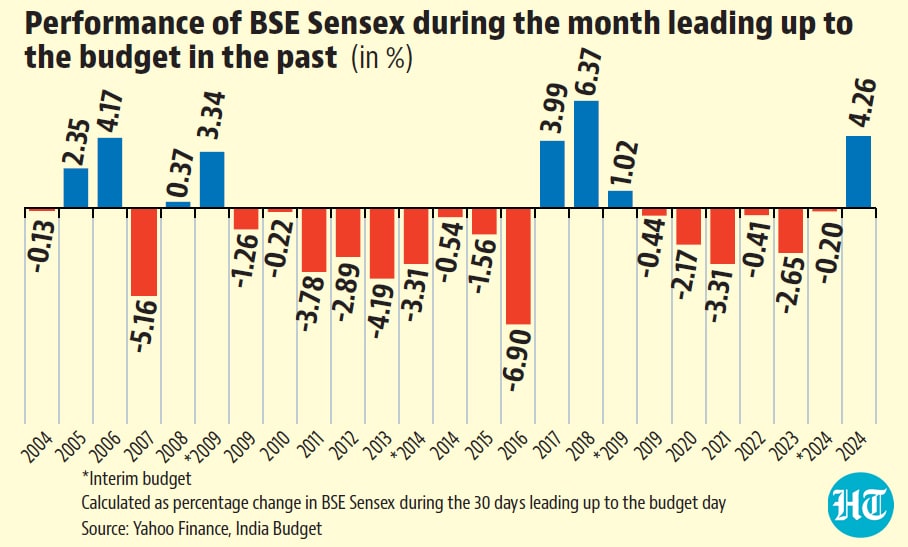
 Markets usually fall the month before the budgetData shows that historically, markets more often than not, fall ahead of the budget day as investors enter into a wait and watch mode. Over the last 25 union budgets, as many as 17 have seen the Indian markets falling during the 30 days leading up to the budget day. The steepest fall was recorded before the 2016 budget, when Sensex fell 6.9% over a month. Equity markets have fallen nearly 2.5% over the last one month BSE Sensex dropping 1747.6 points since the beginning of January to close at 76759.81 as of Thursday.
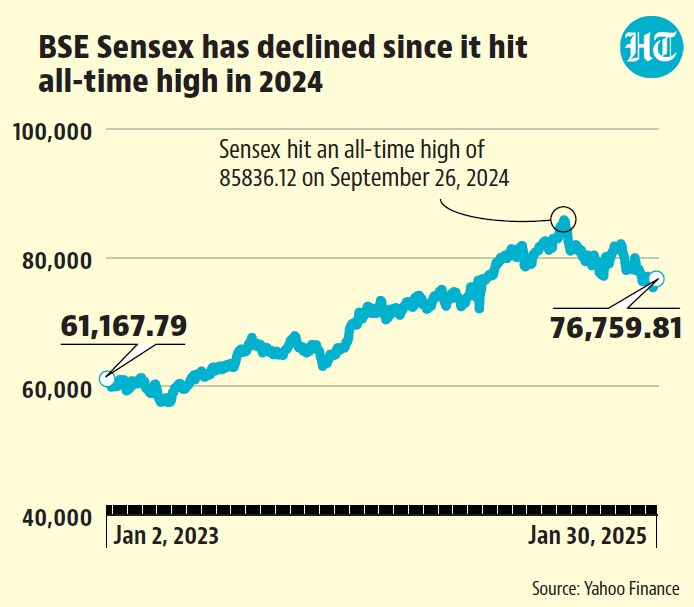
- But this year’s decline is more correction than pre-budget jittersNotwithstanding the general trend of markets falling before the budget, the current decline seems to be part of a larger trend. The Indian markets hit an all-time high on September 26, 2024 as BSE Sensex reached 85836.12 and NIFTY50 reached 26216.05 points. However, the markets have fallen since ; Sensex and NIFTY have declined by 10.57% and 11.32% respectively in four months. Although Sensex and NIFTY have avoided a 20% decline from their all-time highs—commonly regarded as the threshold for a bear market—the broader market sentiment remains bleak. Data from ProwessIQ shows that nearly three out of every 4 stocks in the broader BSE 500 index are down by over 20% from their 52-week peak as of Friday. To be sure, the Indian markets still remains expensive—the P/E ratio of BSE Sensex currently stands at around 21.8, much above that of other emerging markets such as China (10.2), Indonesia (12.7), Vietnam (14.8), etc.
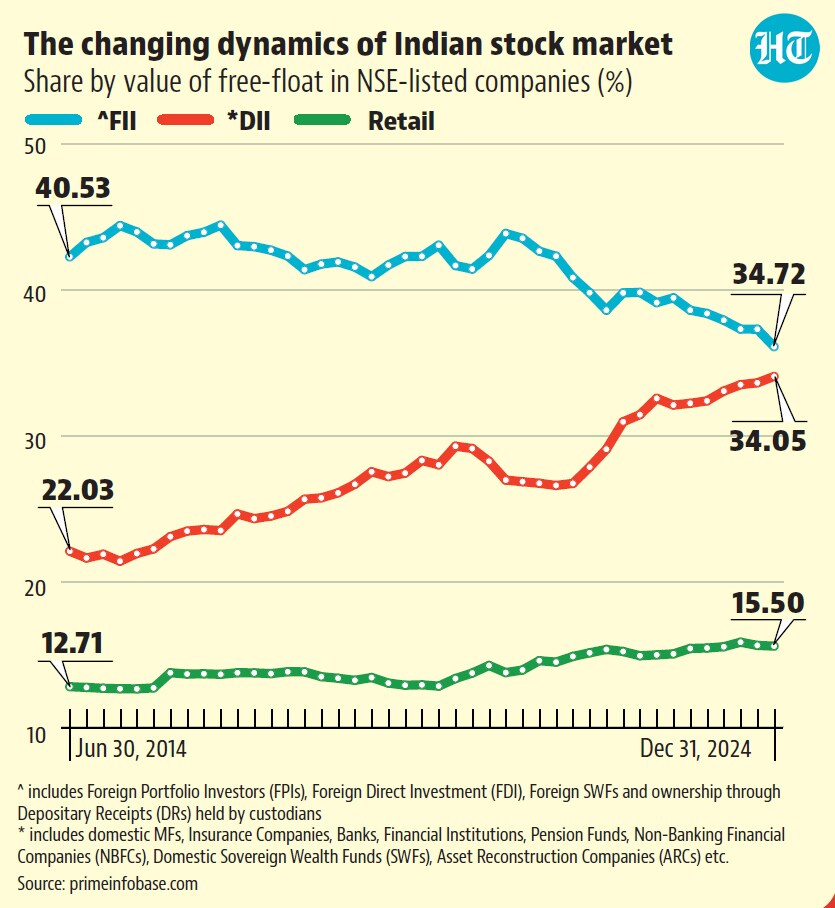
- FIIs are the bears while DIIs and Retail investors are still acting bullishSince October 2024, foreign institutional investors (FIIs) have sold ₹2.63 lakh crore worth of Indian assets, including nearly ₹86,186 crore this month alone as of Thursday, according to provisional cash market data. This exodus is driven by a shift towards US markets and India’s high valuations, which have made other emerging markets more attractive. Domestic institutional investors (DIIs) have partly cushioned the impact, buying ₹2.7 lakh crore in the same period. This shift has altered market dynamics. FIIs once dominated, holding 42.58% of free-floating NSE-listed shares in September 2016, compared to 23.45% for DIIs and 13.56% for retail investors, according to Prime Infobase. Latest figures show that FII holdings have fallen to 34.72%, while DIIs and retail investors have risen to 34.05% and 15.5%, respectively. Free-floating shares refer to stocks available for trading, excluding locked-in holdings like promoter stakes. Much of this DII growth stems from strong retail inflows into mutual funds, particularly SIPs. The number of retail investors has quadrupled in five years, fuelling a market rally that is now being tested.
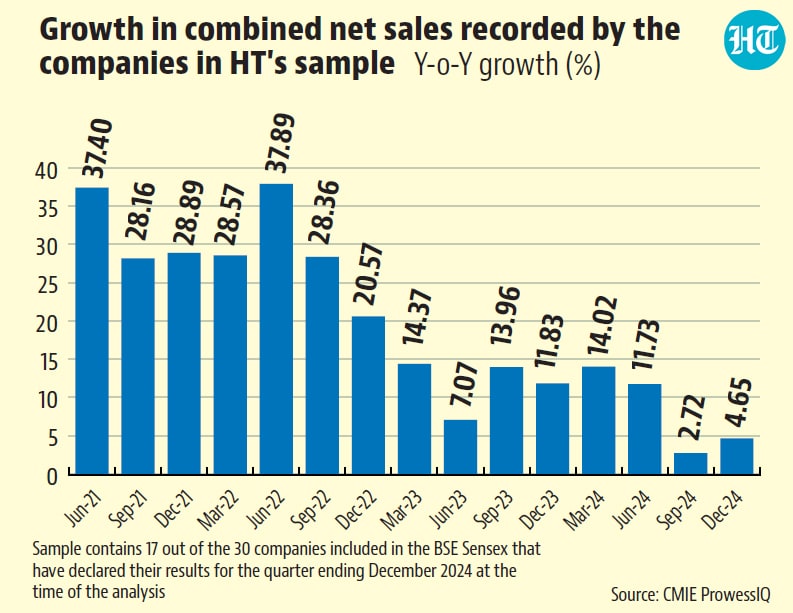
- Subdued earnings and macro concerns make a full market recovery uncertain in the near termMarkets have more often than not posted gains in the week following budget day, recording positive returns over the following five days in 15 of the last 25 instances. However, relying on short-term spikes for major equity allocations is unwise, as long-term trends are driven by corporate earnings and macroeconomic factors. So far, earnings reports for the December 2024 quarter show stagnant growth. HT analysed 17 of the 30 BSE Sensex companies that have reported results for the quarter ending December 2024 at the time of writing this story, using the ProwessIQ database. The sample saw less than 5% annual growth in cumulative net sales over the last two quarters and under 1% quarterly growth. These trends are in keeping with a slowdown in GDP growth which is expected to fall from 8.2% in 2023-24 to just 6.4% in 2024-25.


Unlock a world of Benefits with HT! From insightful newsletters to real-time news alerts and a personalized news feed – it's all here, just a click away! -Login Now!


