E-Paper



Number Theory: What explains Donald Trump's electoral resurrection?
.
Published on: Nov 7, 2024, 09:40:19 IST

 Prefer HTon Google
Share via


Copy link

Donald Trump has been elected as the 47th President of the United States. Trump is only the second president in US history who lost the polls while holding office once and managed to return to power after a gap. What explains this political resurrection? How is his 2024 victory different from the 2016 one? And what went wrong for the Democratic Party? Here are four charts which answer some of these questions in detail.
What explains Donald Trump's electoral resurrection?
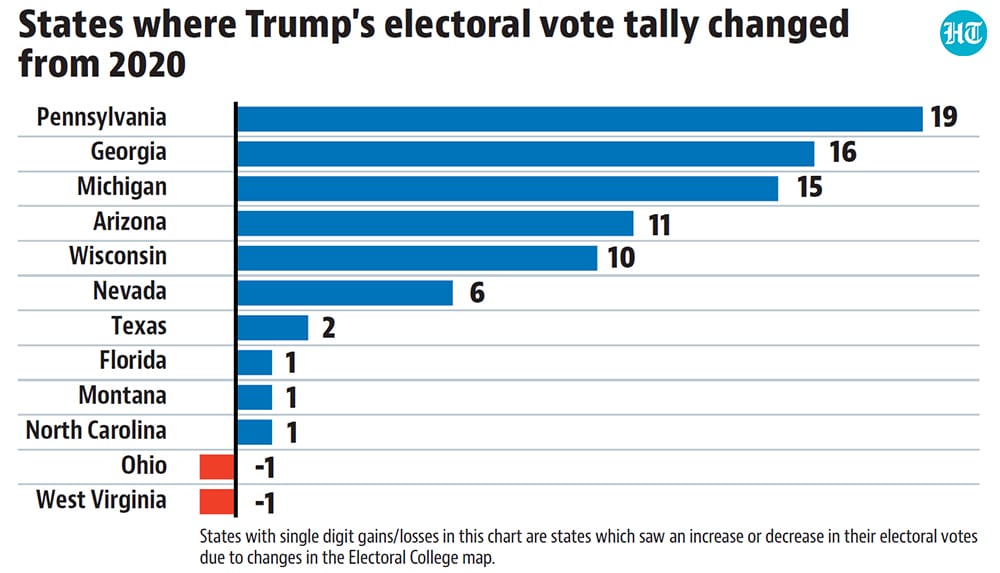
 What was the path to Trump’s 2024 victory?At the time of this report, Trump had won 295 out of the 538 electoral college votes (EV) compared to 226 for Kamala Harris. Trump’s final EV tally, as per the existing trends, is likely to hit 312. This is higher than the EVs secured by Trump in 2016 (304) and Joe Biden in 2020 (306). In 2020, Trump won only 232 . What explains the rise in Trump’s tally? Compared to 2020, Trump flipped and won Georgia (16 EVs), Pennsylvania (20), and Wisconsin (10). He is also expected to win Arizona (11), Michigan (15), and Nevada (6), all of which he lost in 2020. In fact, he lost Nevada even in 2016.
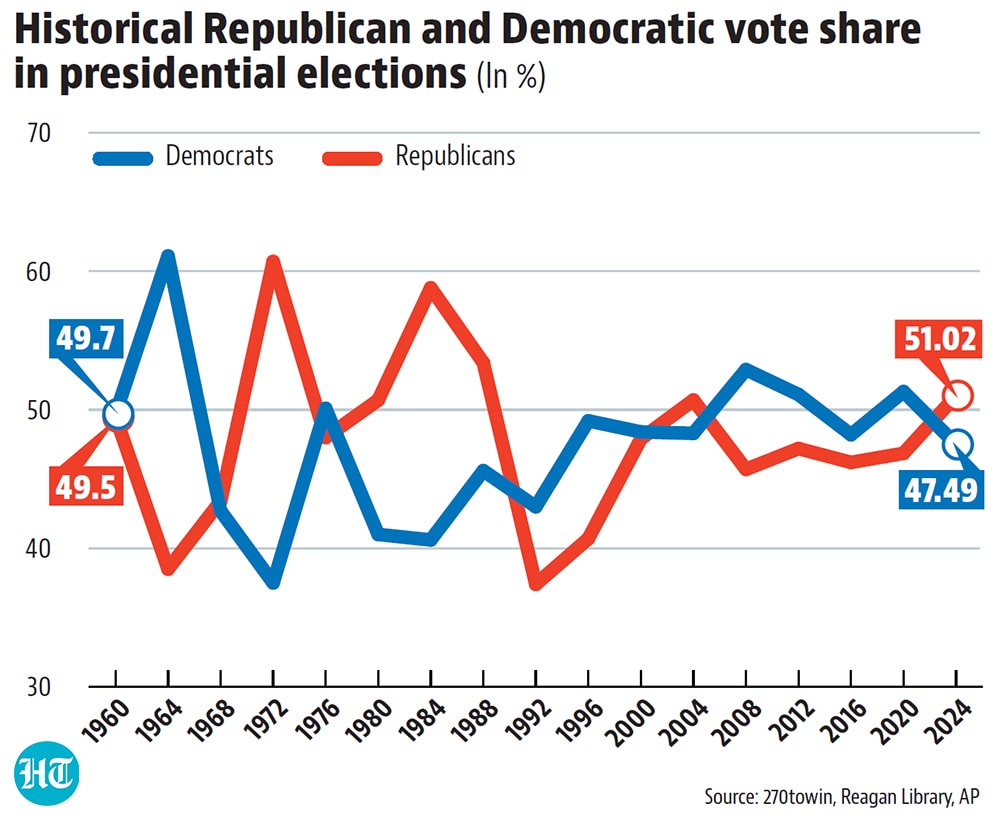
- Trump is more popular today than he has ever beenThis is the most important takeaway from the results. Because the US presidency hinges on a candidate reaching the 270 EV threshold, and there is a voter-EV asymmetry across states, it is possible for a candidate to win the election without wining the popular vote. This is exactly what happened in 2016 when Democratic candidate Hillary Clinton was two percentage points ahead of Trump in the popular vote but ended up 77 short of Trump’s 304 EV count. Trump’s popular vote share increased marginally in the 2020 elections (to 46.8% from 46.1%) despite his EV tally falling to 232. Biden won 51.3% of the popular vote. Trump’s popular vote share is 51%. Not only is this Trump’s highest vote share, it is also the highest vote share for a Republican Party presidential nominee since 1988. Kamala Harris’s vote share of 47.5%, on the other hand, is the lowest ever for a Democratic candidate (winner or loser) since 1992. The takeaway is clear: Trump’s popular support has increased in every election he has contested since 2016.
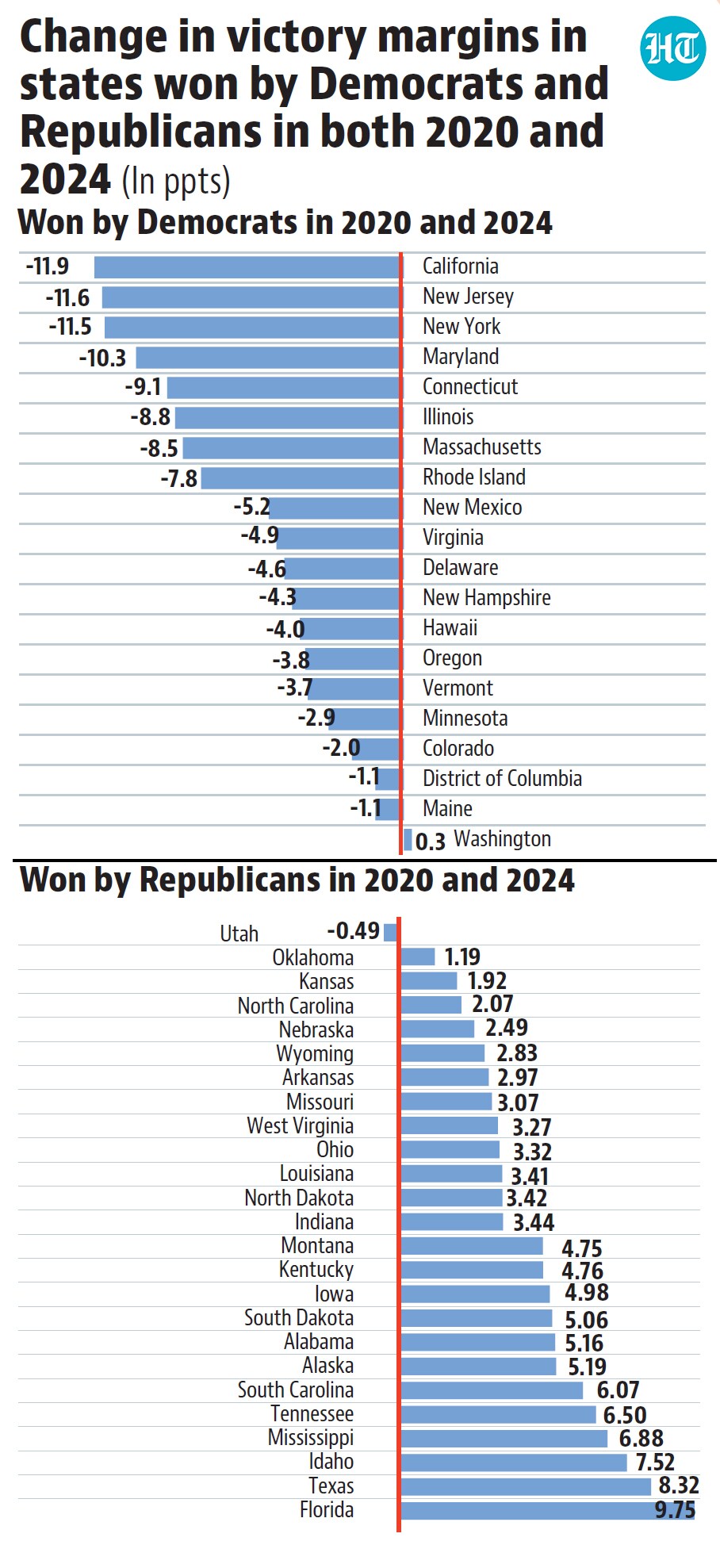
- And there is clear evidence that Trump broke into Blue bastionsThis is what makes the 2024 election a potentially seismic event in US political history. While Trump’s victory is function of him winning back six swing states, he has made significant gains even in states which have voted for Democrats in a long time including in these elections. In 19 out of the 20 states which the Democrats won in both 2020 and 2024, their victory margin has fallen. In 8 of them, the fall in victory margin is more than 6 percentage points. On the other hand, in the 25 states that Trump won in 2020 and 2024, he has increased his victory margin in 24 of them.
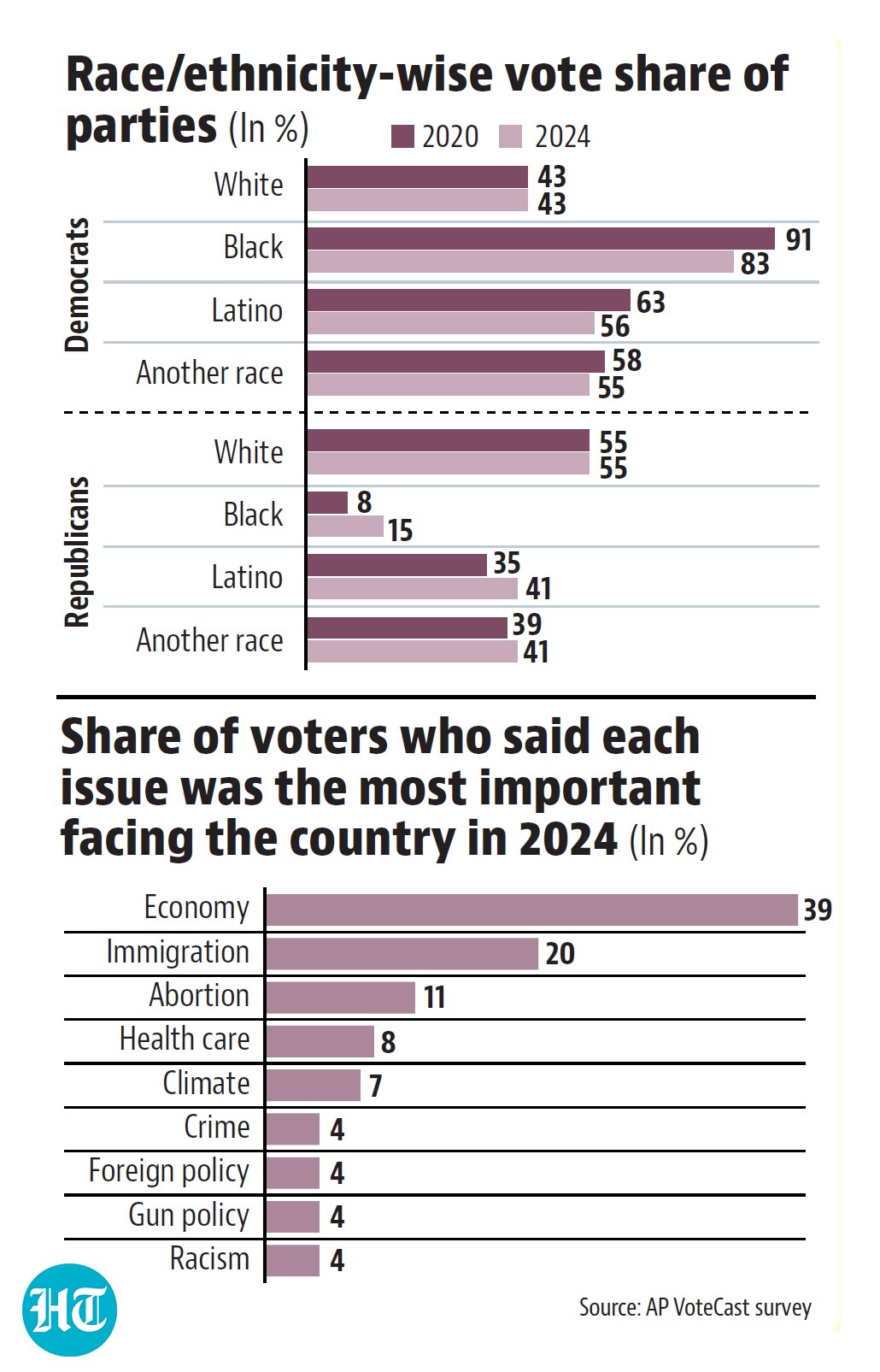
- Trump has improved on his performance among non-White votersJoe Biden won the 2020 election by bringing together a demographically diverse support base against Trump. However, four years since, Trump has improved his support among non-White voters, according to AP VoteCast survey, which includes both early voters and election-day voters. While the support among White voters for both the parties has remained the same as in previous elections, the share of Hispanic voters who voted for Trump has increased from 35% to 41%. Meanwhile, 15% of Black voters seem to have voted Trump this time around, compared to just 8% in 2020. Among other races (ethnicity) as well, Trump’s vote share has increased from 39% to 41%. Interestingly, support for Republicans has increased among younger voters. Among those below the age of 30, Trump’s vote share has increased from 36% to 47% between 2020 and 2024. The broader demographic support for Republicans in this election also needs to be read along with the fact that as many as 39% voters said that the economy is the biggest issue facing the country today, while another 20% said that it is immigration — both are issues that were at the heart of the Republican campaign. Meanwhile, issues such as abortion, health care and racism, which were among the talking points of the Harris campaign, seem to have failed to strike a chord.