
 E-Paper



Problematics | Newton’s cows revisited
Cows keep eating while grass keeps growing. In this new take on an old puzzle, bring in extra cows and speed up the job.

 Prefer HTon Google


The classic “working men” problem goes like this: if x men can complete a job in p days, how many men can complete it in q days? We can leave that to our children’s school exercises.

In Problematics, we have had more advanced versions. For example: if A and B can do a job in x days, B and C can do it in y days, and A and C can do it in z days, how long will it take for all three working together?
An even more interesting variation is Newton’s cows-and-grass problem, which longtime readers may remember from 2022. If m cows can eat up all the grass in a meadow in x days, and n cows can do it in y days, how many cows can clean up the field in z days? This is more than a straightforward manpower vs work problem, because the grass also keeps growing while the cows keep eating. You need to factor in the growth rate as well.
That variation, described by Newton in Universal Arithmetic (and solved by Problematics readers four years ago), has also become a well-known classic. So why not try a variation on a variation. The following version is my own, created especially for Problematics readers.
#Puzzle 207.1
A farmer wants a meadow cleared of grass for a function he is hosting. He sets 20 cows to work on it. They start eating, each at the same rate. But the grass also keeps growing at its own constant rate. The farmer knows, however, that the amount of grass eaten by the 20 cows each day is greater than the amount of new grass that appears on the same day. At this rate, he correctly estimates, the cows will finish the job in 24 days.
The cows start eating on Day 0. Then things happen in the farmer’s household and social circles, the details of which are vague. All we know is that the function has to be held earlier than planned. So, on Day 6, the farmer adds five more cows to the meadow. Being a good mathematician, he knows that the 25 cows will finish the remaining job in another 12 days.
As luck would have it, the function has to be advanced even further. On Day 10, the farmer adds some more cows to his team. Together, the enlarged team completes the job on Day 15.
How many cows were added on Day 10?
#Puzzle 207.2
A library rearranging its books engages an elderly man on a one-day job. He has to remove all the books from one room and arrange them on the shelves in another room. The bargain is settled at ₹1500.
The man, however, will take home only a part of that amount. Knowing that he cannot finish the job in one day, he has brought along a younger assistant. The deal is that they will share the ₹1500 in the same proportion as the amount of work done.
Removing books is a faster job than arranging them anew. The ratio between the two rates is the same for each man, when considered individually. But when you compare one man against the other, the older man can remove books exactly as fast as the younger man can arrange them, and the younger man remove books four times as fast as the older man can arrange them.
How should the ₹1500 be shared between the two?
MAILBOX: LAST WEEK’S SOLVERS
#Puzzle 206.1
Hi Kabir,
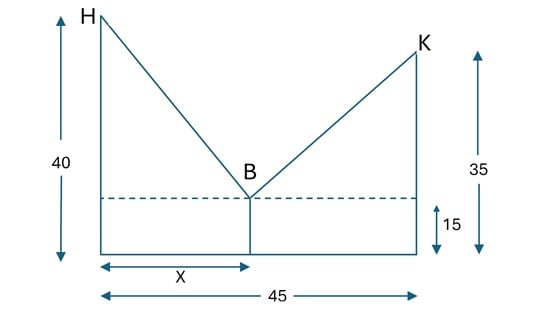
In the figure, the points H and K denote where Hedwig and Kiki are sitting before the boy whistled. The point B denotes the boy's head. The vertical distances of Hedwig and Kuki from the boy's head are 25 ft and 20 ft. Suppose the left and the right buildings are at horizontal distances of X feet and (45 – X) feet from the boy. Therefore,
HB² = 25² + X²; and KB² = 20² + (45 – X)²
Since both pets fly at the same speed and reach the boy at the same time, the distances they travel (HB and KB) are equal. Equating HB² and KB² from the above equations, we get:
25² + X² = 20² + (45 – X)²
=> 625 + X² = 400 + 2025 – 90X + X²
=> 90X = 1800
=> X = 20
This means that the boy is at a horizontal distance of 20 ft from the left building and 25 ft from the right building.
— Professor Anshul Kumar, New Delhi
#Puzzle 206.2
The maximum speed of a car will be about 100 km per hour. The units place in the next such number will have to remain 1, as it is now, and the second number from either side will have to be 6. Considering this, the next palindromic number will be 16061. This will give a speed of 55 km per hour.
The only other practical option for a very fast driver will be a reading of 16161. This gives a speed of 105 km per hour.
— Kanwarjit Singh, Chief Commissioner of Income tax (retired)
Solved both puzzles: Professor Anshul Kumar (Delhi), Kanwarjit Singh (Chief Commissioner of Income tax, retired), Dr Sunita Gupta (Delhi), Sabornee Jana (Mumbai), YK Munjal (Delhi), Shri Ram Aggarwal (Delhi), Ajay Ashok (Delhi), Shishir Gupta (Indore), Vinod Mahajan (Delhi)
Solved #Puzzle 206.2: Dr Vivek Jain (Baroda)


