
 E-Paper



Problematics | Trainspotting
Travelling on a train, you count every train you meet from the other direction. What is your total count?

 Prefer HTon Google


One of the finest examples of wordplay in a numerical puzzle comes from the great English puzzler H E Dudeney (who else)? It runs thus: “A man runs n times around a circular track whose radius is t miles. He drinks s quarts of beer for every mile that he runs. Prove that he will only need one quart!”
Before peeking at the answer below, let’s see what we can work out. The mathematics part is easy. The circumference of the track is 2πt miles, so n circuits means n x 2πt miles. At s quarts every mile, his consumption works out to s x n x 2πt quarts. So, where does the one-quart proof come from? I gave up on this and had to check Dudeney’s solution, but you may want to think a bit before looking at the answer in the following paragraph.
The trick lies in reordering the elements of the product. We may write s x n x 2πt = 2π n t s, or 2 pi n t s, and 2 pints = 1 quart for those using that system of units. I think there is a superfluous element in Dudeney’s answer, because (2π n t s) quarts actually translates to “2 pints quarts” and not strictly “2 pints”, but we cannot deny the ingenuity that went into this construction.
For the main puzzle this week, we shall return to Dudeney, with a tweak I have done to make his puzzle generic rather than specific.
#Puzzle 171.1
In Dudeney’s original version, trains between two stations leave each station every hour, with the journey taking an exact number of hours, which the puzzle specifies. A passenger boards a train from one station and reaches the other in the specified time. Dudeney asks the solver to work out the total number of trains the passenger encountered along the way. In his answer, which is easily worked out from the data given, Dudeney notes that “along the way” excludes the opposite train arriving simultaneously with the passenger’s departure from the first station, and the opposite train leaving simultaneously with the passenger’s arrival at the last station.
In our localised version, trains between Delhi and Amritsar leave both stations every hour, on the hour. The journey takes n hours, where n is an integer greater than zero. You board a train from Delhi at 12 noon and reach Amritsar at n pm the same day. You count every Amritsar-to-Delhi train that you meet along the way. In the spirit of Dudeney’s original puzzle, however, you discount the train from Amritsar that reaches Delhi at 12 noon (your departure time), and also ignore the train that leaves Amritsar for Delhi at n pm (your arrival time).
Is there a general formula for the number of trains you will meet “along the way”?
#Puzzle 171.2
A 1-tonne minitruck is carrying a cargo of 20 pigeons, each 1 kg, resting in the rear compartment (no cages). It reaches a small bridge that allows a maximum weight of 1 tonne, excluding the driver. “1 tonne 20 kg,” notes the finnicky attendant at the bridge. “Only pigeons, only 20 kg. Let us through,” the driver pleads. “Sorry, not allowed,” the attendant signs off with his last word on the matter.
So our man goes to the back of his minitruck, unlocks the compartment and disturbs the resting birds, which leave their perches and go airborne, flapping their wings agitatedly. Now they are no longer adding to the weight of my mini, the driver reasons, while shutting the door.
Is the driver correct?
MAILBOX: LAST WEEK’S SOLVERS
#Puzzle 170.1
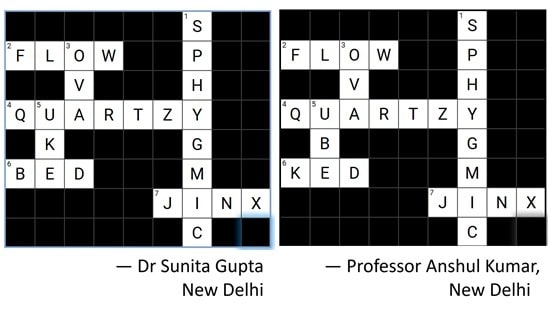
For once, I was correct in my assessment of the relative difficulty of any week’s two puzzles. Last week’s word puzzle did indeed prove to be much harder than the (quite easy) numerical one. Dr Sunita Gupta was the first one to send the completed crossword, and her solution is the same as mine, and also identical with that of most other solvers. The only exception is the solution sent by Professor Anshul Kumar, who enters UBE where the rest of us have UKE, and KED where we have BED. While UKE and BED are more common words than UBE and KED, all four are dictionary words.
A mention should be made of Kanwarjit Singh and Y K Munjal, who attempted (separately) to fill the crossword but did not complete it.
#Puzzle 170.2
Hi Kabir,
The distance between the young woman’s home and the cinema is 9km. If we take the distance as x km, the time taken to reach cinema @ 9km/hr would be x/9, and the return time @ 3km/hr would be x/3. So,
x/9 + x/3 = 4
Or, x=9
It took a lot of time to find the medical adjective for the crossword in Puzzle #170.1
— Shishir Gupta, Indore
Solved both puzzles: Dr Sunita Gupta (Delhi), Professor Anshul Kumar (Delhi), Shishir Gupta (Indore), Ajay Ashok (Delhi), Yadvendra Somra (Sonipat), Shri Ram Aggarwal (Delhi)
Solved #Puzzle 170.2: Dr Jeffrey R Geist (Columbus, Ohio), Kanwarjit Singh (Chief Commissioner of Income-tax, retired), Anil Khanna (Ghaziabad), Amarpreet (Delhi), Nitin Trasi (Sydney)


