
 E-Paper



Putting China's rare earth dominance in perspective | Number Theory
.
Updated on: Jun 20, 2025, 09:05:02 IST

 Prefer HTon Google
Share via


Copy link

After the United States and China re-affirmed the truce in their trade war last week, it is expected that flow of rare earth minerals from China to the rest of the world will return to normal. China imposed export restrictions on seven rare earths – a group of 17 elements with applications from electronics to renewable energy systems – in April. This hurt industries across the globe, including India, where importers do not yet have clarity on resumption of rare earth imports. This episode makes it a good opportunity to check how dominant is China in the production of these elements and how this dominance has evolved over time. Here are three charts that answer these questions.
Putting China's rare earth dominance in perspective
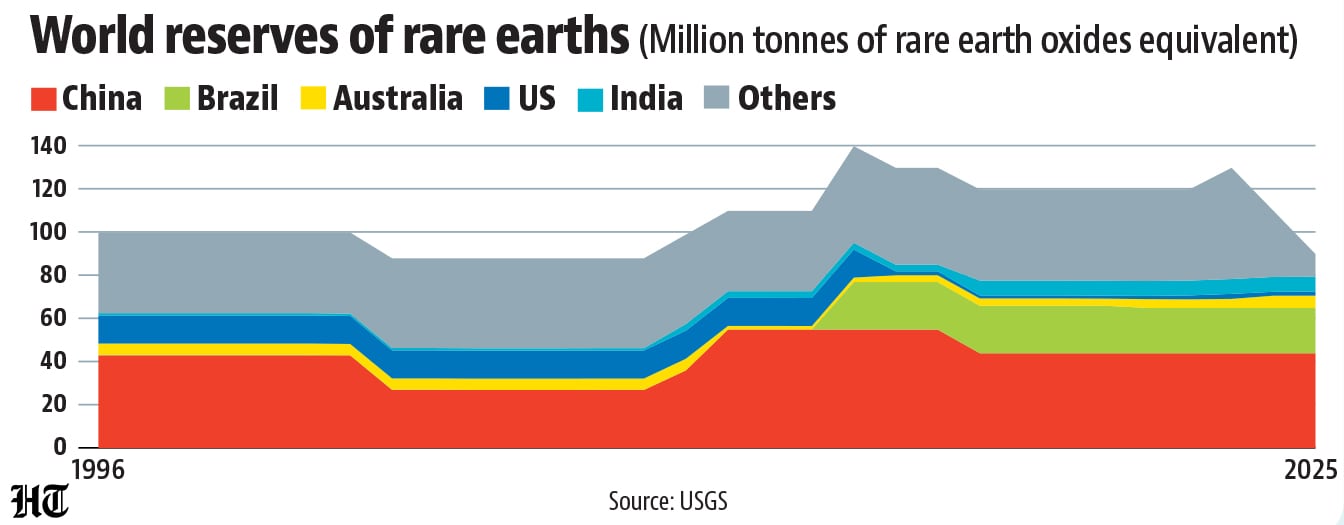
 China’s rare earth reserves have been steady for the past three decadesChina has about half the global reserves of rare earths. This share (and even the absolute amount of reserves in the country) has not changed much over the past three decades. On the other hand, US reserves have declined substantially and Brazil has taken its place since 2015. While much behind China and Brazil, India is currently far ahead of the US. To be sure, Russia, and Vietnam could have bigger reserves than India but show big fluctuations.
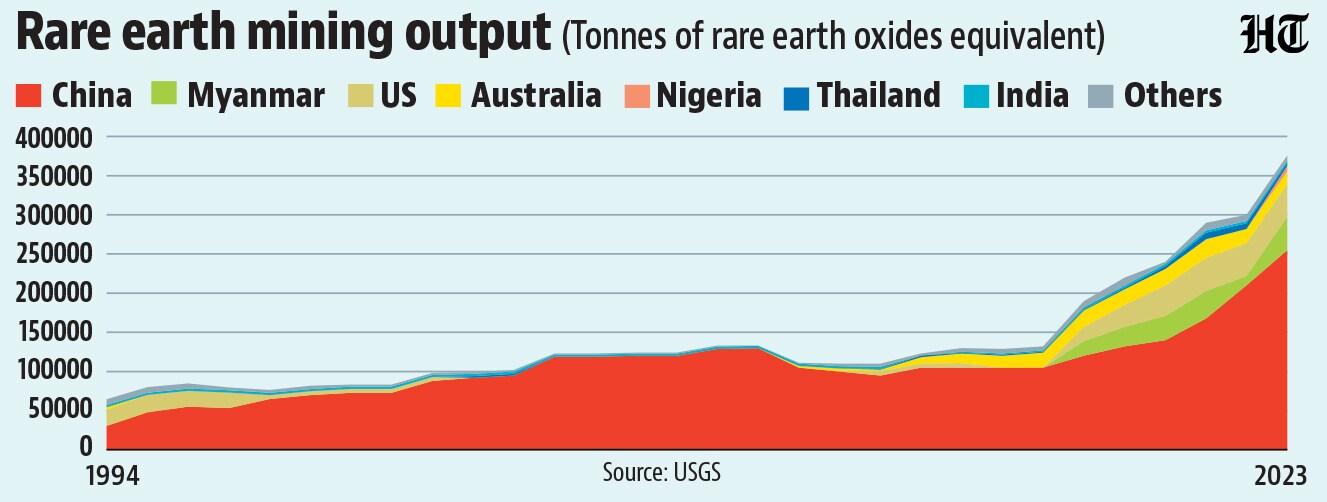
- But its mining output share is almost two-thirds of global outputTo be sure, a country possessing a reserve does not mean it can extract it immediately. A reserve means that a material has been located, quantified, its quality determined, and meets minimum physical and chemical criteria of economic extraction under current mining practices. It does not mean that the extraction process has started. For example, India produced 2,700 tonnes of rare earths in 1995 when it had 1.1 million tonnes of reserves; 2,900 tonnes in 2014, when it had identified 3.1 million tonnes of reserves; and 2,900 tonnes also in 2023, when its reserves had grown to 6.9 million tonnes. This is where China has beaten other countries with big reserves, as its share in mining output is two-thirds of global output, higher than its share in reserves. Without much change in domestic reserves, mine production in China has increased from 30,600 tonnes in 1994 to an estimated 255,000 tonnes in 2023. To be sure, increase in production by the US, Australia, and Myanmar in the past decade has deceased China’s dominance compared to the first decade of the 21st century, when it had over 80% share in every year. Another thing to keep in mind while reading China’s dominance in rare earth mining is that it is not just a matter of intent. While the country promoted the mining industry through export tax reimbursements and other measures, being the single-largest holder of reserves also helped it make extraction more profitable by achieving scale. Low labour costs and less stringent environmental regulations are other factors that made the country’s mining competitive globally. This can be understood in contrast with the United States. For example, Donald Trump’s efforts to start mining the deep sea for minerals (including rare earths) has been met with opposition from environmentalists. Similarly, US production was nil in 2016 and 2017 just because of excess supply from China (where efforts to curb illegal mining were progressing slowly) had caused prices to crash.
- China’s share in processing and refining is almost 90%While mining output concentration has decreased in recent years, this may not be the case so much for separation and refining processes that convert mined output into metals, their oxides, or magnets made from them. China had 87% market share in processing in 2019 and Malaysia 12%. In fact, there are just four plants outside China -- one each in Malaysia, France, India, and Estonia – according to a 2021 report by the International Energy Agency (IEA). However, the latter four process only light rare earths. This is another trend driven by the fact that China has much higher heavy rare earth concentration. However, this is not the only factor. “While India has existing facilities from mining to separation and refining in oxide form and also developed capability of metal extraction, but further industrial scale facilities (intermediate) from alloy, magnet etc. are non-existent. In these alloys, RE is a minor component and other than Rare Earth Elements (REE) many other materials are required. Though from the stages of metal extraction onwards, the sector is under free category, industry in the intermediate segment have not been established due to non-availability of technology,” Jitendra Singh, minister of state (independent charge) in the Department of Atomic Energy said in a parliament reply in 2023. Do these trends mean that the rest of the world is going to forever remain at the mercy of China? Not necessarily. For example, universities in the US are studying ways to extract rare earth metals from the waste of other industrial processes, according to a May New York Times report. This is not an isolated example. As an opinion piece by Niranjan Rajadhyaksha published in Mint on June 10 pointed out, researchers have empirically shown that a similar export restriction imposed by China in 2010 led to a surge of patents in other countries in developing alternatives and using rare earths more efficiently. These efforts may gather pace now.



Unlock a world of Benefits with HT! From insightful newsletters to real-time news alerts and a personalized news feed – it's all here, just a click away! -Login Now!


