
 E-Paper



The caste inequality in Bihar’s labour market | Number Theory
.
Published on: Oct 24, 2025, 08:02:29 IST

 Prefer HTon Google
Share via


Copy link

The first of this three-part data journalism series looked at the overall size and occupational distribution of Bihar’s workforce -- something that shapes a state’s economic fortunes. To be sure, there are other factors influencing this, including worker-productivity and income levels -- both of which are a function of education. The second part looked at the educational status of Bihar’s labour force and the relative wage premium for Bihar’s unskilled workers because of migration. The concluding part of the series will look at the caste-based inequality in Bihar’s labour force.
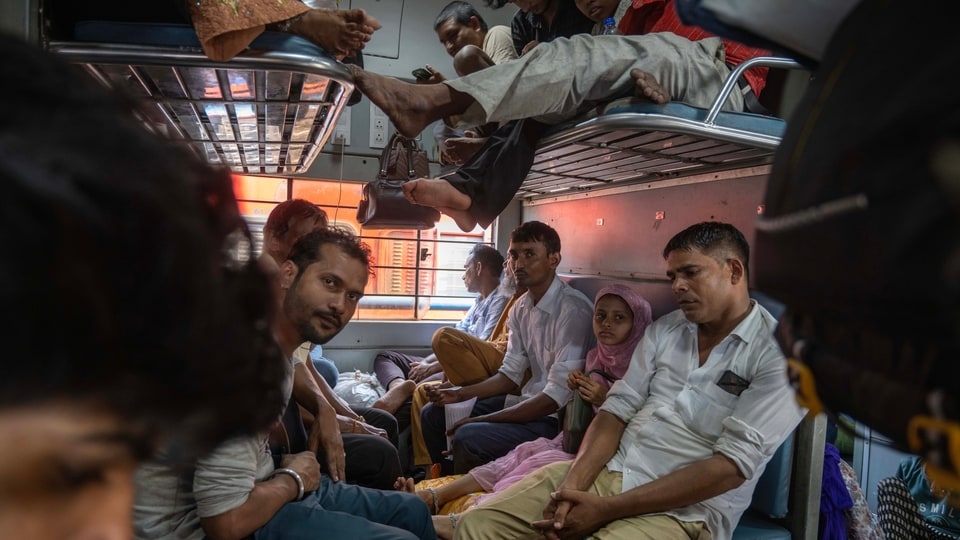
The caste inequality in Bihar’s labour market
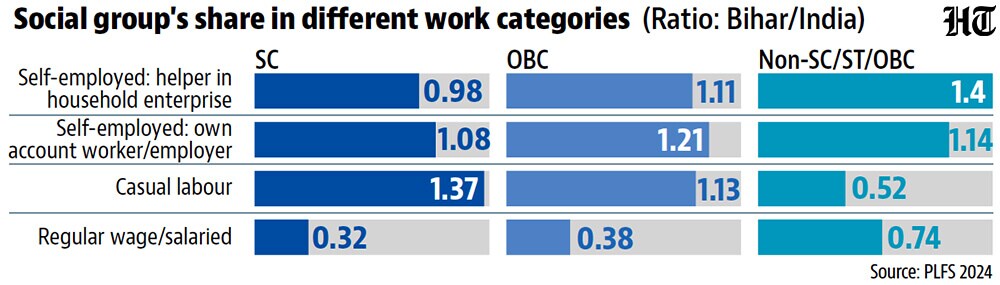
 Upper castes can live off family enterprises and Scheduled Castes are poorly represented in salaried jobsThe most basic parameter to compare caste inequality in the labour market is to look at the caste-wise distribution of workers in different kinds of jobs. The Periodic Labour Force Survey (PLFS) classifies workers into four categories: self-employed, unpaid workers in household enterprises, casual workers, and regular workers. Regular workers are normally the best paid workers while casual workers are the least paid. Comparing social group-wise share in different kinds of employment for 2024 shows that workers who do not belong to either Other Backward Classes (OBCs), Scheduled Caste (SC) or Scheduled Tribe (ST) have the highest over-representation advantage among unpaid workers in Bihar compared to the average non-SC/ST/OBC worker in India. This should be seen as a reflection of the relative well-being of the non-SC-ST-OBC population in the state, which can afford to work without wages instead of migrating. The under-representation is the highest for SC workers in regular jobs in Bihar. Because Bihar has a very low share of ST population (1.3% according to the 2011 census), the analysis has excluded STs.
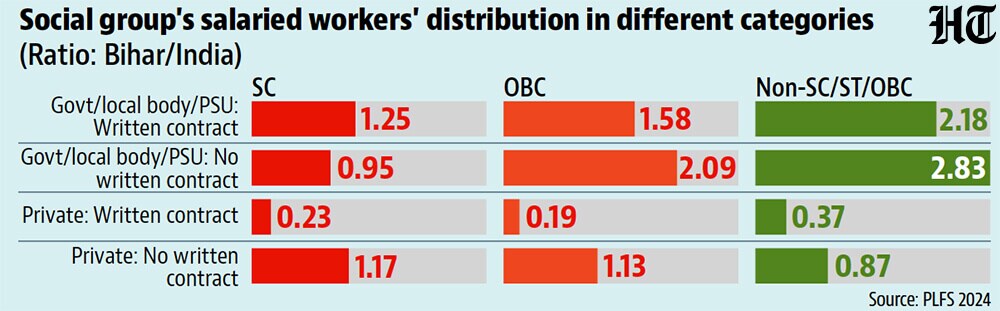
- Upper castes lead in quality and government jobs, but state lacks a vibrant white-and-blue-collar workforceNot all salaried jobs are equal. The PLFS data actually accounts for this by classifying them into government and private and with or without a written contract. A social-group wise comparison of Bihar and all-India numbers for 2024 PLFS shows that non-SC-SC-ST-OBCs have a huge advantage when it comes to their share in government jobs with or without written contracts in Bihar. What is counter-intuitive is the fact that even OBCs and SCs are overrepresented in these kinds of jobs in the state. However, all social groups in the state are poorly represented in private salaried jobs with written contracts (the more high-paying ones). This lack of a vibrant white-collar and even blue-collar (more on this later) economy, which is almost caste agnostic in nature, is the biggest indictment of Bihar’s lack of development.
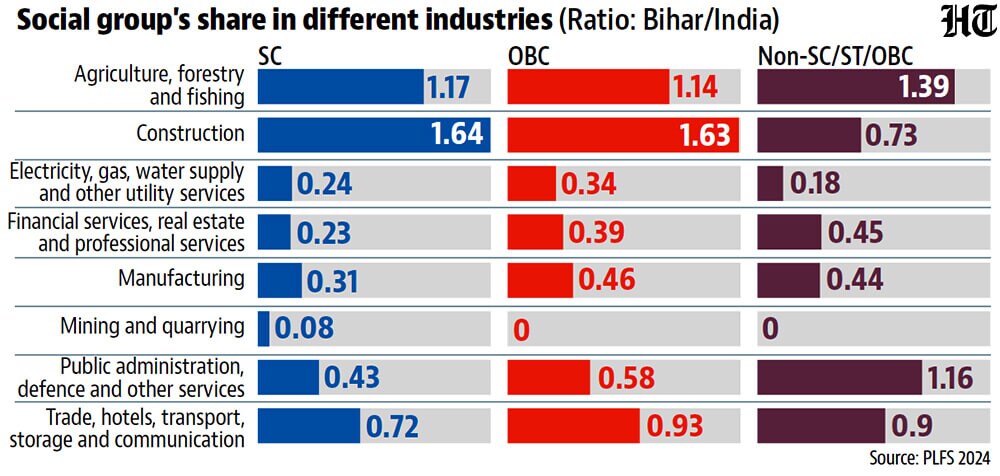
- All social groups overrepresented in agriculture but lag in manufacturing and private servicesEvery major social group in Bihar is more likely to be over-represented in agricultural employment in Bihar than at the national level. In fact, the over-representation is highest for the non-SC-ST-OBC workers. On the other hand, the disadvantage Bihar faces in the share of workers who are employed in manufacturing or high-value private services is also caste-agnostic. Bihar does have a caste-specific over-representation in sectors such as construction (on account of OBCs and SCs) and public administration, defence and other services (on account of non-SC-ST-OBCs), which is in keeping with the trends described in the previous section.
- At least some of these trends are explained by education levelFor example, a person in the labour force from the non-SC/ST/OBC groups in Bihar is more likely to be a graduate than such an average non-SC/ST/OBC person in the labour force in India. This explains why the group appears less likely to migrate for casual work and is over-represented in high quality jobs. On the other hand, a person in the labour force from SC and OBC groups is far more likely to be illiterate or have no formal schooling in Bihar than at the national level. This explains their readiness to migrate as well as work casual jobs in Bihar.



Unlock a world of Benefits with HT! From insightful newsletters to real-time news alerts and a personalized news feed – it's all here, just a click away! -Login Now!


