
 E-Paper



The rich are not buying expensive art like before| Number Theory
.
Updated on: Oct 4, 2025, 07:58:18 IST

 Prefer HTon Google
Share via


Copy link

At some point of time in the history of capitalism, acquiring art also became an act of investment for some people. This market seems to have entered a bear phase at the moment. Sales growth has been stagnant for the biggest auction houses for years now. Global auction giant Sotheby’s saw its losses double to $248 million in 2024, FT reported earlier in September. Christie’s, the other global giant, saw its sales fall 8% in 2024. What is happening? Here is what the numbers tell us.

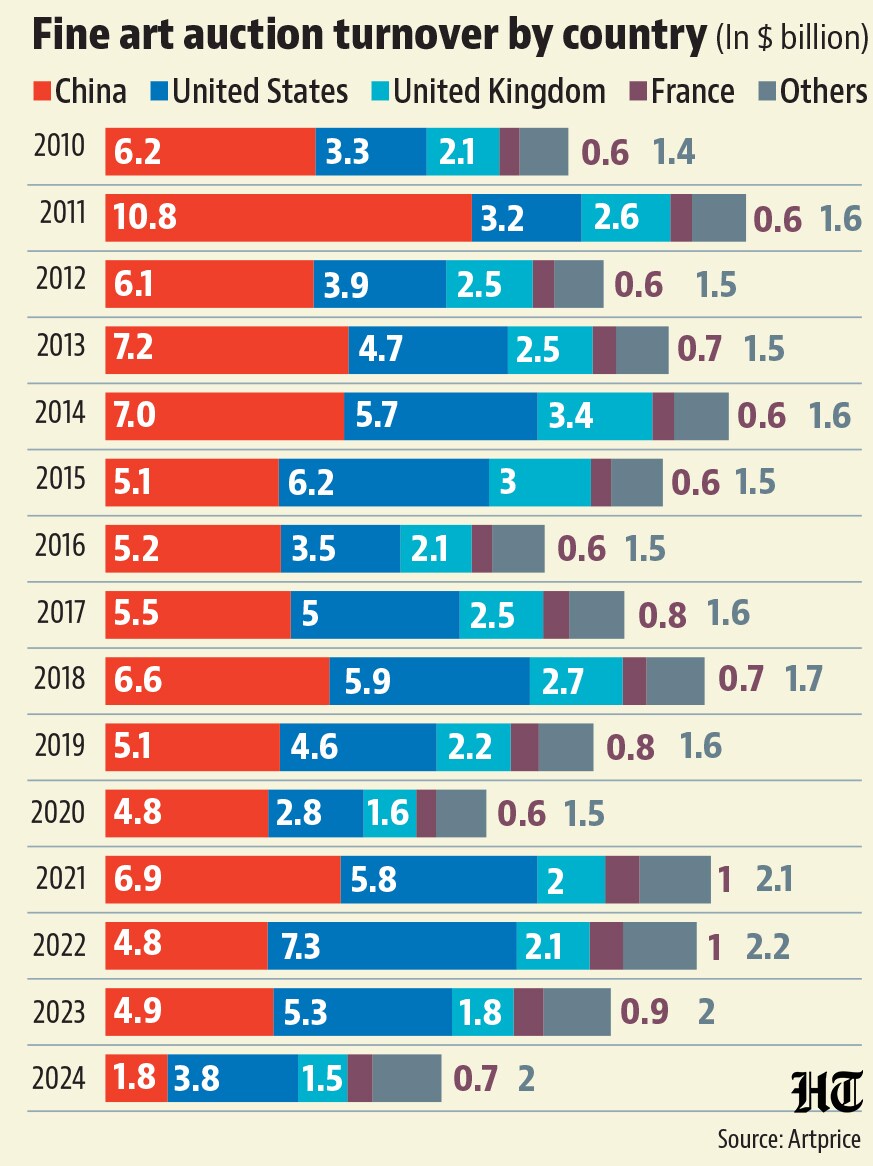
 Turnover from art auctions has declined in recent yearsIn 2024, global fine art auction turnover fell 33.5% to reach $9.9 billion, according to Artprice, a French art market information company. The main drag was weaker demand from China and the US, the two biggest markets, amid economic and geopolitical headwinds. China’s slowdown—linked to its property debt crisis and tariff pressures—has been particularly damaging. The decline has also been witnessed by the broader art sector, including private sales, galleries, etc., which fell 12% to reach $57.5 billion in 2024, according to a report by UBS and Art Basel. “On the buyer side, there seems to be momentary caution on account of the pessimistic global outlook. Established, seasoned collectors, normally accustomed to allocating hundreds of millions annually to art and lifestyle asset acquisitions have placed a temporary hold due to the visible volatility.” said Arvind Vijay Mohan, founder of Artery India, an art intelligence and asset advisory firm.
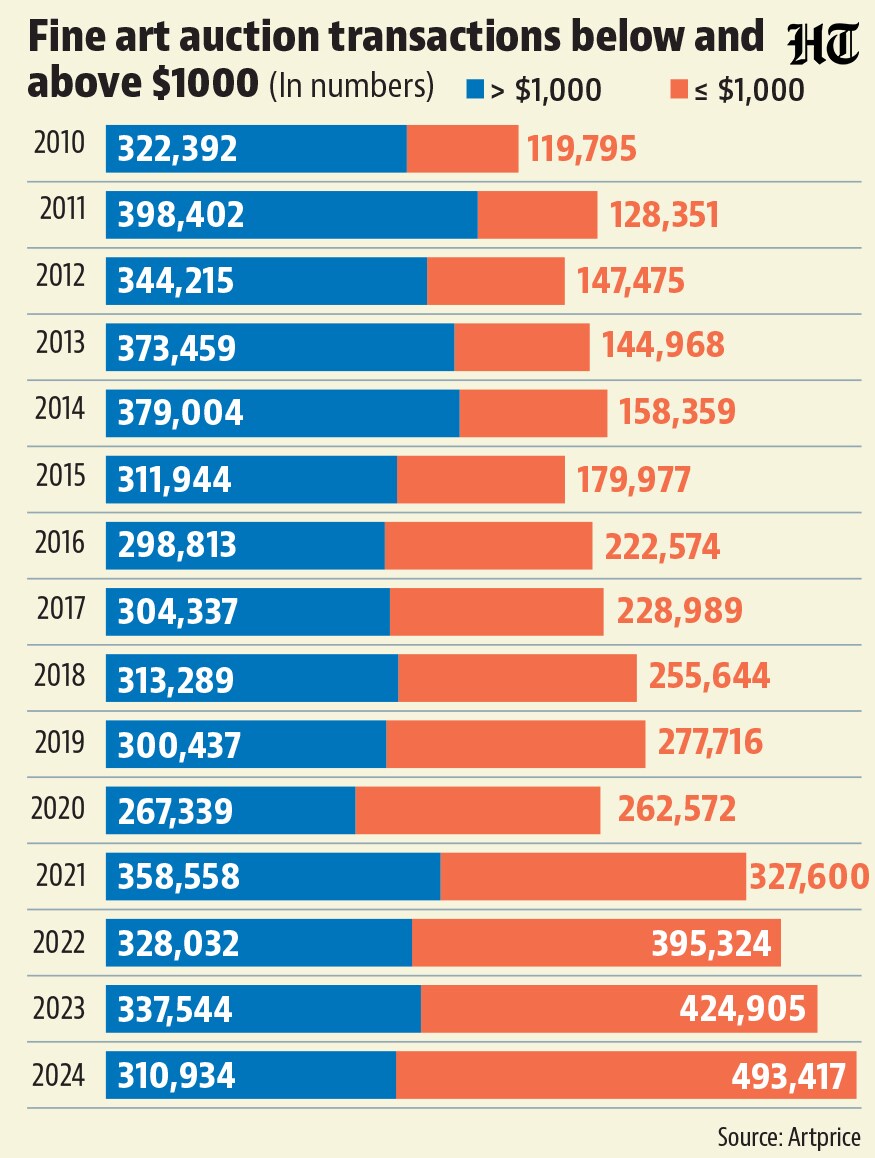
- But the slump is more in the really premium art segmentThe decline in revenues in art is mainly due to a slump in the premium segment. The number of fine art works sold fetching more than $100,000 fell by as much as 17% in 2024, while those fetching more than $500,000 fell by as much 24%. But the number of fine art auction transactions itself crossed eight hundred thousand in 2024, the highest figure ever recorded. Behind this growth in the number of sold lots despite the overall slump in sales figure is the growth in the affordable, below $1000 segment. In fact, Artprice data shows that more than half of the works sold in 2024 went for under $600. The divergence suggests that the contraction in the sector is less about falling interest overall and more about a withdrawal of top-end consignments which could also be described as consumption rather than investment driving the demand for art. At the same time, the surge in the below $1,000 segment points to auctions functioning increasingly as a volume business, as multi-million lots become rarer.
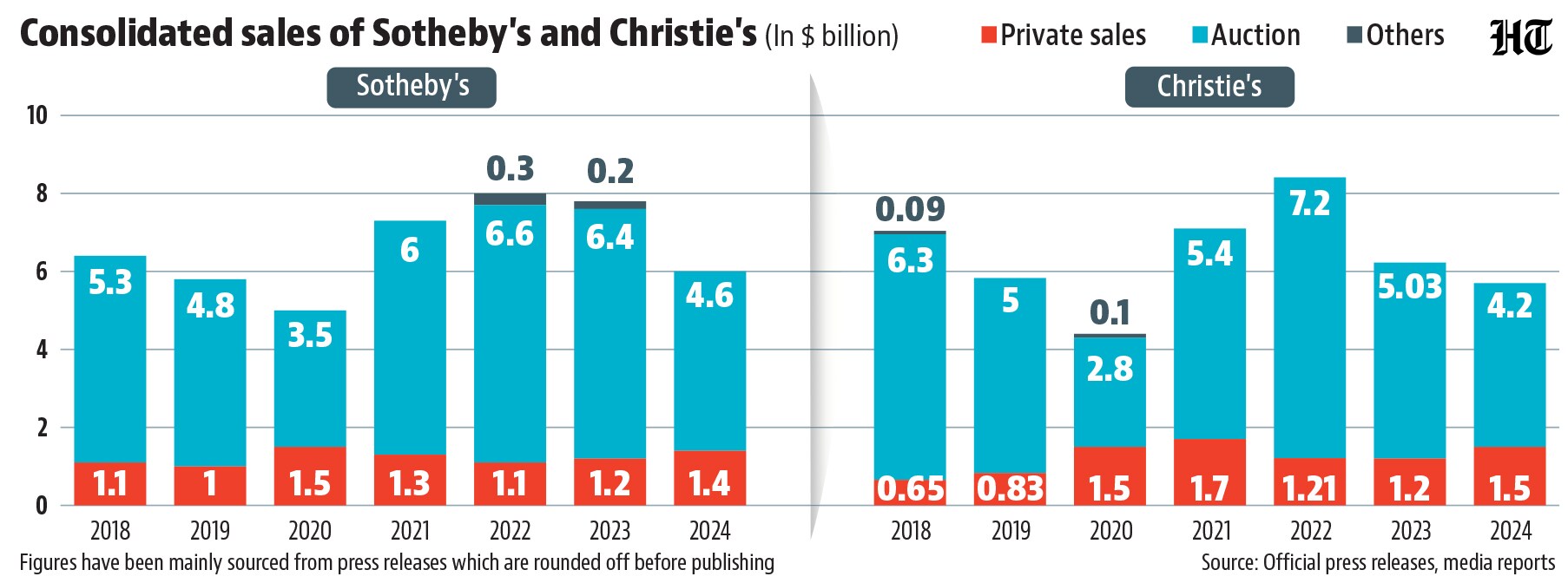
- How are the major players responding to this slump?With auction revenues shrinking, major auction houses are leaning more on private sales—discreet, negotiated transactions outside the auction room. Unlike auctions, which rely on public bidding and carry the risk of unsold lots, private sales, which saw an uptick during the Covid-19 pandemic, give sellers greater control and certainty, especially in uncertain markets. UBS and Art Basel note that while global auction sales fell 25% in 2024, private sales at major houses rose 14%, showing how vital this channel has become. The numbers tell the story. Sotheby’s private sales rose from about $1 billion in 2019 to $1.4 billion in 2024, even as its auction revenues nearly halved. Christie’s followed a similar path, with private sales nearly doubling over the same period to reach $1.5 billion. This pivot helps to steady revenues and keep big consignments in play, but it also shifts more of the market into opaque channels, weakening auctions’ traditional role as public price-setters.
- So where does India stand?India has bucked the trend with record sales. In March, M.F. Husain’s “Untitled (Gram Yatra)” (1954) fetched $13.8 million ( ₹118 crore) at Christie’s New York—far above its presale high estimate of $3.5 million—and set the new record for the most expensive work of modern Indian art. In April, Mumbai’s Saffronart sold Tyeb Mehta’s “Trussed Bull” (1956) for $7.2 million ( ₹61.8 crore). Overall, India’s fine art auction market has expanded from about $58 million in 2019 to $113.8 million in 2024. “Despite a strong continuing turn, particularly over the past two years, India still remains a young, relatively nascent market. Indian billionaires are now displaying comfort with investing serious capital on lifestyle and art assets, an orientation that’s already well-established in China and the West,” said Vijay Mohan. As of 2024, India accounts for just around 1.1% of the global fine art auction market.


Unlock a world of Benefits with HT! From insightful newsletters to real-time news alerts and a personalized news feed – it's all here, just a click away! -Login Now!


