
 E-Paper



The youngest state in India is going to polls | Number Theory
.
Updated on: Oct 16, 2025, 09:39:27 IST

 Prefer HTon Google
Share via


Copy link

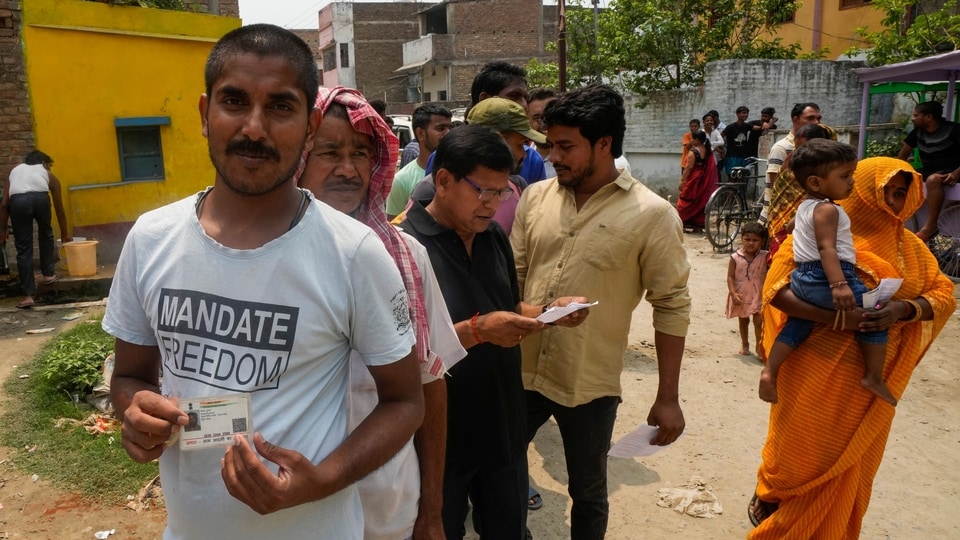
Bihar will vote in two phases on 6 and 11 November. With nominations in full swing, the political attention is focused on the dynamics within and between parties in the two major alliances in the state. However, Bihar is unique in at least one way compared to the rest of the country: it is the youngest state in the country. This fact has implications for how political choices and memory can play a role in these elections. Here are four charts which explain this in detail.
The youngest state in India is going to polls
 Bihar has the lowest share of electors relative to its share in populationIn the 2024 Lok Sabha election, Bihar had 77.3 million electors. This number has come down to 74.2 million after the final electoral roll was published following the completion of the Special Intensive Revision (SIR) exercise. Bihar’s all-India share in the number of electors in the 2024 Lok Sabha election was 7.9% while its population share, according to projections by the National Commission on Population for 1 March 2024, was 9.2%. If one were to rank major states and union territories according to the ratio of these two numbers, Bihar has the lowest number of just 0.86. The state with the highest share of electors relative to its share in India’s population was Telangana, where this number was 1.24.
- Bihar’s elector-population ratio is the lowest because its population is the youngestIf one were to compare median age from the age-wise population projections given by the National Commission on Population for March 1, 2026 (age-wise projections are available only at five-year intervals), Bihar’s median age is 22.65 years, the lowest among major states and union territories. What is even more remarkable about the state is that the share of population which is younger than the voting age in the state is 37%, the largest by a big margin among major states and UTs in the country and around nine percentage points higher than what this number is at the all-India level.
- Around 42% of Bihar has not seen a chief minister other than Nitish, but over 90% of electors haveIf one were to exclude the nine months when Jitan Ram Manjhi was the chief minister of Bihar after Nitish Kumar himself handed over the reins to him between May 2014 and February 2015, then Nitish Kumar has been the chief minister of the state continuously since October 2005. Around 42% of the state’s March 2026 population was born after 2005 according to age-wise projections of the state’s demography. The balance among voters, however, is very different. Of the 83 million people of voting age in March 2026 according to these projections, over 90% were born by 2005 and 63% were at least age nine, which means they have seen the period when Lalu Prasad Yadav or his wife Rabri Devi was in power. Similarly, 34% were at least nine years old in 1990, and would have seen the pre-1990 period in the state. In a state where preventing a return of Lalu Prasad Yadav in power is still one of the central political planks of the National Democratic Alliance (NDA), this kind of an asymmetry between the political memory of the overall population and the subset of electors can have an important role in shaping political choice. The fact that only a third of the electorate has seen the pre-Lalu years also means that it is relatively easier for the NDA to pin the blame for the state’s material problems on Lalu era, which was the longest in the state before Nitish surpassed him.
- What we understand...There is another way to look at Bihar’s political economy in the context of its demographic composition. The ruling NDA has announced a slew of populist measures ahead of the elections to ensure that it comes back to power. According to a research note by Neelkanth Mishra, chief economist at Axis Bank, Bihar’s pre-poll announcements were expected to cost ₹32,000 crore, 2.9% of the state’s GSDP in 2025-26, and one of the highest among all states. The note also says that Bihar was unlikely to breach its fiscal deficit target for the year as the extra spending would come on account of expenditure substitution rather than extra spending. Typically, this would also mean that the state is taking money away from spending in the future of its younger population to placate those who are of voting age.





Unlock a world of Benefits with HT! From insightful newsletters to real-time news alerts and a personalized news feed – it's all here, just a click away! -Login Now!


