
 E-Paper



This year may be cooler, but climate crisis is far from over | Number Theory
.
Updated on: Sep 29, 2025, 11:21:24 IST

 Prefer HTon Google
Share via


Copy link

The past two years were the warmest ever recorded on Planet Earth. Almost three-fourth of 2025 is over but trends so far suggest there will be no hat-trick of the highest average global temperature being recorded in three consecutive years . However, this does not mean a weakening of global warming and a mitigation of the resultant climate crisis threat. The reasons for 2025 most likely being cooler than 2024, and perhaps even 2023, are largely cyclical in nature.

This year may be cooler, but climate crisis is far from over
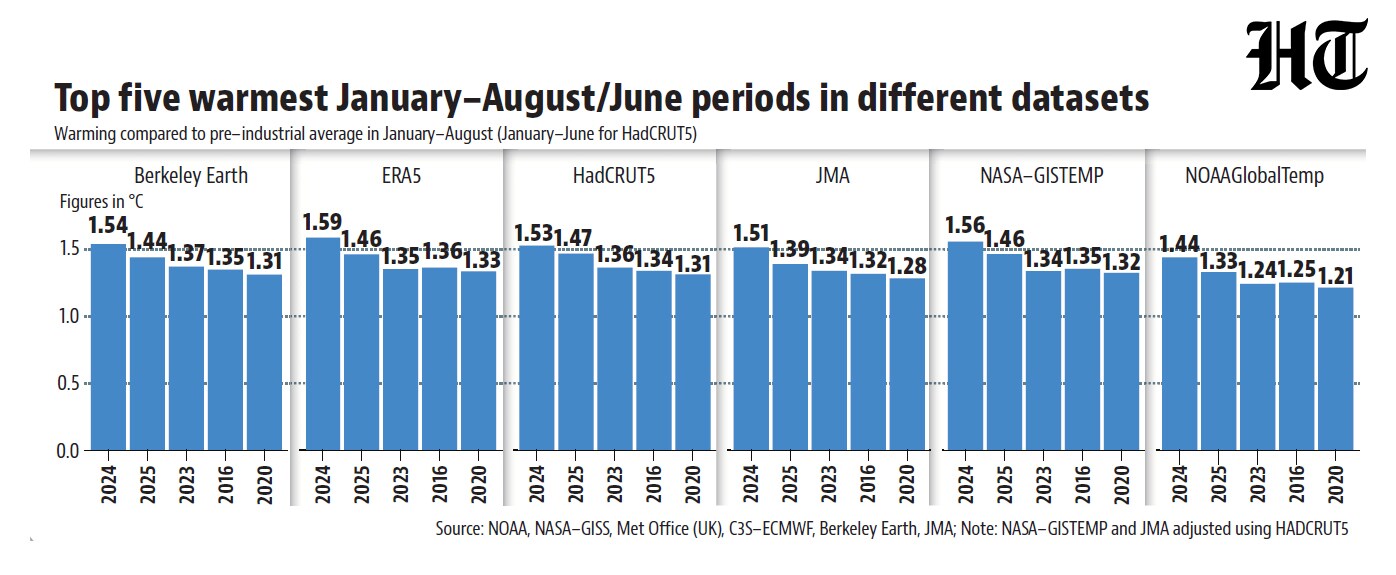
 2025 is the second warmest year so farIn all the six global temperature datasets that the World Meteorological Organisation (WMO) tracks, the year up to August (up to June in the case of one dataset that has not published data up to August) is the second warmest after 2024. If 2025 holds this rank up to December 31, it will replace 2023 as the second warmest year. This, however, is unlikely to happen. Berkeley Earth, a US non-profit which produces one of the six datasets, forecast on September 17 that there was a 95% chance that 2025 will end up as the third warmest year. An HT analysis suggests that this is also likely in other datasets.
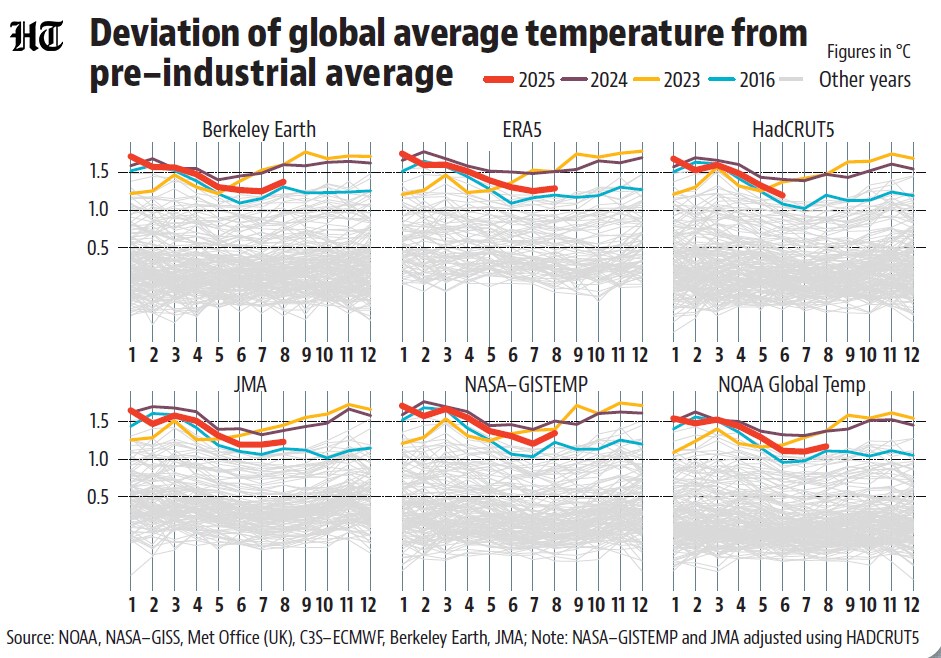
- But that is mostly because of warming earlier in the yearOne reason why 2025 is not expected to continue to hold on to the second rank is that the year-to-date temperature’s deviation from the pre-industrial average is driven by the early part of the year. January was the warmest ever this year. The month was also warmer than the pre-industrial average by more than 1.5°C across all datasets, the threshold which global leaders agreed to not breach long-term in the 2015 Paris Agreement. Warming has decreased thereafter. While even long-term warming is slower in the northern hemisphere summer (June-August), what is encouraging in 2025 is that all three summer months were ranked the third warmest this year, a climb-down from the January-May period, when months were generally ranked highest or second highest.
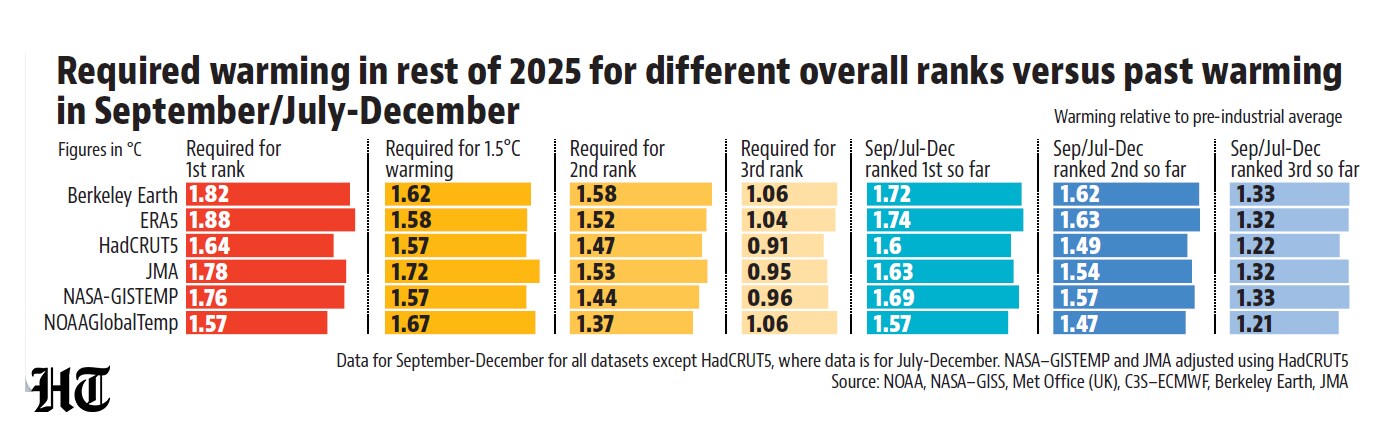
- Extraordinary warming is required in the rest of 2025 for it to finish first or secondIf 2025 has to finish as the hottest year as a whole, the July/September -December period will have to be 0.05-0.17°C warmer than 2023, the warmest year in the July/September -December period across datasets. For it to finish second warmest, this period needs to be 0.11-0.25°C warmer than the third warmest year (which is 2015 for the September-December period and 2019 for the July -December period). These are unlikely scenarios because they suggest an acceleration in warming absent in recent months (see chart 2). For 2025 to finish as the third hottest year, the rest of the year needs only around 1°C warming from the pre-industrial average, a level every dataset has breached every year since 2015 in the July/September -December period on average.
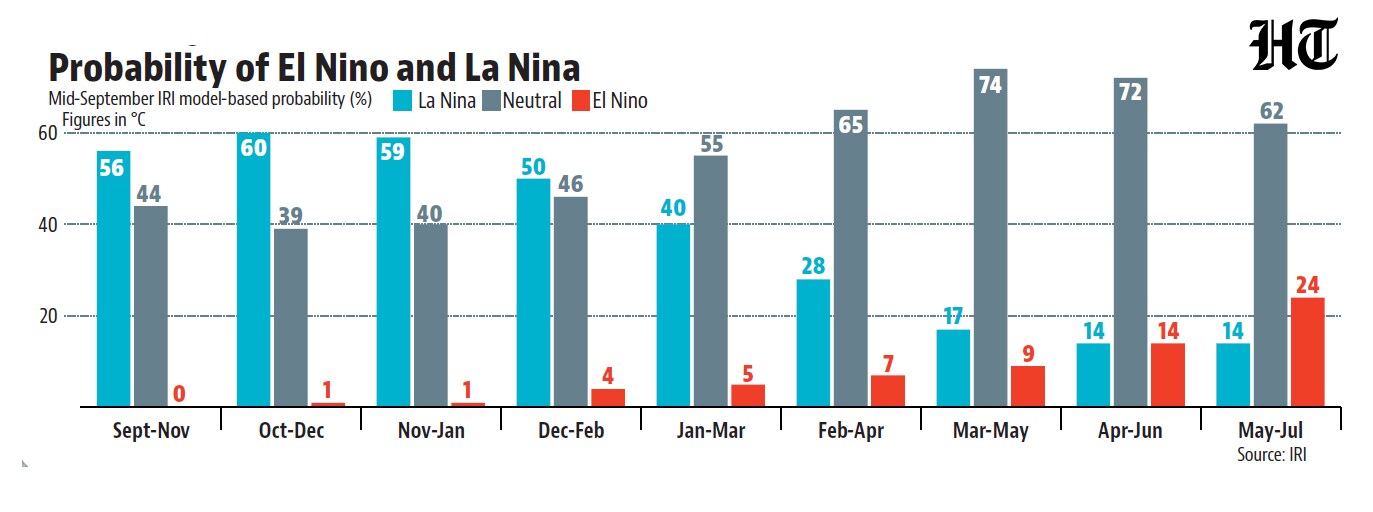
- With El Nino far away and a second short La Nina incoming, extraordinary warming is unlikelyTo be sure, 2024 and 2023 did breach past records with a big margin in the second half of the year (see chart 2). Therefore, past statistics are not enough to suggest that this will not happen in 2025. However, there is another factor guiding forecasts. For example, one reason behind record warmth in the past two years was an El Nino, a cyclical warming of the equatorial Pacific that increases global temperature with some lag. An El Nino prevailed from April-June 2023 to March-May 2024. This was followed by neutral conditions (neither significant warming nor cooling) before a short La Nina – a cyclical cooling in the equatorial Pacific that cools global temperature -- took hold from November 2024 to February 2025. While the La Nina conditions were too short-lived to be officially classified as La Nina by some metrics, it is expected to have decreased warming with some lag in 2025. It is the expected return of La Nina conditions from the September-November season that is suggesting that 2025 will not be ranked higher than third warmest.
- La Nina’s role in 2025 decreases the significance of the coolingIn other words, if 2025 is ranked third warmest, it will still be the warmest year without an El Nino and bookended by La Nina conditions; and may not be far below the 1.5°C threshold. This means that temporary fluctuations are cooling the earth only for the short term this year. The long-term warming goes on unabated.


Unlock a world of Benefits with HT! From insightful newsletters to real-time news alerts and a personalized news feed – it's all here, just a click away! -Login Now!


