
 E-Paper



What UAE’s exit means for OPEC’s hold on oil markets | Number Theory
The longer-term question is different: what happens to a cartel whose share of world crude production has been falling
Updated on: Apr 30, 2026, 10:41:35 IST

 Prefer HTon Google
Share via


Copy link

The United Arab Emirates’ exit from OPEC comes at a moment when the war in West Asia has already roiled oil markets and made the ability to traverse the Strait of Hormuz the main driver of prices. That is why the immediate market reaction to the move has been muted. The longer-term question is different: what happens to a cartel whose share of world crude production has been falling, and which has now lost one of the few members with the capacity and incentive to pump more?
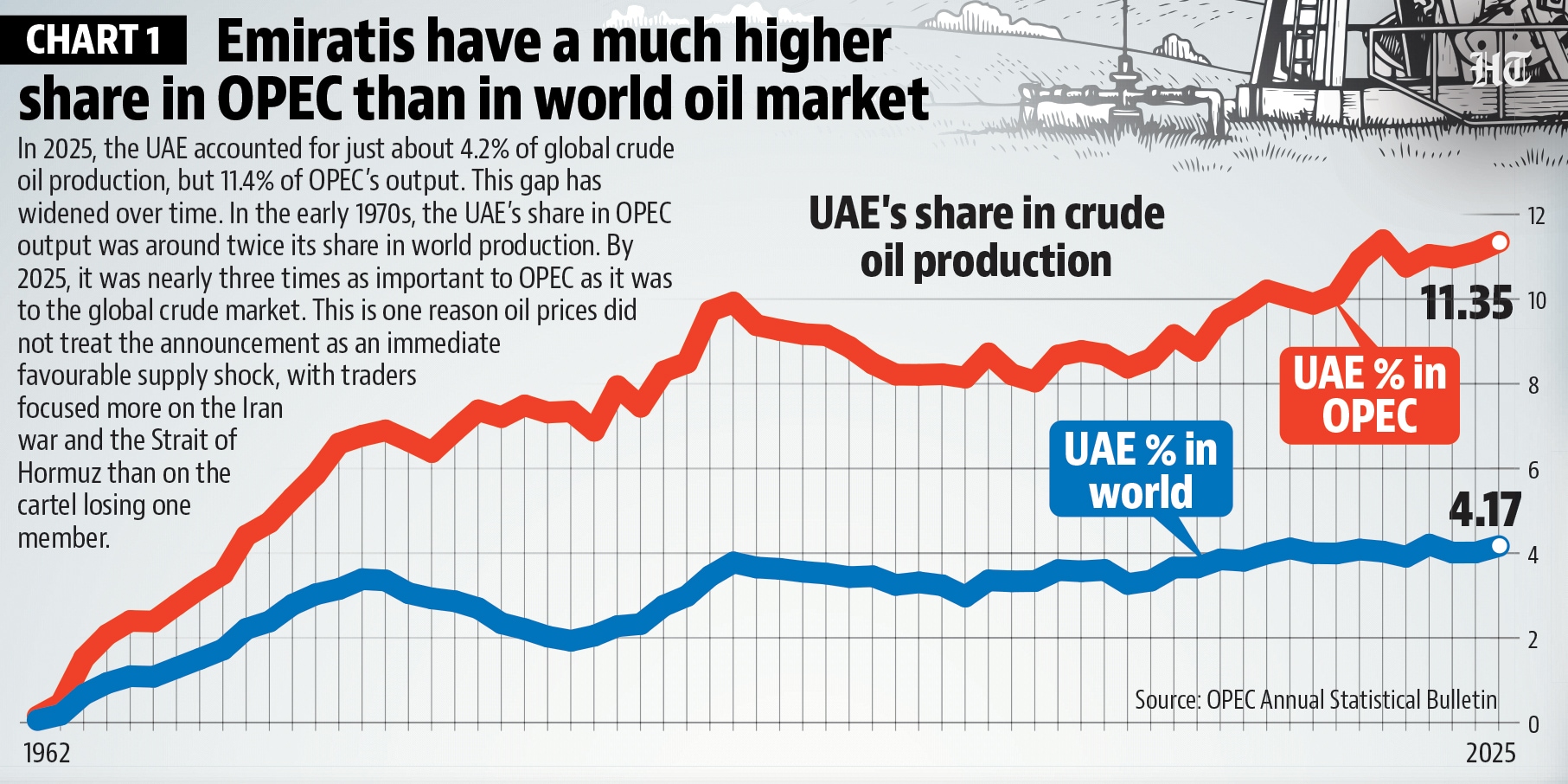
 Emiratis have a much higher share in OPEC than in world oil marketIn 2025, the UAE accounted for just about 4.2% of global crude oil production, but 11.4% of OPEC’s output. This gap has widened over time. In the early 1970s, the UAE’s share in OPEC output was around twice its share in world production. By 2025, it was nearly three times as important to OPEC as it was to the global crude market. This is one reason oil prices did not treat the announcement as an immediate favourable supply shock, with traders focused more on the Iran war and the Strait of Hormuz than on the cartel losing one member.
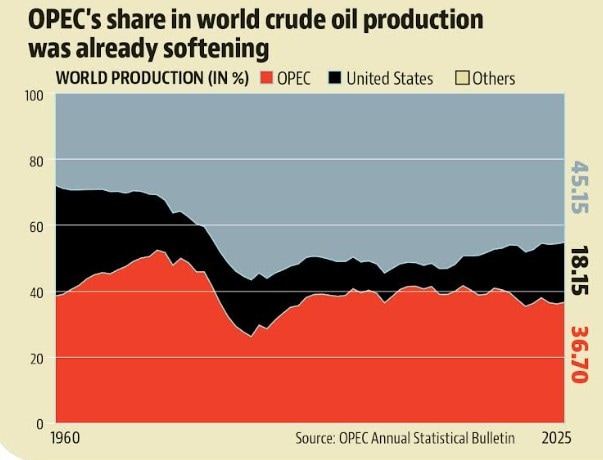
- OPEC’s dominance over oil markets was already decliningThe UAE’s departure also comes at a time when OPEC’s grip on world crude production had already been softening. The cartel accounted for more than half of global crude output in 1973, the year of the Arab oil embargo. By 2025, its share had fallen to 36.7%. The US, meanwhile, has moved in the opposite direction. After falling to just 7% of world crude output in 2008, its share rose to 18.2% by 2025, helped by the shale boom. This has changed the balance of power in oil markets. OPEC remains central to supply management, but it no longer commands the kind of production dominance it had in the 1970s. “Growing production in the Americas over the past two decades has already eaten away at opec’s share of global output, weakening its sway over prices. Once oil exports through the Strait of Hormuz resume, Saudi Arabia—which has the most spare capacity of any of the bloc’s members—will have to curtail more of its output if it wants to support prices,” said a piece published by The Economist after the UAE’s announcement.
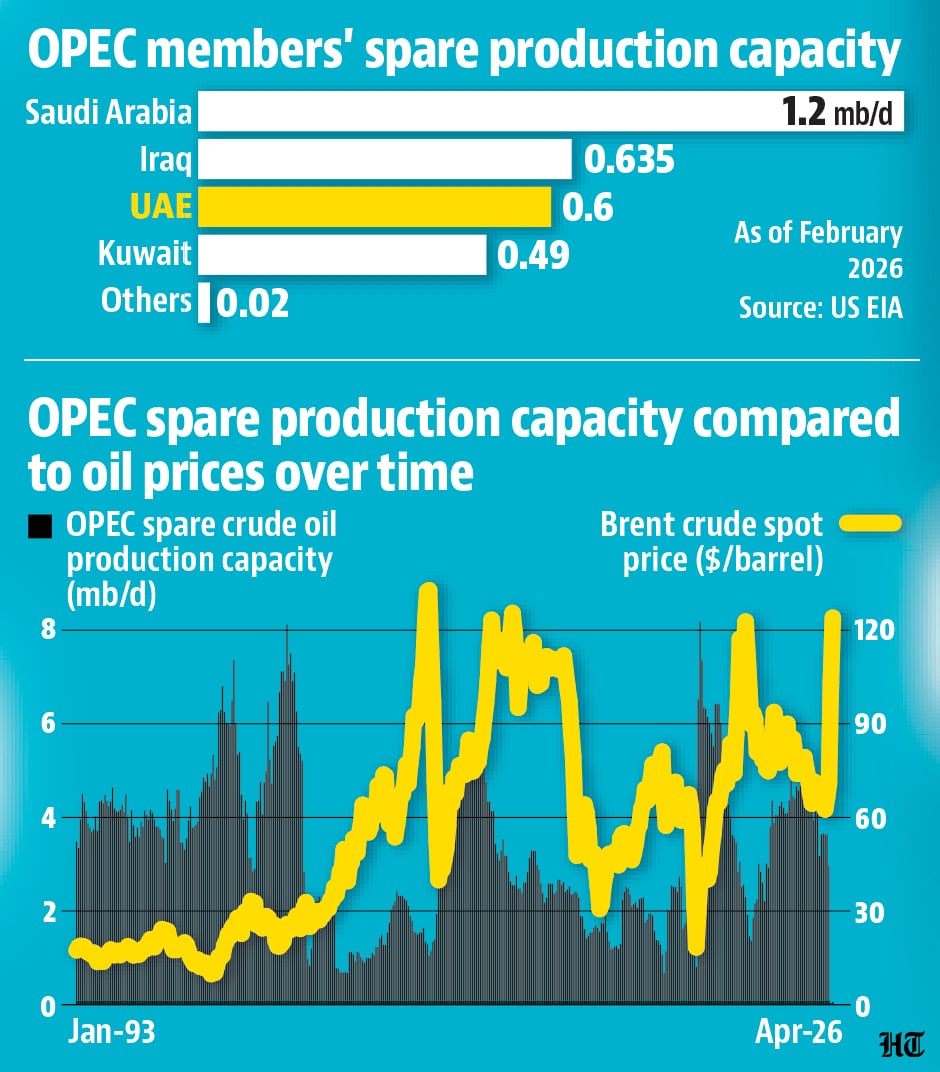
- And this is where the friction between the UAE and OPEC stems from, and why its exit matters for the cartelOPEC’s quota system is the mechanism through which the cartel tries to manage oil prices. When it wants to raise prices, members are asked to produce below what they otherwise could. This requires discipline, but also spare capacity, because the cartel’s influence depends on its ability to add or withhold barrels when market conditions change. This is where the UAE becomes important. According to estimates from the US Energy Information Administration, in February 2026, Saudi Arabia had 1.2 million barrels per day of spare capacity, followed by Iraq at 0.64 million, the UAE at 0.6 million and Kuwait at 0.49 million. Other OPEC members had almost none. This made the UAE unlike earlier departures such as Qatar, which was more important as a gas producer than as a crude oil swing producer. The friction with Saudi Arabia, OPEC’s de facto leader, reflected different national calculations. Riyadh needs higher prices to fund a much larger population, an oil-dependent budget and expensive diversification plans. Abu Dhabi, with a smaller population, deeper fiscal buffers and heavy investments in production capacity, wanted to produce more and monetise its reserves faster. These tensions predated the US-Israel war with Iran, but deepened as Gulf states responded differently to the conflict. The UAE took a more openly pro-US and pro-Israel position, while others remained more cautious. In short, the UAE’s exit matters not just because of the barrels it already produced, but because of the spare barrels it could have brought under OPEC’s control. To be sure, this does not make OPEC irrelevant as Saudi Arabia still has enough production heft and spare capacity to influence the world market. But the cartel will need to ensure that the UAE’s departure does not encourage other members to question the value of staying inside the quota system.

Unlock a world of Benefits with HT! From insightful newsletters to real-time news alerts and a personalized news feed – it's all here, just a click away! -Login Now!


