
 E-Paper



Muslims in focus as 55 UP constituencies go to polls in second phase
UP assembly election 2022: Amid the ongoing hijab controversy, 55 seats in western Uttar Pradesh that go to the polls on Monday (February 14), would reveal the nature of churning in this Muslim belt

 Prefer HTon Google


Nida Khan, a triple talaq victim, and Samyun Khan, a social worker in Bareilly, represent two ends of the political spectrum during the Uttar Pradesh assembly elections in the second phase in which Muslims are in focus. Nida, who moves in a burqa (veil) with security, campaigns in densely populated Muslim colonies for the BJP. Samyun, without a veil, is all for the Samajwadi Party (SP) and is accompanied by her team of social workers.
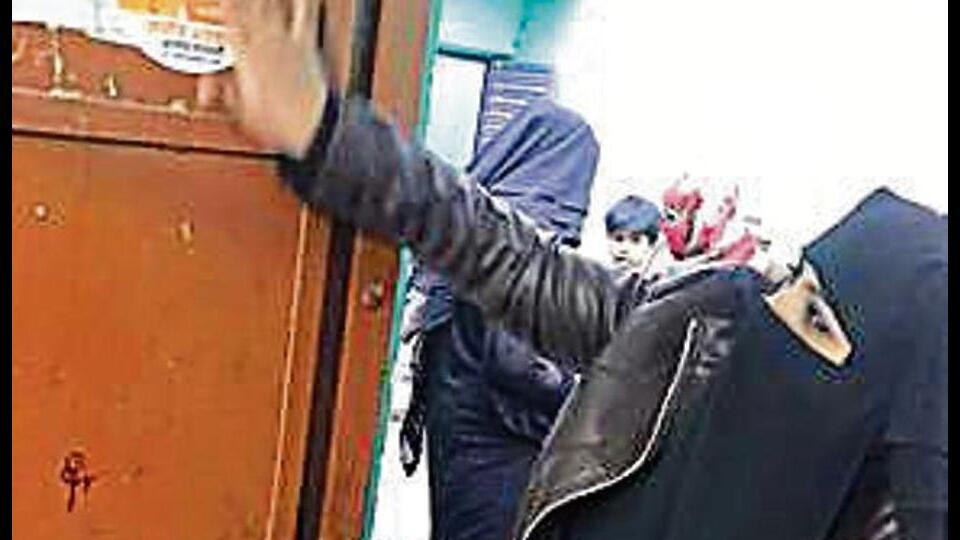
Their parties are different, but their issues are the same – security and women empowerment.
Amid the ongoing hijab controversy, 55 seats in western Uttar Pradesh that go to the polls on Monday (February 14), would reveal the nature of churning in this Muslim belt where the ruling BJP is hoping for a division in the Muslim votes, a prospect that its main challenger the Samajwadi Party is out to avoid, according to analysts.
“We haven’t flagged the hijab controversy that has been deliberately raked up during poll time to turn this election into a Hindu-Muslim one,” says Samyun, who heads an NGO, feels the real issues of empowerment, price rise, social security are the same for all women, irrespective of the political divide.
“That is why we are focusing on real issues, not peripheral ones,” she says. Nida, the daughter- in-law of cleric Tauqir Raza Khan from Bareilly’s famous Dargah Ala Hazrat, adds that scrapping of the triple talaq instant divorce practice has helped the Muslim women enormously.
“I am a victim myself, but there have been women who have been instantly divorced on the flimsiest of pretexts. Now, things are much different,” she says while steering clear of the hijab controversy.
Samyun, however, says that triple talaq hasn’t been as big an issue as has been made out to be.
“It isn’t as if all Muslim women have a husband wanting to divorce them. The real issues are of lives and livelihood,” she says.
In two public meetings, Prime Minister Narendra Modi had flagged the issue of scrapping of the triple talaq, making a detailed mention of how he didn’t care about votes and the opposition while pushing ahead with the law which, he said, had provided security to Muslim women. On the other hand, chief minister Yogi Adityanath has waded into the hijab controversy by stating that the country is run by the Constitution, not by Shariat – the Islamic law. Political experts say they will watch how the Muslim factor plays out in these 55 seats.
“This time, even the BJP alliance has fielded a Muslim candidate and BJP leaders are telling the community that they should also consider who has really worked for them. It would be interesting to see the voting pattern here,” says Irshad Ilmi, a political observer.
Even at the height of the BJP wave in 2017, 10 Muslim candidates won from among these 55 constituencies while 18 had stood second. This time, 78 Muslim candidates have been fielded by non-BJP parties. Even the BJP-Apna Dal (Sonelal) alliance has nominated a Muslim – Haider Ali Khan — from the Swar in Rampur. The BJP held 38 of the 55 seats while the Samajwadi Party had won 15 in 2017 despite the BJP wave.
“Back in 2017, in nearly 16 to 17 assembly constituencies, most leading parties put up Muslim candidates, paving the way for the BJP wining those seats. The BJP knows that a united Muslim vote bank would spell trouble for it,” says Congress leader Zishan Haider. This time, four assembly constituencies each have four Muslim candidates in the fray. In six constituencies, three minority candidates are contesting. Two seats have two Muslims candidates each.
A key factor this time is that Samajwadi Party heavyweight Azam Khan, the present Lok Sabha MP from Rampur who has won the Rampur assembly seat a record nine times and is again contesting the assembly elections, is in jail.
Azam Khan had been booked in over 100 cases since 2017, when the BJP came to power in UP. His son Abdullah Azam, who had won the Swar assembly seat in 2017 before being disqualified, is currently out on bail and is contesting this time too. Khan’s wife and current lawmaker Tazeen Fatima says cases against Azam Khan and the family are politically motivated.
“He will win because irrespective of the politics, he has made a place for himself in people’s heart,” she says.
Union minister Anurag Thakur, who has been actively campaigning in Uttar Pradesh, says, “In phase 1 of the polls, (Samajwadi Party chief) Akhilesh (Yadav) banked on Nahid Hasan (contesting from Kairana), who is in jail under the Gangsters Act. In phase 2, he is remembering Azam Khan and by the time the elections head to the east, he will also start remembering Mukhtar Ansari and Atiq Ahmad,” Thakur said. All four named by Thakur are in jail for varying charges.
Of the 55 seats, the Congress had won two while the BSP failed to open its account in 2017.


