Cast: Adil Hussain, Trimala Adhikari, Pushpendra Singh
Director: Nidhi Saxena
Star rating: ★★★.5
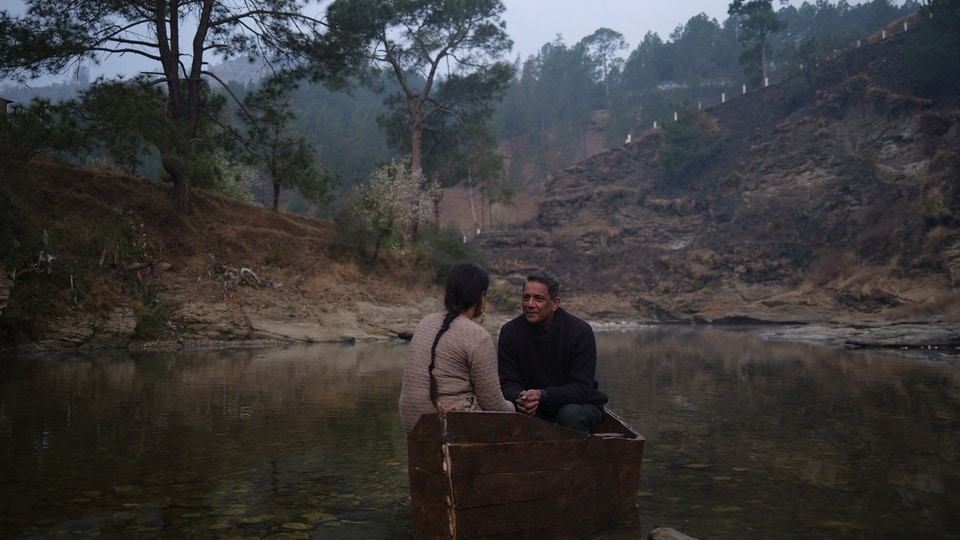
Beauty and terror clash in Nidhi Saxena's arresting sophomore feature, Secret of a Mountain Serpent, which opened the Biennale College Cinema section at the Venice Film Festival this year. Set in a remote Himalayan town during the Kargil War of the late 1990s, this film chronicles the lives of women who are left behind. In a village emptied of men, these women live with the emptiness of something waiting to happen. Their loneliness, yearning and desire are delicately drawn out to form a mythical mood poem of sorts, one that is steeped in local folklore.
Secret of a Mountain Serpent had its World Premiere at Venice.
The premise
The saying goes that a woman encountered a snake in the river and made a promise that she ultimately did not keep. The snake is still waiting in the river, and the women are forbidden from entering the river. This local myth forms the subtext of Secret of a Mountain Serpent, as the film opens with a bunch of women at leisure after a day's toil of getting straw wood. The shot freezes as a woman sees a black snake entwined around her ankle.
This Eden-like setting is underlined by the recurring image of the apple being eaten, which does get a little too indulgent against the film's sobering quality. The local schoolteacher, Barkha (a graceful performance from Trimala Adhikari), will lead the story ahead. Her husband Sudheer (Pushpendra Singh) is away at war, and she spends her days in an absent-minded daze, looking ahead through the windows and whispering, as if searching for something.
What works
Working with cinematographer Vikas Urs, Saxena creates a vivid portrait haunted by absence and longing. This is a film seen and crafted in the presence of a woman, and there is no way you can forget it. This is a woman's world. The gaze is so unmistakably inwards, so full of texture and ache. There is no front-footedness in the storytelling; it is thankfully in no hurry to move ahead with startling revelations and gimmicky monologues. Instead, this is an inner world full of small discoveries and happenstances, a world illuminated with the desire to be seen and included. The soft notes of Rekha Bharadwaj's vocals that arrive early on become the film's heartbeat.
When the enigmatic Manik Guho (Adil Hussain) arrives out of nowhere, things get complicated for Barkha. Saxena does well by never reorienting the film's gaze towards creating more conflict. Rather, in a particularly memorable sequence, Guho and Sudheer cohabitate the same space, and it is left to Barkha- and in extension to the viewer- to decipher whether her yearning has led to this tentative meeting point of the two men in her life. Somehow, the film feels a little too inert at times, as Barkha's resolve tends to become distant and heavy. What to do with beauty when there is so much loss around her?
Final thoughts
Secret of a Mountain Serpent shifts and expands in a dream-like vision. The actors provide fine support to Saxena's vision that rewards the patient viewer with a distinct sense of perspective by the end. Neeraj Gera's exquisite sound design- full of whispers, echoes of chaotic rumbles, creaking trees- provides so much to the film's distinct atmospheric effect. Yet, Secret of a Mountain Serpent feels a little too inert at times, as Barkha's resolve tends to become distant and heavy. What to do with beauty when there is so much loss around her? Barkha does not seem to know. But do we? Restraint is somehow the film's greatest strength and subtlest obeisance.
Santanu Das is a Senior Content Producer at Hindustan Times with over 5 years of experience, writing on films, pop culture and film festivals. He has a keen interest in writing about South Asian independent films and has covered several film festivals, including Sundance and CPH: Docx. He also brings a sharp perspective to the monthly column called The Fault in Our Stars, where he writes about a recent film/series and what stops the ‘good’ from becoming ‘great’.
A gold medalist from Banaras Hindu University, Santanu completed his postgraduate studies in English from Jadavpur University. He is also a Rotten Tomatoes-certified film critic. When not watching films or speaking to celebrities, Santanu can be found reading a book. Some of his favourite films are Aparajito, Ponyo and The Double Life of Veronique. His favourite books include The Corrections, The God of Small Things and A Room of One's Own.
Santanu continues to write passionately about films and celebrity culture. He brings a relatable, as well as critically informed, lens to entertainment and culture for a wide audience.
Find him on LinkedIn: santanudasfilm
Instagram: @santupechaRead More

 E-Paper