E-Paper



Weather Bee: How is India experiencing floods despite a deficit in intense rain?
An HT analysis shows that higher intensities of rain are a bigger contributor to India’s rain deficit this monsoon season.

 Prefer HTon Google


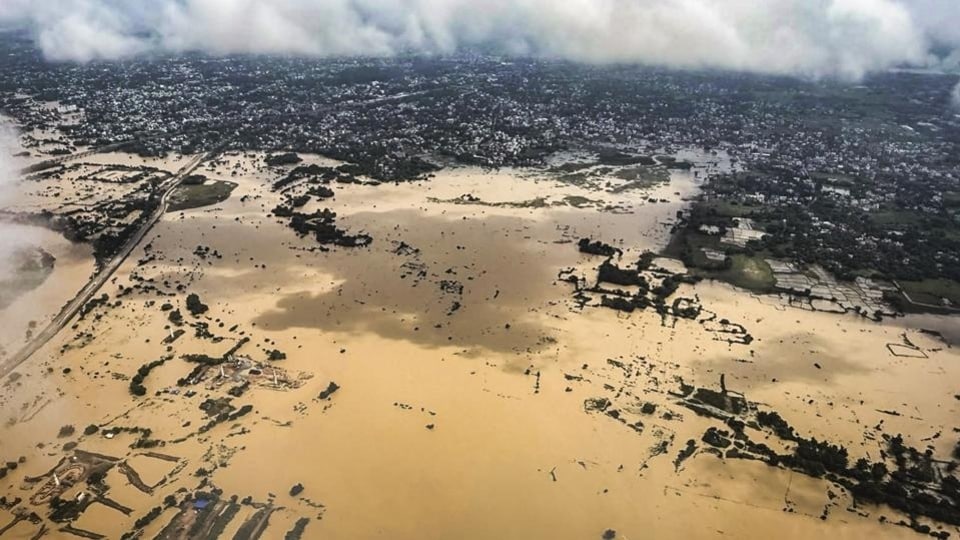
Odisha and states in the north-east such as Assam, Arunachal Pradesh, and Nagaland are facing floods currently. Parts of south Gujarat have also faced floods this monsoon, as have parts of Maharashtra near Mumbai. Floods and landslides have also been reported this July from Uttarakhand and Jammu and Kashmir. This would suggest that India has received its fair quota of intense rain this monsoon even if the monsoon overall is running dry. That is not the case. An HT analysis shows that higher intensities of rain are a bigger contributor to India’s rain deficit this monsoon season. How is this possible? The following charts explain how.
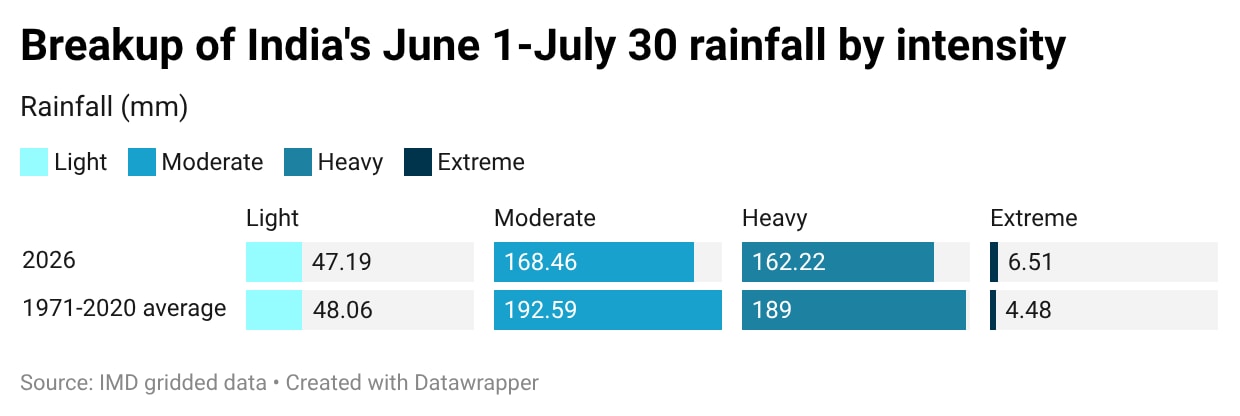
One simple reason for higher intensities of rain making a bigger contribution to rain deficit this monsoon is described here. Most of the contribution to India’s monsoon total – at least up to July 30 – is made by moderate or heavy intensity of rain. These are categories the India Meteorological Department (IMD) assigns to rain of 7.5-35.5mm and 35.6mm-244.5mm at a place in 24 hours, while rain of under 7.5mm is called light rain and that of more than 244.5 mm rain is called extreme rain. In the 1971-2020 period – the long period for which IMD averages rain to track rain’s performance – light rain had a share of 11% in India’s total rain, moderate and heavy intensities had shares of around 44% each, and extreme intensity had a 1% share.
Clearly, any percentage deficit in moderate and heavy intensities of rain will have a far bigger impact than the same percentage deficit in light or extreme rain. In other words, a big deficit in monsoon rain makes it more likely that the deficit is the result of a deficit in moderate or heavy intensity than light rain. That is indeed the case this year. Compared to the overall deficit of 11.5%, moderate and heavy intensities have deficits of 12.5% and 14.2% while light rain has a deficit of only 1.8% and extreme rain has a surplus of 46%.
The description above makes it somewhat clear why India on average is running a deficit because of a deficit in moderate and heavy intensity rain. However, they do not completely explain why India is experiencing rain related disasters in July. This aspect can be understood somewhat by looking at how much different places contribute to India’s Long Period Average (LPA) of moderate-to-extreme intensity rain volume and whether their contribution this year matches the required contribution.
As the accompanying map for usual contribution shows, the biggest contribution to moderate-to-extreme intensity rain is made by places along the west coast and by hilly regions in north-eastern states, Uttarakhand, and Himachal Pradesh. On the other hand, most places in Rajasthan, Gujarat, Tamil Nadu, or interior Karnataka are not expected to make a big contribution.

The broad geographical pattern is not drastically different from the usual this year, but some changes can be seen in the map for 2026 volume of moderate-to-extreme intensity rain. Parts of Rajasthan, Gujarat, and Odisha appear to be on the higher end of contributions. On the other hand, most 5% percentile levels – of moderate-to-extreme intensity rain volume received this year as a share of India’s LPA of such rain – seem to have shifted downwards. This suggests that most places have failed to contribute as much as they usually do. This can be seen in the map for the deviation in contribution. The deviation map also explains why some places are flooded and others are dry. Odisha, parts of Maharashtra, Gujarat, Uttarakhand, Assam, and Nagaland have made far more contribution to moderate-to-extreme intensity rain than they usually do.


Hence, most places in India are not getting the intensity of rain they should in the monsoon season. This explains why India is running a deficit in the monsoon season. However, small parts have ended up receiving more than their usual share of high intensity rain, which makes floods more likely.