
 E-Paper



Pragati: AI for Impact- Enabling entrepreneurs to educate, skill and build livelihoods at the last mile
This initiative showcases how inclusive AI developed by the OpenLinks Foundation, and The Apprentice Project is improving learning in India’s classrooms.

 Prefer HTon Google


AI has become integral to India’s policy landscape. From the National Strategy for Artificial Intelligence (2018) to the newly launched IndiaAI Mission, the government’s vision of “AI for All” reflects a strong top-down commitment to embed technology across sectors- education, healthcare, agriculture, and governance.
In education, particularly, the state’s digital efforts are visible through initiatives like DIKSHA, the National Digital Education Architecture (NDEAR), and the integration of AI in teacher training and adaptive learning systems. Some states have also begun incorporating AI literacy at the school level. Haryana, for instance, recently introduced AI as a compulsory subject from Class 9. These efforts create the foundational framework for an AI-enabled ecosystem.
But as India moves from policy to implementation, a deeper question arises: Can systems designed centrally respond effectively to the diversity of Indian classrooms?
The Case for a Bottom-Up, Context-Aware AI
Top-down approaches serve an important purpose. They set standards, allocate resources, and create common architectures for innovation. However, they also tend to assume that technology can be deployed uniformly across different contexts. The challenge is not intent, but fit.
The Annual Status of Education Report (ASER) 2024 highlights this through a rural survey that covered 6L+ children across 18,000 villages in 605 districts. While enrollment levels remain high, for above 95 percent of children aged 6–14, learning outcomes vary widely. Only 37 percent of Grade 3 children could read a Grade 2 text, and less than 30 percent could perform basic subtraction. Despite multiple national initiatives on foundational literacy and numeracy, these disparities persist across regions, income groups, and gender lines. The data reveals a systemic truth: scale alone does not ensure success.
Even well-intentioned, programmes risk losing traction if they fail to adapt to local realities.
Social-innovation ecosystem building for the last mile
India’s emerging social-innovation ecosystem is moving in this direction, where AI learns from users. These systems evolve through continuous interaction: observing how teachers teach, how students respond, and how local conditions shape learning behaviour.
Organisations like OpenLinks Foundation, Saarthi Education, and The Apprentice Project (TAP), which are part of Pragati: AI for Impact initiative led by Meta and The/Nudge Institute, are examples of this. Their approach complements policy-led infrastructure.
The OpenLinks’ Vinoba platform follows this logic of adaptive augmentation. It assists teachers in lesson planning, but its recommendations are shaped by accumulated evidence of practice- how teachers reorder activities, simplify concepts, or modify engagement styles. Over time, the algorithm internalises these behavioural cues, generating context-specific suggestions instead of standard templates.
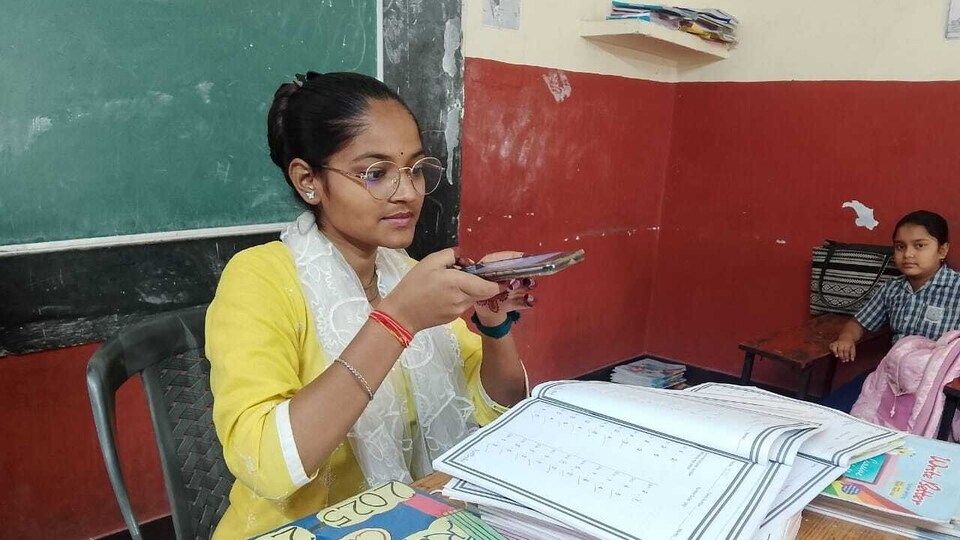
Saarthi Education addresses another structural challenge: the feedback gap in low-resource schools. In most government classrooms, limited access to digital infrastructure means assessment is paper-based, placing a heavy workload on teachers and leaving them with little time to provide timely insights to students about their learning progress. Saarthi’s AI numeracy model intervenes here. It scans handwritten worksheets, diagnoses misconceptions, and auto-generates remedial tasks, even without internet access. This makes AI viable within India’s infrastructural realities and helps redefine the unit of innovation, from “digital school” to data-enabled practice, where teachers and algorithms share responsibility for learning continuity.
The Apprentice Project (TAP) focuses on preparing students for a changing economy. Its AI-enabled WhatsApp chatbot delivers adaptive and personalised micro-modules in creativity, communication, and financial literacy. Beyond convenience, TAP’s contribution lies in behavioural analytics: the system tracks engagement patterns, what prompts sustain interest, where drop-offs occur, and adjusts its pedagogy accordingly. It functions less as a content app and more as a learning observatory, generating evidence about how underserved learners engage with abstract skills. For policymakers, this offers a new layer of insight: bottom-up behavioural data that can inform curriculum and skilling frameworks.
Together, these three models form a continuum of experimentation- from classroom design (OpenLinks) to foundational learning (Saarthi) to skill formation (TAP), each addresses a distinct systemic constraint. These initiatives align with the National Education Policy (NEP) 2020, reinforcing its focus on equitable, technology-enabled, and context-sensitive education across India's diverse learning environments.
What unites them is a design philosophy that treats intelligence as evolving: built through interaction, iteration, and error correction. Such models also shift the metric of success. The effectiveness moves away from just quantity to responsiveness - how well systems adapt to human behaviour. When algorithms are trained by teachers’ adjustments, children’s errors, and learners’ curiosity, they become repositories of collective intelligence. This moves India’s education technology from distribution to dialogue.
Towards a co-evolutionary model
India’s education policy and innovation ecosystems are not in opposition; they are complementary halves of a whole. Policy provides coherence and resources; grassroots innovation ensures relevance.
If top-down systems symbolise ambition to scale, bottom-up models such as OpenLinks, Saarthi, and TAP embody the discipline to learn. Together, they can define a trajectory for AI that is rooted in co-evolution.
The potential of AI in education will not lie in how fast it expands, but in how well it listens. The future belongs to systems that evolve through interaction, learn from diversity, and recognise that intelligence, whether human or artificial, is always contextual.
The organisations OpenLinks Foundation, Saarthi Education, and The Apprentice Project (TAP) are part of the Pragati: AI for Impact initiative by Meta and The/Nudge Institute. For more information, visit website.
Note to the Reader: This article is part of Hindustan Times' promotional consumer connect initiative and is independently created by the brand. Hindustan Times assumes no editorial responsibility for the content.


