E-Paper



In India, 38% kids under 5 are stunted, one in four girls is a mother before 20: Report

 Prefer HTon Google


NGO Save the Children’s End of Childhood Report 2018, released on Wednesday with data from 175 countries, shows 38.4% children below the age of five are stunted, a marginal improvement from 39% the previous year.
Two in five children below the age of five in India are stunted due to severe undernourishment, a global report has said, highlighting a stubborn problem in child health, which otherwise has shown improvement in India.
NGO Save the Children’s End of Childhood Report 2018, released on Wednesday with data from 175 countries, shows 38.4% children below the age of five are stunted, a marginal improvement from 39% the previous year.
Stunted children’s growth and development is impaired. Such children are vulnerable to repeated infections that can also effect brain development, which can create learning problems.
India’s battle with severe acute malnutrition (SAM) has been hard and long. The World Health Organisation defines it as a very low weight for height, visible severe wasting or the presence of nutritional oedema (swelling).
According to National Family Health Survey-4, about 7.5% of country’s under-five children are severely wasted, means they are underweight. The government has set up around 1,000 rehabilitation centres in its hospitals for such children as part of a string of initiatives under the National Health Mission (NHM).
National Health Mission aims to improve healthcare by strengthening primary infrastructure, with special focus on improving on mother and child.
Only 7-10% SAM children require hospitalisation and most are managed within the community. “It continues to be a challenge to manage these children but most states have extremely well-utilised rehabilitation services for these children, and there are protocols in place to provide quality care to them,” said Manoj Jhalani, mission director, NHM, Union health ministry.
“We are doing our best to ensure those states that are not able to optimally utilise these services also catch up.”
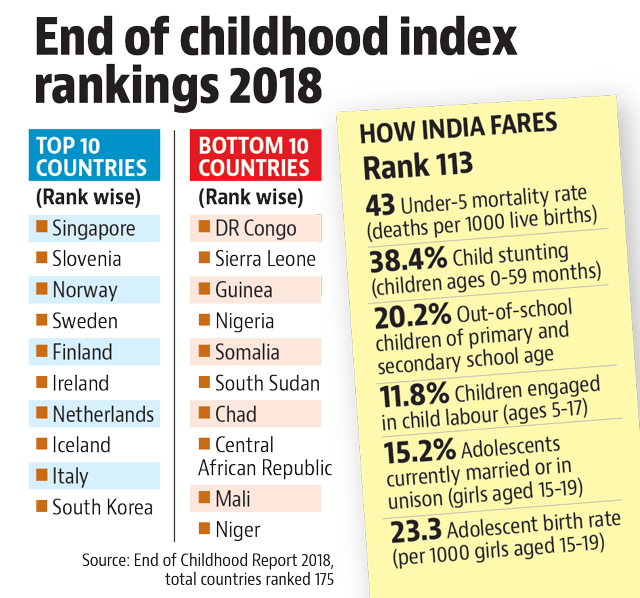
The second big challenge that emerges from the report is that of adolescent pregnancy. In India, the number of births per 1,000 girls aged 15-19 is 23.3%, which means almost one in four girls is a mother before she is even 20.
“It is alarming that adolescent pregnancy is still high in the country even though a girl is neither physically nor mentally prepared for it. Awareness generation is crucial if we want things to change,” said a senior gynaecologist at New Delhi’s All India Institute of Medical Sciences on condition of anonymity.
The good news, however, is that compared to 2017, India’s score has improved, from 754 to 768. “In South Asia, four out of eight countries improved their scores. Bangladesh made the most progress in the region… mostly by getting more children into school. India’s reduced rate of child marriage helped increase its score…,” says the report.