
 E-Paper



‘Warnings and precautions lower heat-related deaths’

 Prefer HTon Google


The number of heat-related deaths have fallen to almost a fifth between 2016 and 2017, according to provisional government data, falling from 1,111 in 2016 to 222
The number of heat-related deaths have fallen to almost a fifth between 2016 and 2017, according to provisional government data, falling from 1,111 in 2016 to 222 in 2017.
The reported deaths are significantly lower than 2,040 deaths from heat stress in 2015. Considering the average temperatures, both 2016 and 2017 were hotter years than 2015.
Kamal Kishore, a member of the National Management Disaster Authority (NDMA), attributed the fall in deaths to improved early warning system and better local preparedness.
The India Meteorological Department (IMD) has been working with local health departments to develop heat action plans and recommending measures to tackle heat stress. The weather agency also issues long range summer temperature outlooks and releases updates on heat wave hotspots on a weekly basis. Location specific heat index forecasts were issued for the first time in 2017.
“Our approach should be to have zero tolerance to heat wave deaths this year. We have ample time to revise our plan, launch awareness campaigns, and take preventive steps,” said RK Jain, another NDMA member.
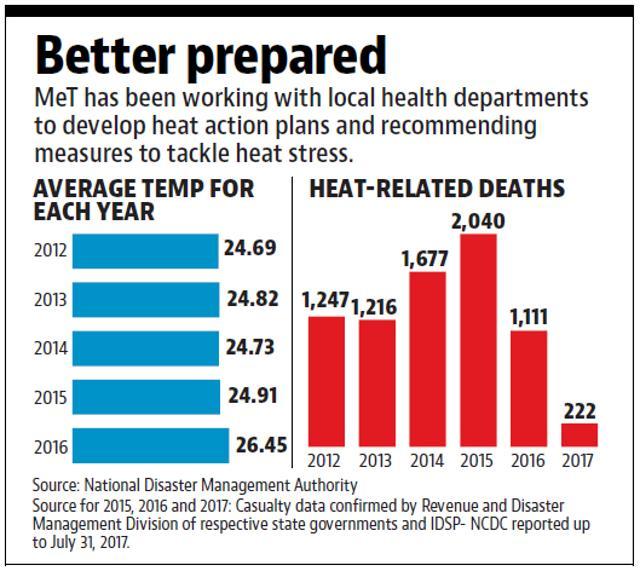
Heat-related deaths do not necessarily reflect average temperatures but rather exposure to extreme heat, with dehydration, heat and sun strokes being the leading causes of death.
Except for a dip in 2011 and a marginal decrease in 2013, the number of deaths have steadily increased every year from 2008 to 2015. This is partly a result of better reporting and also rising average temperatures fuelling more frequent and severe heat waves.
In India, heat waves usually occur between March and June, and in some cases even in July.
The core heat wave zone spreads over Punjab, Himachal Pradesh, Uttarakhand, Delhi, Haryana, Rajasthan, Uttar Pradesh, Gujarat, Madhya Pradesh, Chhattisgarh, Bihar, Jharkhand, West Bengal, Odisha and Telangana and parts of Maharashtra and Andhra Pradesh. Of these, Andhra Pradesh, Delhi-NCR, Gujarat, Haryana, Jharkhand, Maharashtra, Odisha, Telangana.


