Opposition parties have started collecting signatures for a fresh notice seeking the removal of Chief Election Commissioner (CEC) Gyanesh Kumar. Former Congress president Sonia Gandhi, Leader of the Opposition in the Lok Sabha Rahul Gandhi, Leader of the Opposition in the Rajya Sabha Mallikarjun Kharge and other Opposition floor leaders are expected to sign it, according to remarks by various party representatives.
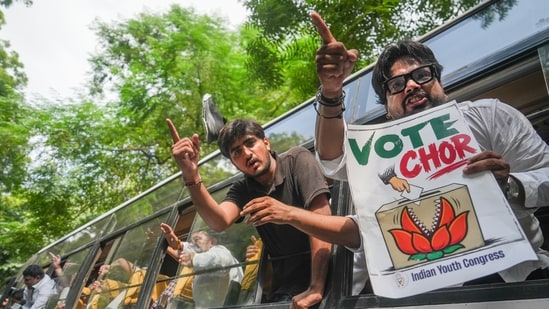
Earlier notices against Kumar were signed by Opposition MPs, and these leaders stayed off them because of the positions they hold in the House.
Derek O’Brien, the Trinamool Congress's leader in the Rajya Sabha, said on Thursday the notice would be moved in both Houses of Parliament.
The move follows an Indian Express report that the two election commissioners, Sukhbir Singh Sandhu and Vivek Joshi, raised formal objections at least 14 times in 10 months to decisions on the special intensive revision (SIR) of electoral rolls. The SIR is a fresh, house-to-house verification of voter lists. Groups critical of it say it has wrongly excluded voters in several states.
On Thursday, Rahul Gandhi demanded Kumar's immediate resignation. The Cockroach Janta Party, which led protests at Jantar Mantar in June and July, gave the CEC 48 hours to step down and threatened a nationwide agitation. The Election Commission has said all its decisions over the past year, including those on SIR, were unanimous decisions of the full commission.
Removing a CEC is among the hardest things Parliament can attempt. Removing either of the other two election commissioners needs no vote in Parliament at all. Here is how each process works, how a commissioner resigns, and what happens to the commission if its chief leaves.
The constitutional guarantee
{{/usCountry}}Removing a CEC is among the hardest things Parliament can attempt. Removing either of the other two election commissioners needs no vote in Parliament at all. Here is how each process works, how a commissioner resigns, and what happens to the commission if its chief leaves.
The constitutional guarantee
{{/usCountry}}Article 324 of the Constitution creates the Election Commission. Clause (5) protects its chief: “The Chief Election Commissioner shall not be removed from his office except in like manner and on the like grounds as a Judge of the Supreme Court.” Section 11(2) of the Chief Election Commissioner and Other Election Commissioners (Appointment, Conditions of Service and Term of Office) Act, 2023, repeats the rule. This is the law Parliament passed to govern the commission’s appointments and working.
The grounds and the vote come from Article 124(4), which covers Supreme Court judges. A judge “shall not be removed from his office except by an order of the President passed after an address by each House of Parliament supported by a majority of the total membership of that House and by a majority of not less than two-thirds of the members of that House present and voting has been presented to the President in the same session for such removal on the ground of proved misbehaviour or incapacity”.
The process is often called impeachment. The Constitution uses that word only for the President, in Article 61. For judges and the CEC, the term is removal.
Also read: CJP's nationwide protest from Oct 2 if CEC Gyanesh Kumar doesn't resign: Abhijeet Dipke
What counts as grounds for removal
Article 124(4) allows removal on two grounds only: “Proved misbehaviour or incapacity”. Neither the Constitution nor the Judges (Inquiry) Act defines either term.
The Supreme Court has described what misbehaviour covers. In C Ravichandran Iyer vs Justice AM Bhattacharjee (1995), a two-judge bench called it “a vague and elastic word”. The bench adopted a test Justice K Ramaswamy had set out in an earlier case: “Every act or conduct or even error of judgment or negligent acts by higher judiciary per se does not amount to misbehaviour. Wilful abuse of judicial office, wilful misconduct in the office, corruption, lack of integrity, or any other offence involving moral turpitude would be misbehaviour.”
The bench added that the Constitution's framers chose a cumbersome removal process, which “implies that impeachment process is not available for minor abrasive behaviour”. These rulings concern judges. The CEC inherits the judges’ grounds through Article 324(5), and no court has yet applied the test to a CEC.
The Judges (Inquiry) Act treats incapacity as being “unable to discharge the duties of his office efficiently due to any physical or mental incapacity”. The inquiry committee can order a medical examination to test it.
The Act also sets out when either ground counts as proved. Under Section 6, misbehaviour or incapacity is deemed proved only after an inquiry committee finds against the judge and both Houses adopt the motion by the special majority.
Until both steps are complete, the charges in a notice remain allegations, whatever the number of MPs who sign it.
Neither Article 324 nor the 2023 Act lists grounds for removing an election commissioner. The only standard is the one the Supreme Court set in a 1995 case that the CEC can recommend removal but it must rest on “intelligible, and cogent considerations” related to the commission’s efficient functioning.
From notice to removal, step by step
The first step is the notice. Section 3(1) of the Judges (Inquiry) Act needs the signatures of at least 100 Lok Sabha members or 50 Rajya Sabha members. It goes to the Speaker or the Rajya Sabha chairman.
The presiding officer then decides whether to admit it. The Act says the Speaker or chairman “may, after consulting such persons, if any, as he thinks fit and after considering such materials, if any, as may be available to him, either admit the motion or refuse to admit the same”. The Act sets no deadline for this decision and does not require reasons to be published.
If the notice is admitted, an inquiry follows. The presiding officer sets up a three-member committee: a Supreme Court judge or the Chief Justice of India, a high court chief justice, and a “distinguished jurist” chosen by the presiding officer. The committee frames definite charges, and the CEC gets to file a written defence, cross-examine witnesses and be heard. The committee has a civil court’s powers to summon people, take evidence on oath and demand documents. In an incapacity case, it can order a medical examination, and if the officer refuses, it may presume the incapacity alleged.
The committee's report is laid before Parliament. If it finds the CEC not guilty, “no further steps shall be taken” and the motion lapses. If it finds misbehaviour or incapacity, the motion and the report go to the House or Houses for a vote.
The vote needs a special majority in each House, in the same session: a majority of the House’s total membership, and two-thirds of members present and voting. Once both Houses adopt the motion, the Act treats the misbehaviour or incapacity as proved.
The final step is an “address”, a formal written request from each House to the President asking for the officer’s removal. Each House then presents its address to the President, and the President’s order removes the CEC.
Why filing in both Houses changes the arithmetic
A proviso to Section 3(2) of the 1968 Act deals with notices given in both Houses. Where notices “are given on the same day in both Houses of Parliament, no Committee shall be constituted unless the motion has been admitted in both Houses”. The Speaker and the chairman then form the committee jointly. Where the notices are given on different dates, “the notice which is given later shall stand rejected”.
A notice filed in both Houses on the same day therefore needs Speaker Om Birla and Rajya Sabha Chairman CP Radhakrishnan, who is also the Vice-President, to admit it. A notice filed in one House needs only that House’s presiding officer.
Also read: ECI postpones CEC Gyanesh Kumar’s 2 outreach events in UP, says no link to row
What happened in March
Opposition MPs submitted notices in both Houses on March 12. The Lok Sabha notice carried 130 signatures and the Rajya Sabha notice 63, both above the minimum. These were the first notices seeking a CEC’s removal. The notices cited Article 324(5) read with Article 124(4), Section 11(2) of the 2023 Act and the Judges (Inquiry) Act.
On April 6, Birla and Radhakrishnan refused to admit them. The Lok Sabha bulletin said the Speaker acted “after due consideration of the notice of Motion and a careful and objective assessment of all relevant aspects and issues involved therein”, in exercise of his powers under Section 3 of the 1968 Act. The Rajya Sabha bulletin used near-identical words. Neither bulletin gave reasons. Each presiding officer also issued a longer, reasoned order, circulated to the MPs who signed and was not made public. The March notices ended at the admission stage.
The two election commissioners have weaker protection
Election commissioners Sandhu and Joshi can be removed far more easily than Kumar.
The second proviso to Article 324(5) of says “any other Election Commissioner or a Regional Commissioner shall not be removed from office except on the recommendation of the Chief Election Commissioner”.
Section 11(3) of the 2023 Act repeats this. Removing an election commissioner needs no notice in Parliament, no inquiry committee and no vote. In SS Dhanoa vs Union of India (1991), the Supreme Court summed up the position, and said that election commissioners “can be removed on the recommendation of the Chief Election Commissioner, although not otherwise”.
The President makes the decision, and the CEC’s recommendation is a precondition for it.
BR Ambedkar, who chaired the Constituent Assembly's drafting committee, explained the clause in 1949. “We have left the matter to the President as to the circumstances under which he would deem fit to remove any other member of the Election Commission, subject to one condition that the Chief Election Commissioner must recommend that the removal is just and proper,” he had said.
The Supreme Court has limited the CEC’s side of that power. In TN Seshan vs Union of India (1995) case, a five-judge bench held that “the recommendation for removal must be based on intelligible, and cogent considerations which would have relation to efficient functioning of the Election Commission”.
Without that limit, the court said, the CEC “would become an instrument of oppression”.
The bench explained the gap in protection by pointing out that the CEC is a permanent incumbent, while election commissioners “are not intended to be permanent incumbents”.
A second route to ending a commissioner”s tenure bypasses the CEC entirely. Article 324(2) lets the President fix the number of election commissioners “from time to time”.
In October 1989, the President created two election commissioner posts and appointed SS Dhanoa and VS Seigell to them. On January 1, 1990, the President rescinded those notifications, abolishing the posts. Dhanoa challenged this, arguing that he could be removed only on the CEC’s recommendation.
But the Supreme Court upheld the abolition in 1991, holding that “it is a clear case of the abolition of posts and the termination of the service is a consequence thereof”. It also described the President’s power to reduce or abolish the posts as unfettered, and recorded that the CEC had never recommended their removal. The President exercises this power on the advice of the Union Council of Ministers, under Article 74 of the Constitution.
Sandhu and Joshi keep their posts unless Kumar recommends their removal and the President accepts it, or the President reduces the number of election commissioners.
How a commissioner resigns
Section 11(1) of the Election Commissioners (Appointment, Conditions of Service and Term of Office) Act, 2023, covers resignation for all three members. “The Chief Election Commissioner or an Election Commissioner may, at any time, by writing under his hand addressed to the President, resign his office,” it says.
The section attaches no conditions and sets no notice period. In practice, the law ministry publishes the President’s acceptance in the official gazette.
Election commissioner Arun Goel resigned this way on March 9, 2024, days before the 2024 Lok Sabha election schedule was announced. The gazette notification read: “In pursuance of clause (1) of Section 11 of The Chief Election Commissioner and other Election Commissioners (Appointment, Conditions of Service and Term of Office) Act, 2023, the President is pleased to accept the resignation tendered by Shri Arun Goel, Election Commissioner with effect from the 09th March, 2024.”
Election commissioner Anup Chandra Pandey had retired in February, so Goel’s exit left CEC Rajiv Kumar as the commission’s only member. Ashok Lavasa, an election commissioner who had dissented on several model code decisions during the 2019 general election, resigned in August 2020 and later joined the Asian Development Bank (ADB).
If the CEC's chair falls vacant
Neither Article 324 nor the 2023 Act names anyone to act as CEC during a vacancy. A new CEC can be appointed only through the process the 2023 Act lays down, whether the vacancy follows a resignation, a removal or the end of a term.
A search committee, headed by the Union law minister with two other members of secretary ranks, prepares a panel of five names.
A selection committee then recommends one person to the President. It consists of the Prime Minister as chair, the Leader of the Opposition in the Lok Sabha, and a Union Cabinet minister the Prime Minister nominates. Candidates must hold or have held a post equivalent to secretary to the Government of India and have experience in managing elections.
Under Section 7(2), an appointment is not invalid merely because the selection committee has a vacancy. The term is six years or until the age of 65, whichever comes first.
The commission itself keeps working with members missing. Article 324(2) provides for a CEC and “such number of other Election Commissioners, if any, as the President may from time to time fix”. After Goel's resignation in March 2024, the commission ran with one member until the selection committee appointed Kumar and Sandhu as ECs a week later. Kumar became CEC in February 2025.
Leaving office also does not expose a commissioner to lawsuits over official decisions. Section 16 of the 2023 Act bars courts from entertaining “any civil or criminal proceedings against any person who is or was a Chief Election Commissioner or an Election Commissioner” for anything done or said “in the course of acting or purporting to act in the discharge of his official duty or function”.