
 E-Paper



Black rain, burning skies, and the world's silence
This article is authored by Arpit Raj, founder, Diplomatic Threads, a think tank and media house focused on international relations and world geopolitics.

 Prefer HTon Google


Iran and Israel/US are at war but it is the civilian who pays the heaviest price. While missiles and drones dominate the headlines, the world is quietly sleepwalking into a devastating energy crisis, primarily in crude oil and LNG, whose consequences will be felt far beyond the battlefield.
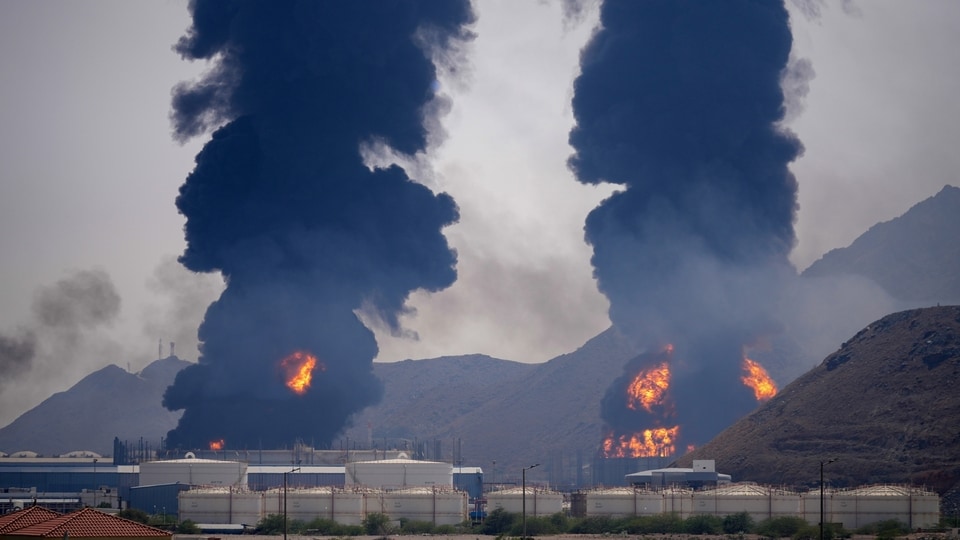
The US and Israel have systematically targeted and destroyed Iran's most critical energy infrastructure facilities that are not merely strategic assets but the economic lifeline of an entire nation. The list of destroyed or severely damaged sites reads like a who's who of global energy geography- Kharg Island which handles up to 90% of Iran's oil exports, the South Pars gas field, the world's largest natural gas reserve, the Shahr Rey oil refinery in Tehran, oil depots in Karaj and Saharan, the Asaluyeh oil facility, oil infrastructure in Alborz, Isfahan gas facilities, Bandar Anzali port and the Khorramshahr pipeline among many others.
In retaliation, Iran has struck back hard targeting the energy infrastructure of its neighbouring countries. The destruction has been sweeping: The Fujairah oil facility in the UAE, the Ras Laffan LNG terminal in Qatar the world's largest LNG production complex, the Ras Tanura oil refinery in Saudi Arabia, the Haifa oil refinery in Israel, the Mina al-Ahmadi oil refinery in Kuwait, the BAPCO refinery in Bahrain, an oil facility at the Port of Salalah in Oman and scores of others across the Gulf region.
The result is a global energy crisis of historic proportions, with Brent crude breaching $116 per barrel and European natural gas benchmarks surging by 24% in a single day. Ordinary families from Mumbai to Manchester, from Nairobi to New York are already feeling the pain at the pump and in their heating bills.
But beyond the geopolitics and the economics lies a humanitarian catastrophe that the world is almost entirely ignoring: Black rain over Iran.
The burning of thousands of tonnes of stored fuel across dozens of targeted facilities has produced a toxic atmospheric phenomenon--black, oily rainfall descending on Iranian cities, farmlands, and water sources. This is not a new phenomenon. The world has seen it before most devastatingly after the atomic bombings of Hiroshima and Nagasaki by the United States in 1945, and again during the 1991 Gulf War, when Kuwaiti oil facilities were set ablaze by retreating Iraqi forces, turning the Kuwaiti sky black for months.
The black rain falling on Iran is not merely an environmental inconvenience, it is a public health emergency. The pollutants it likely contains include benzene, acetone, toluene, and methylene chloride, all of which are known carcinogens. Short-term exposure causes lung, eye, and skin irritation. Long-term exposure causes cancer. Beyond human health, these compounds are contaminating vegetation, destroying crops, and poisoning rivers, reservoirs, and groundwater, threatening the food and water security of millions of civilians who had no say in this war.
The World Health Organization (WHO) has taken notice. Christian Lindmeier, WHO spokesperson in Geneva, has explicitly stated that the acidic rainfall in Iran, following the March 2026 strikes on oil facilities, poses significant dangers to public health particularly respiratory risks. He warned that toxic hydrocarbons and compounds from the fires are contaminating both air and water, advising residents to stay indoors.
At the United Nations, Iran's Permanent Representative, Amir Saeid Iravani, has raised the alarm about the catastrophic effects of black rain and how the US-Israel strikes are directly impacting the civilian population, a population that bears no responsibility for the decisions of its government.
Iran's geographic reality is making this disaster dramatically worse. The Alborz mountain range, which runs along northern Iran, creates conditions for temperature inversion--a meteorological phenomenon where a layer of warm air traps cooler, polluted air close to the ground, preventing it from rising and dispersing into the troposphere, Earth's innermost atmospheric layer.
In normal conditions, pollutants rise, disperse, and dilute. Under temperature inversion, which the Alborz range actively promotes, toxic air is locked in place, concentrating over populated areas like Tehran and surrounding cities. The mountains that have defined Persian civilisation for millennia are now, cruelly, acting as walls that trap poison over the people who live in their shadow.
What is most damning about this situation is not the destruction itself--wars, tragically, destroy things. What is damning is the silence.
Not a single major world power has issued a formal condemnation of the environmental and public health catastrophe unfolding in Iran. Not a single country has offered humanitarian assistance specifically addressing the black rain crisis. International environmental bodies have issued warnings, but warnings without action are merely words.
The civilians of Iran, the people breathing this air, drinking this water, watching their crops blacken are being failed not just by the warring parties, but by the entire architecture of international humanitarian law and global solidarity.
History will not judge this war solely by its missiles and military outcomes. It will also judge the world by what it chose to ignore.
This article is authored by Arpit Raj, founder, Diplomatic Threads, a think tank and media house focused on international relations and world geopolitics.


