
 E-Paper



Myanmar votes: Turning point or dead end?
This article is authored by Rajiv Bhatia.

 Prefer HTon Google


Elections in Myanmar for the two chambers of the parliament and regional assemblies will be conducted in three phases, beginning on December 28. The other two phases are scheduled for Janurary 11 and 25, 2026. This will be followed by the election of a new president. Should all go well, Myanmar’s military government is set to transfer power to a civilian government in April 2026, after a five-year hiatus of direct military rule following the February 2021 coup.
Optimists and well-wishers of the people of Myanmar hope that political forces and leaders, weary of turmoil, violence, and widespread hardship, will craft a modus vivendi to restore peace and stability in the country. How realistic is this optimism?
The nation has already paid a heavy price for the deep fissures that afflict it: between the military and civilian forces; between the military and Ethnic Armed Organisations (EAOS); and within the majority Bamar community. Two conflicting visions compete for the nation’s support: the Army leadership’s preference for “a disciplined democracy,” as enshrined in the 2008 Constitution, and the Resistance’s aspiration for “a Federal Democratic Union,” grounded in a new constitution which is yet to be drafted due to deep internal divisions.
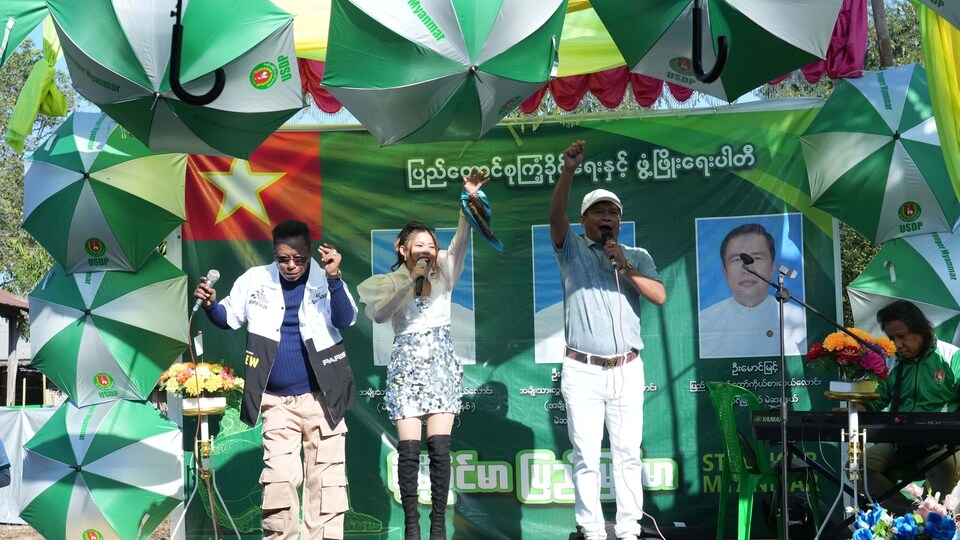
ASEAN’s diplomatic approach, driven by its Five-Point Consensus (FPC), envisaged a national dialogue between the two contending sides. But this never materialised because the army and the Resistance saw each other as arch adversaries. Hence, negotiation between the two was impossible. Now, however, elections could yield a new set of leaders and forces that may seek to work on the middle ground to craft a possible solution. The army is confident because, with the National League for Democracy (NLD) barred from the elections, the ‘King’s party’ – the Union Solidarity and Development Party (USDP) – is expected to win enough seats in the parliament to form a government and elect a president of its choosing. The Resistance is skeptical and pessimistic, ready to dismiss elections as “a sham”– a mere means for the generals to win some legitimacy for their illegal rule.
The situation on the battleground has gradually turned in favour of the military. There is much less fighting going on now than before. The military is better equipped and motivated, while the Resistance forces are short on resources, riven by disunity, and constrained by pressure from China. If military authorities hold successful elections in over 80% of townships, this will be perceived as a serious setback for the opposition. It may find that it has no alternative but to accept the hard reality: What you lose on the battleground cannot be won at the negotiating table.
The forthcoming elections are being compared to the November 2020 elections, which paved the way for Myanmar’s experiment with limited democracy for a decade. This was the system in which powers were shared between elected civilian representatives and the army. It worked so well for the first five years, 2011–2016, that the NLD, the nation’s most popular political party, was allowed to come to power in the next five years (2016–21), with Daw Aung San Suu Kyi serving as the State Counsellor, i.e., effectively as the Premier.
Daw Suu Kyi, now 80, has been in prison – often in solitary confinement – since February 2021. Will she have a role in helping the army put the nation back on the path to limited democracy? The younger generation of the opposition, especially from ethnic communities, contends that “the era of Suu Kyi is over.” Still, many in the majority Bamar community and a few minority groups disagree, arguing that she remains the most popular leader in the country. They note that her political influence is strong. As one of them put it, “If she is released and allowed to re-enter politics, she will be able to speak to the entire country.” What military planners have in mind for her future role is currently unknown.
Her younger son, Kim Aris, engaged in an international campaign to seek her early release, stated in a recent interview that he had not heard from her mother “in years” and believed that she was being held in Naypyidaw, the capital. The government criticised him for trying to disrupt the general elections but clarified that Daw Suu Kyi “is in good health.”
Finally, speculation is rife about the role Senior General Min Aung Hlaing may play in the political landscape after the elections. A widespread view is that he may be the next president. Official sources have indicated, at least by implication, that he has the experience, the desire, and the ability to proceed strictly in accordance with the Constitution to secure this goal. On the other hand, some experts believe that he may remain in his current position as Commander-in-Chief, with a loyal friend elevated to the presidency. Clarity will emerge only after the elections are over.
The international situation, too, has turned in favour of the military government. Several countries, including China, Russia, Belarus, Thailand, and India, have expressed support, either directly or indirectly. In April 2025, Prime Minister Narendra Modi, during a meeting with Myanmar’s top military leader, emphasised “the importance of early restoration of a democratic process through inclusive and credible elections.” India stands for advancing a Myanmar-owned and Myanmar-led transition towards a peaceful, stable, and democratic future.
The contrary view was expressed by the UK ambassador in New York, who told the UN Security Council meeting on 22 December, “Elections under present circumstances risk provoking further violence and make a long-term solution more elusive.|” A more even-handed assessment was presented by Julie Bishop, the UN Special Envoy for Myanmar, who reiterated the urgent need to cease hostilities to facilitate the delivery of humanitarian aid and to protect civilians. She suggested that Myanmar be kept on the global agenda and that the UN provide substantial support towards “a Myanmar-led, sustainable, inclusive and peaceful solution to the protracted crisis.”
It is ironic that, like neighbouring Bangladesh, Myanmar has seen its principal political party excluded from the forthcoming elections. While many in India have been passionately calling for the participation of the Awami League in the upcoming Bangladesh elections, virtually no voice is heard in favour of the NLD on this score. The reason: Political realities differ between the two countries, imposing their own compelling dynamics on policy planners and opinion-makers in India.
This article is authored by Rajiv Bhatia, Distinguished Fellow, Gateway House, former ambassador to Myanmar, and author of India-Myanmar Relations: Changing Contours (Routledge, 2016).


