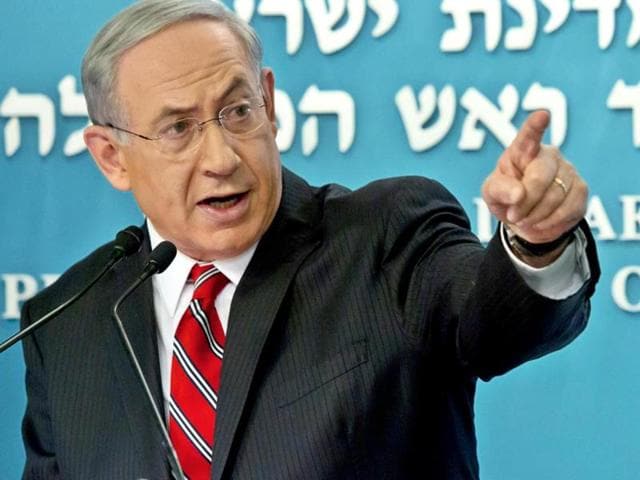
'The two countries are not only two democracies proud of their rich traditions but also are eager to seize the future’ — Israeli Prime Minister Benjamin Netanyahu’s opening remarks at his meeting with Prime Minister Narendra Modi, New York, September 28.
In view of the wide-ranging scope and depth of India-Israel relations today, encompassing as they do all spheres of human and bilateral endeavour, the mere fact that it is deemed necessary to remark on the meeting this week between the prime ministers of the two countries is in itself remarkable.
Looking back, it could perhaps be seen as strange that India and Israel were not drawn together from their very inception as modern nation states. Both countries had extricated themselves after a lengthy struggle from a common colonial power in more or less the same year. Both underwent a difficult and often bloody process of partition and found themselves in an unwanted conflict with the other side; both opted for democracy — somewhat uncommon in Asia at that time — as their chosen system of governance; and both had, then, viewed non-alignment as the optimal course which would facilitate their focus on internal development and nation-building.
And yet, the internal and external constraints that India was facing at that time, and which included India’s leadership of the non-aligned world together with Egypt’s Gamal Abdel Nasser, Israel’s most intractable adversary, compelled it to strike a course which brought it to a position diametrically opposed to that which Israel took.
Indeed, it was only in early 1992, after the collapse of the Soviet Union and the end of the Cold War, that formal diplomatic relations between the two countries were established. However, in the 22 years since the formalisation of relations, the ties have undergone an almost unprecedented metamorphosis in absolutely all fields — trade and investment both in the civilian and non-civilian spheres, agriculture, academia, industrial R&D, tourism, hi-tech, political relations and mutual social development. What is no less important is that the burgeoning relations took place under successive governments in India, both the Congress and BJP-led coalitions and thus was a policy agreed upon across the political spectrum. Indeed, an oft-forgotten fact is that the very establishment of full diplomatic ties was decided upon by a coalition led by the Congress.
{{/usCountry}}Indeed, it was only in early 1992, after the collapse of the Soviet Union and the end of the Cold War, that formal diplomatic relations between the two countries were established. However, in the 22 years since the formalisation of relations, the ties have undergone an almost unprecedented metamorphosis in absolutely all fields — trade and investment both in the civilian and non-civilian spheres, agriculture, academia, industrial R&D, tourism, hi-tech, political relations and mutual social development. What is no less important is that the burgeoning relations took place under successive governments in India, both the Congress and BJP-led coalitions and thus was a policy agreed upon across the political spectrum. Indeed, an oft-forgotten fact is that the very establishment of full diplomatic ties was decided upon by a coalition led by the Congress.
{{/usCountry}}While the reasons for the establishment of formal relations can be easily identified, it is more difficult to pinpoint exactly why they took off in the way they did. The answer lies in a conglomeration of factors, including the complete absence of any anti-Semitism in India, the fact that India had never adopted the hardline attitude calling for an end to the Jewish State, the groundswell of support for Israel including in political and media circles and the placing of agricultural and technological development at the pinnacle of both countries’ agendas in the understanding that enhanced cooperation is mutually beneficial.
Observers of India-Israel relations dwell at far too much length on the defence aspects of these. And indeed, both countries, as well as all civilised democracies the world over, share strategic concerns originating from extremism in Pakistan and West Asia. It was, of course, by design not accident that the carnage perpetrated on Indian soil by terrorists emanating from Pakistan in November 2008 aiming to kill Indian civilians, was also directed at only one other foreign country — Israel.
Yet undoubtedly, the strength and contribution of India-Israel relations lies elsewhere — in the cooperation between the two countries in all forms of innovative agricultural techniques, water conservation, water usage and water management and the application of hi-tech models designed to produce higher crop yields for the Indian farming community. In a country where close to 800 million people live off the land, the cooperation between Israeli and Indian agricultural experts in the adaptation of drip irrigation systems and other technologies combined with establishing Agricultural Centres of Excellence have the capacity to bring about a true revolution for Indian farmers.
And yet, among all these dynamic activities, high level political dialogue has always lagged behind, perhaps due to perceived rather than actual negative repercussions that this might have inside India. Here lies the anomaly, here lies the need to remark on what would be ordinarily run-of-the-mill diplomacy between two countries with such a vast common agenda and here lies the significance of the meeting this week between Modi and Netanyahu. India today is a global player and while it may not always agree with Israel’s policy in West Asia, this will not detract from the complete support by Israel of India’s position on Kashmir. It is not necessarily that any new major agreement was entered into, rather that two friendly countries should and must carry out the highest-level political dialogue, and when such a meeting will become unremarkable, we will know that the ties are not only flourishing but also normal.
Mark Sofer is president, Jerusalem Foundation, and former Israeli ambassador to India.
The views expressed by the author are persona.