
 E-Paper



Global experts unite to address surgical inequities in Indian urban slums
Surgical Accredited & Trained Healthcare Initiative (SATHI) programme, a pioneering healthcare model, has emerged as a game-changer

 Prefer HTon Google


The Lancet Commission on Global Surgery estimates that five billion people worldwide lack access to safe and affordable surgical care, with common conditions such as hernias, cataracts, and traumatic injuries remaining untreated due to financial barriers, trust deficits, and lack of primary care compounded by patchy universal healthcare. However, success stories like Mumbai’s Dharavi slums’ effective control of Covid-19 demonstrated how education and community determination can foster self-reliance in healthcare and positively impact the broader society.
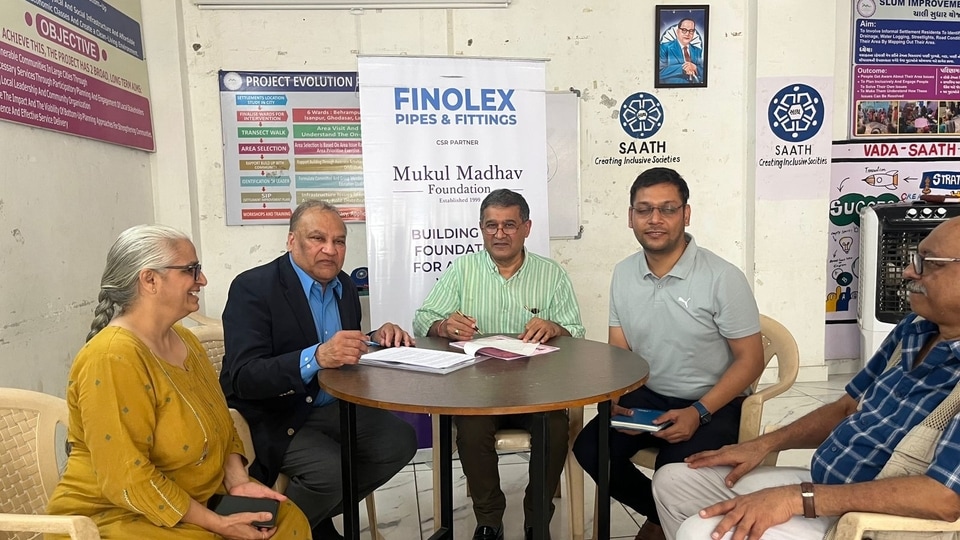
The Surgical Accredited & Trained Healthcare Initiative (SATHI) programme, a pioneering healthcare model developed collaboratively by international and regional experts, has emerged as a game-changer in addressing surgical inequities. By combining grassroots empowerment by removing entrenched trust-deficit, it has showed that one can achieve a remarkable 60% conversion rate from unmet to met surgical needs.
The genesis of SATHI: An international team uniting for a common cause
In 2018, a remarkable international collaboration began when Prof Rahul M Jindal, an Indian-American transplant surgeon and humanitarian, envisioned SATHI. Prof Jindal found a kindred spirit at a US conference in Prof Dileep Mavalankar, director of Indian Institute of Public Health Gandhinagar. Prof Mavalankar brought his own impressive global credentials to the partnership. He is an alumnus of Gujarat University as well as Johns Hopkins University.
The vision expanded when Prof Jindal travelled to India, where Prof Mavalankar introduced him to Kranti Vora, another alumnus of Johns Hopkins University, who is a professor of public health and an expert in curating population databases, creating a powerful triumvirate of medical expertise spanning continents.
The team’s expertise grew with the addition of Rajendra Joshi, founder of SAATH. His extensive work in integrated slum development provided crucial grassroots perspective. The project received vital support through Prof Jindal’s Fulbright-Nehru Distinguished Chair.
The initial cross-sectional study done by Prof Kranti Vora with the help of on-ground researchers Falguni Salvi, Bhavesh Vora, Shahin Saiyed, and Hansaben revealed a critical need — 39% of surgical requirements in slums remained unmet despite existing healthcare schemes. This finding catalysed the team’s focus on training community health workers as cultural and medical bridges between communities and healthcare providers.
The coalition was further strengthened with the addition of Dr Keyur Buch, a distinguished orthopedic surgeon whose 25-year practice spanned across the UK, the US, and India. The turning point came when Dr Buch’s outreach led to a strategic partnership with the Mukul Madhav Foundation in London, spearheaded by Ritu Prakash Chhabria, co-founder and managing trustee. Facilitated by Nitul Barot, this alliance unlocked new avenues for impactful change.
The SATHI model
The SATHI model strategically developed its curriculum through a collaboration of international experts. Rahul Jindal initiated this by engaging Lyndsay S Baines, PhD, who brings extensive credentials as programme lead for Global Health Diplomacy & Security at the University of Oxford in the UK. Her prior collaboration with Prof Jindal during pioneering kidney transplants in Guyana and Suriname made her an ideal choice for curriculum development.
The curriculum team was further expanded with the addition of Dr Mehr Muhammad Adeel Riaz, a Pakistan-based physician specialising in trans-disciplinary research in gender/sexual minority rights and Dr Berjo Dongmo Takoutsing from the Research Department of the Association of Future African Neurosurgeons in Yaounde, Cameroon. They worked on the curriculum modules for the SATHI training programme, focusing on rapport building within communities and understanding sociocultural barriers to surgical care-seeking behaviour.
Prof Kranti Vora, Falguni Salvi and Raju Param (SATHI supervisors) helped create modules that addressed how factors like caste, gender, religion, and sexuality influence healthcare access. Under the leadership of Dr Buch, a strong execution team consistently reached out and educated the slum-dwellers, helping in building their trust.
This comprehensive approach enabled community health workers to deliver impactful care that transcended measurable metrics, focusing on building trust and providing meaningful support to their communities. The programme was introduced in 2018. This is believed to be the world’s biggest government-funded health insurance programme covering more than 100 million of India’s poorest families of which 40% of the population will get free health coverage for secondary and tertiary hospitalisation.
Central to SATHI’s success is its reliance on community workers who belong and live within the very communities they serve. These women, many with only basic education, were trained to:
1. Identify surgical needs within their communities
2. Provide basic first aid and post-operative care
3. Navigate patients through complex healthcare systems
4. Address cultural and emotional barriers to surgical care
Impact and a global template for change
The SATHI model has expanded from the pilot to serve approximately 50,000 more individuals across 10,000 households and eventually to 350,000 slum-dwellers, demonstrating a scalable solution for addressing surgical inequities in low-income settings globally.
Challenges and sustainability
Despite its success, the programme faces challenges in sustainability. Prof Jindal emphasised the need for government support and integration into current public health systems.
Rajendra Joshi believes that a programme like this should be taken over by the Indian government, just like the well-known and acclaimed Accredited Social Health Activist (ASHA).
Dr Riaz and Prof Mavalankar suggested public-private partnerships and expanded data collection to attract long-term investment.
A call to action
Policymakers, investors, and global health organisations must:
1. Increase funding
2. Enhance trust
3. Strengthen data collection
4. Encourage public-private partnerships
For investors and policymakers, the message is clear: supporting initiatives like SATHI is not only a moral imperative, but also a strategic investment in building healthier, more resilient communities.
The authors of this article are a business, cybersecurity and risk governance consultant, and a thought leader.
(*Partnered Content)


