
 E-Paper



10 years on, Bengaluru Metro project still on slow track
The delay in completion of the Metro project has forced over 12 million residents of Bengaluru to depend on private transport for commuting in the city. There are at least 9.4 million vehicles that ply the roads of Bengaluru, according to the Department of Urban Land Transport (DULT).


Exactly 10 years ago, the first 7 kms stretch of the Bengaluru metro between Byapanahalli and MG Road was flagged off, raising the hope of a city that was plunging deeper into chaos over the rise of private vehicles. However, till date, only 64 kms are operational so far.
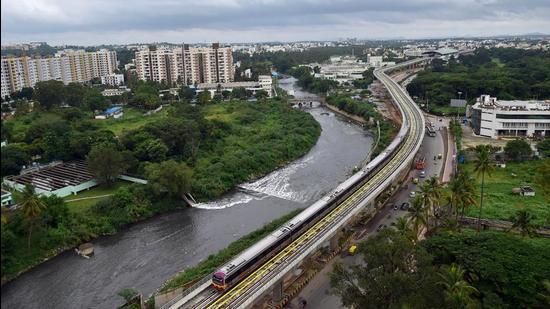
The delay in completion of the Metro project has forced over 12 million residents of Bengaluru to depend on private transport for commuting in the city. There are at least 9.4 million vehicles that ply the roads of Bengaluru, according to the Department of Urban Land Transport (DULT).
Managing director of Bengaluru Metro Rail Corporation (BMRCL) while lauding the people of Bengaluru and the staff for their cooperation agreed that there is still a lot of work to be done. “Today Bengaluru Metro, BMRCL (Bengaluru Metro Rail Corporation Limited) has completed 10 years. On 20 October, 2011, the first line started. Today 10 years have been completed and this has been done with the cooperation of the people of Bengaluru, those who have lost their lands (for the project) and our employees and we have been very successful in giving this service,” Parvez said on Wednesday. He added that there was still a lot of work to be done as only 64 kms are operational so far.
Till now, only the green line between Yelachenahalli and Nagasandra as well as the purple line between Byappanahalli and Kengeri are operational .
The ridership of the Metro is in the range of 500,000 per day as against the BMTC, which during pre-Covid-19 accounted for over 4 million passengers or over 40% of the city’s commuters.
Work for the Metro began in 2007 and the slow pace of work so far have resulted in just under 5 kms of operational lines being constructed per year.
Parvez said that works are in progress and subsequent phases would take the total length to 175 kms across a city that expands to over 800 square kms by December 2024.
This would mean that the agency would have to construct and operationalise 55 kms per year for the next two years or 10 times more than what it has achieved over the last 13 years (10 years since the first line became operational and 13 years since the metro works started)
In a recent interview to Hindustan Times, Parvez said that the first phase was a learning experience and that the subsequent phases will progress faster.
Each year of delay adds a minimum of 5% to the overall cost of the project, according to senior metro officials.
The remaining phases include extension of lines towards the Bengaluru International Airport from Silk Board, one of the most congested junctions in the city, if not in the country.
The ₹15,767 crore suburban rail project, another proposed solution to decongest Bengaluru, is scheduled to be completed only by 2026.
Metro officials said that over 1.41 lakh vehicles have been taken off the road, leading to savings of over 13.25 lakh vehicle kms since the metro has been operationalised.
The dependence on private vehicles have increased over the course of the last year and a half as people have stayed away from the public transport due to Covid-19.
The poor quality of roads, inadequate public transport, increase of private vehicles has also added to the city’s crumbling infrastructure with promises on mass mobility solutions remain a distant and delayed dream which has caused more hardships due to addition of bottlenecks to the already nasty traffic snarls. With most of the roads dug up currently in Bengaluru in the name of “smart city” and other developmental projects, the dust and vehicular emissions have taken a toll on the general quality of life due to air and water pollution.


