
 E-Paper



150.5 million tonne kharif foodgrain output projected
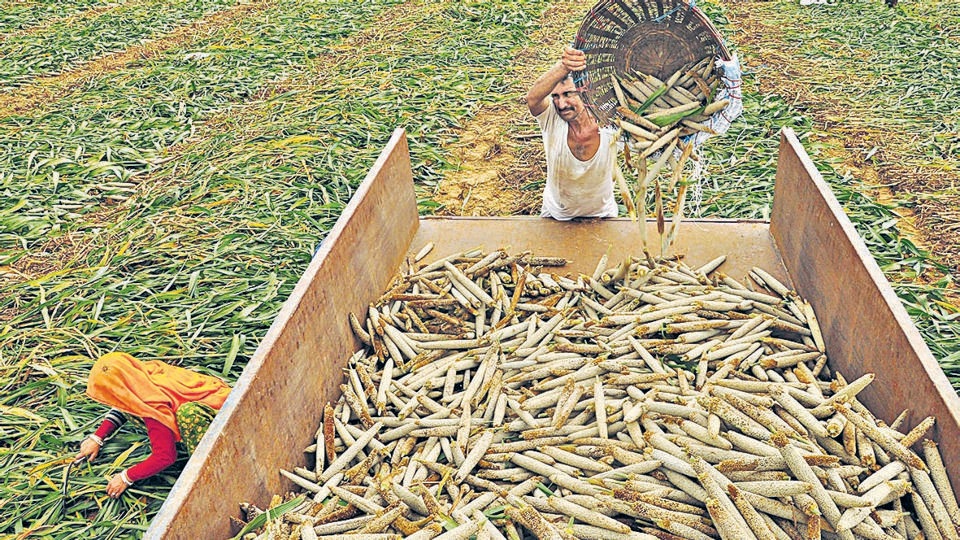
Coarse cereals output, such as oats and pearl millets, are set to be nearly 34 million tonne, higher by 2.11 million tonne than the five-yearly average production of 31.89 million tonne.

 Prefer HTon Google


New Delhi: India has projected a record foodgrain output of 150.5 million tonne from summer crops (2021-22) despite an erratic monsoon, up 4% from the previous year, official estimates on Tuesday showed.
The government’s first of the four quarterly estimates of food production, a key indicator of the country’s farm sector that employs half of all Indians, pointed to plentiful harvests of rice, coarse cereals, maize, higher pulses, oilseeds, etc.
Farm-produce output and agricultural gross domestic product (agri GDP) was robust in 2020-21, too, when the wider economy came to a standstill due to strict Covid-19 restrictions, pointing to resilience of the rural sector.
Robust food output will likely keep a lid on food inflation. Overall inflation levels of between 4-6% offer the Reserve Bank greater flexibility in adjusting its monetary policies to keep the country’s nascent economic recovery on track. However, gluts in some items tend to send food prices crashing, which hurts farmers’ incomes.
Still, these are early projections subject to revision when final production figures at the end of the harvest season become available. According to the so-called first advance estimates 2021-22, rice output is estimated to be 107.04 million tonnes, up 5 million tonne from the previous year.
Coarse cereals output, such as oats and pearl millets, are set to be nearly 34 million tonne, higher by 2.11 million tonne than the five-yearly average production of 31.89 million tonne.
According to Tuesday’s official data, the production of pulses is estimated to be 9.4 million tonne, largely the same as last year. Pulses are among a clutch of items that tend to stoke food prices, along with oilseeds or edible oil.
Summer oilseeds are pegged at 23.39 million tonne, higher by 2.96 million tonne than the five-year average oilseeds production of 20.42 million tonne. India will still have to import edible oils, as it routinely does, to meet domestic demand.
The data also estimated record sugarcane output of 419.25 million tonnes.
“The estimates will undergo revision later, but they point to good harvests. However, the trends are more or less similar as earlier. Cereals tend are higher than non-cereals,” said Abhishek Agrawal of Comtrade, a commodities firm.
The latest kharif output figures show India’s agriculture sector appears to have emerged unscathed during the second Covid-19 wave, just as it had during the first outbreak in 2020.
In 2020, when the country faced a recession, agriculture was the only sector to record positive growth. It grew 3.4% in the June 2020 quarter, when the overall economy shrank 24.4%. When all-India growth returned to positive territory in the December 2020 quarter, expanding 0.4%, agriculture grew higher at 3.9%. Two years of back-to-back normal monsoon (2019 and 2020) was also to record farm output.


