
 E-Paper



Chhattisgarh: Two commanders among Maoists killed in Kanker; nine identified
The exchange of fire also marks a clear upsurge in aggression from security forces in Chhattisgarh in 2024, with 79 Maoists killed in the year already

 Prefer HTon Google


A day after there was a fierce encounter in Chhattisgarh’s Kanker district in which 29 Maoists were killed, senior police officials said they had identified nine of the dead, of whom two are key commanders Shankar Rao and Lalita Meravi, and that there were 15 women cadre among those that had perished in the exchange of fire.
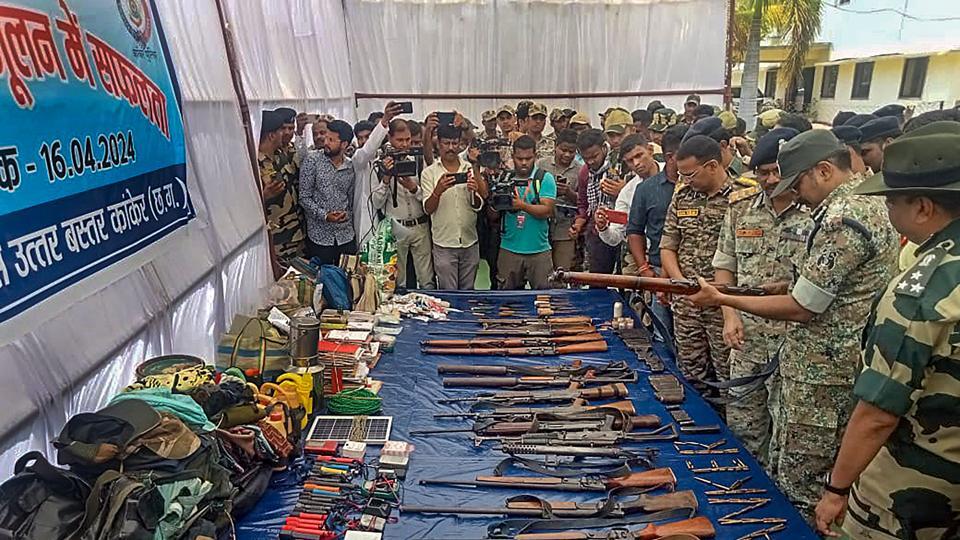
Senior officers also said that the North Bastar division of the Maoists, that operate in the Kanker region had been dealt a significant blow, and in the process of acting on specific intelligence that led to the encounter, they had likely foiled a Maoist plot to carry out “violent activity.” The two seats in Bastar division of Chhattisgarh go to the polls in the first two phases of the Lok Sabha elections—Bastar Lok Sabha seat will vote on April 19, and Kanker on April 26.
Tuesday’s encounter, that took place in the Binagunda-Korragutta forests under the Chhottebetiya police station limits, marks the most significant single incident blow to the rebel in eight years, and the biggest ever in Chhattisgarh. The exchange of fire also marks a clear upsurge in aggression from security forces in Chhattisgarh in 2024, with 79 Maoists killed in the year already, much higher than the 22 killed in 2023. 55 Maoists have been killed since February 25 alone with 13 killed in Bijapur in another encounter on April 2.
Senior police officers said that while they were in the process of identifying the other cadre that were killed on Tuesday, Shankar Rao and Lalita Meravi were both divisional committee members of the north Bastar division of the CPI(Maoist), who carried rewards of ₹8,00,000 on their heads. “The rest are likely from the Partapur area committee of the CPI(Maoist) and the People’s Liberation Guerilla Army,” a senior police officer said. Three security personnel were injured in the encounter, but have been declared out of danger.
Read Here | Amit Shah reacts to Chhattisgarh anti-Maoist operations: ‘Over 80 killed….’
Rao was a key military link in the North Bastar division of the Maoists — that operates in the Kanker district, and was originally a resident of Warangal in Telangana. “He used to operate in the Partapur, Badgaon, Koylibeda, Siksod, Durgkondal and Chhotebetiya areas. His wife, Ranjita is also an active member of the Partapur area committee. He is trained in handling AK 47, INSAS, SLR rifles and jungle warfare, and his name appears in at least 50 cases of Maoist attack across districts. Lalita was also the head of the janatana Sarkar of the North Bastar division and carried an INSAS rifle. She had an excellent information network and is known for her planning capabilities,” a senior police officer said.
The other seven were identified as Madhvi, Ramshila, Ranjitha, all divisional committee members of north Bastar, Jugni, Sukhlal, Shrikant, from the Partapur area committee and Rupi, a commander of the Medhki local organisation squad), said Kanker superintendent of police Indira Kalyan Elesela.
“Twenty-two weapons, including one AK-47 rifle, two Insas rifles, one Self-Loading Rifle (SLR), one carbine, three .303 rifles, two .315 bore rifles, two 9MM pistols, two country-made launchers, eight muzzle loading guns, one country-made hand grenade and a huge cache of ammunitions were recovered from the encounter site,” he said, outlining what is a significant haul for the forces.
P Sunderraj, inspector general of police (Bastar) said that the encounter is a big dent for the north Bastar division. “Villagers in the area where the encounter happened suffered from Maoists collecting illegal levy, and some parts were a safe haven for Maoists. After this encounter, the Maoists have lost significant strength,” he said.
Read Here: Chhattisgarh Police announce ₹5 lakh reward for intel on Naxals
The IG also said that the intelligence inputs that the security agencies received and acted on, could have prevented a Maoist conspiracy to carry out violence during the Lok Sabha polls in the district. “Even in the assembly elections, we made proper security arrangements and they were not able to execute a big incident. We now hope that the elections in Bastar and Kanker will be completed peacefully,” he said.
The political firestorm over the encounter however continued on Wednesday, with former Chief Minister Bhupesh Baghel saying that his Congress government had also acted decisively against Maoists, but that security action in the BJP regime were under a cloud of doubt. “There were many fake encounters during the 15 years of BJP rule(before Baghel took oath in December 2018) which did not happen in our regime. Tribals are being threatened that they will be arrested,” he said.
State Congress chief Deepak Baij said that the increased aggression had led to residents of Bastar feeling unsafe. “Fake encounters have increased and cases are being registered against people in the name of being Maoists. Since this government has come to power, tribals in Bastar feel worried,” he said.
But deputy chief minister Vijay Sharma, who also is in charge of the home department, dismissed any suggestions of a fake encounter, and attacked the Congress for making such allegations. “It is sad to hear Bhupesh Baghel, a former chief minister of the state, saying this. The soldiers who were hurt, were they falsely injured? All the weapons that have been recovered, are they fake? The Maoists were all wearing uniforms, can that be fake? All the Maoists killed in the operation were hardcore Maoists,” he said.
-kW0H-U20214218012MgB-250x250%40HT-Web.jpg)


