E-Paper



2022: Year of border deals, flare ups in northeast
Assam and Meghalaya resumed talks in August to sort out disputes in the remaining six “complicated” areas of border dispute


Deals to end border disputes in the northeast and flare ups along disputed boundaries remained in the headlines this year. Border talks between Assam and Meghalaya, which share an 885-km-long boundary, gathered pace at the beginning of the year. The two states constituted regional committees for six of the 12 disputed areas suggesting a “give and take” formula to resolve the dispute.
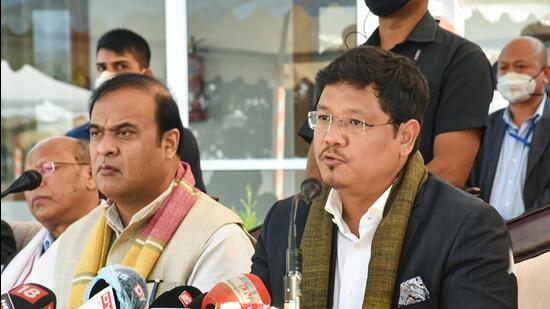
Assam chief minister Himanta Biswa Sarma and his Meghalaya counterpart, Conrad Sangma, this year signed an agreement in New Delhi in presence of Union home minister Amit Shah. The two sides agreed that of the total 36.79 sq km of disputed land, Assam would get 18.51 sq km and Meghalaya 18.28 sq km.
Assam and Meghalaya resumed talks in August to sort out disputes in the remaining six “complicated” areas of dispute.The two sides agreed to form three regional committees each, which would visit the disputed sites, talk to local residents and submit reports based on factors such as administrative convenience and geographical contiguity.
Amid the breakthrough, six people including five Meghalaya residents and an Assam forest guard were killed on November 22 in a firing incident at Mukroh on the border between the two states.
Meghalaya accused Assam’s forest guards of resorting to “unprovoked” firing in the state’s West Jaintia Hills district. Assam claimed the firing took place in its West Karbi Anglong district and that forest personnel resorted to it to save their lives from “unknown miscreants” smuggling timber.
The two states ordered separate inquiries and appealed to the Centre to hand over its probe to a neutral agency. In December, the Meghalaya high court ordered an interim stay on its implementation till February 6.
Talks between Assam and Arunachal Pradesh to sort their border dispute separately gathered pace. The two states signed the Namsai Declaration and agreed to form 12 regional committees to resolve the issue.
Assam and Arunachal Pradesh share an 804 km long boundary. There was no dispute initially. Over the years there have been allegations of encroachment of land that have led to violence. A suit has been pending in Supreme Court since 1989 on the issue.
In September, Sarma and his Mizoram counterpart, Zoramthanga, also met in New Delhi and agreed to form a regional committee to resolve their long pending boundary dispute.
Since August last year, Assam and Mizoram have held ministerial-level meetings to discuss the dispute. Both states earlier agreed to maintain peace and harmony along their boundaries and solve the issue through dialogue.
Mizoram shares a 164.6 km long border with Assam. It was carved out as a union territory from Assam in 1972. The border dispute is related to two colonial notifications of 1875 and 1933. Assam insists on the finality of the 1933 boundary. The border dispute has led to skirmishes, especially since 1994.
In July last year, police forces of the two states exchanged fire along the disputed border and left six policemen and a civilian from Assam dead.
Eviction drives in Assam also remained in the headlines from the region. The biggest such exercise was carried out in Nagaon this month to clear around 330 acres of encroachers settled around Batadraba Than, the birthplace of Srimanta Sankardev, the 15th-16th century saint-scholar and socio-religious reformer.
The state government told the assembly in September that 4,449 families have been evicted for allegedly encroaching on government land since May 2021 when the Bharatiya Janata Party (BJP)-led government took office for the second time.
The highest number of 2153 families were evicted in Darrang followed by 805 families in Lumding and 404 from government land in Dhubri. Most evictions have been peaceful.
Two people were killed in police firing and nearly 20 others injured at Dholpur in September last year in clashes between police and residents during one of the first such drives.
The Assam Police also made a series of arrests of suspects allegedly with links to Bangladesh-based terror outfits and al-Qaida in the Indian Subcontinent (AQIS). The arrests followed demolitions of their homes and seminaries.
This month, Sarma told the assembly that 53 such suspects were arrested since March. In August, three seminaries were demolished within days of arrests of persons connected to these institutions for alleged links to AQIS and other terror groups.
The seminaries were razed soon after the arrests of people connected to them. But the orders for them said the buildings were razed as they were structurally vulnerable, not safe for human habitation, did not conform to building guidelines, were constructed without permission on government land, or had illegal electricity connections.
Like last year, deaths in police action also remained in the news in Assam in 2022. This month, the government admitted in the assembly that 30 persons have been killed and 12 others injured in such actions over two years. But it stressed that none of them were encounters—a term used to describe extrajudicial killings.
In June, the government submitted an affidavit in the high court saying 51 people died and 139 others sustained injuries in police action between May 2021 and May 2022.
In the affidavit filed following the high court’s directions on a plea of lawyer Arif Jwadder for a federal inquiry into the deaths, the government said the deaths were “accidental” while the accused “were escaping from police custody”.
In poll-bound Tripura, clashes between followers of political parties as well as shifting loyalties of legislators and leaders continued to hit headlines this year.
On Wednesday, ruling BJP legislator Diba Chandra Hrankhawl quit the party. He became the fifth BJP lawmaker to do so.
In Arunachal Pradesh, one Miram Taron was handed over to India nine days after he went missing in January along the de facto border with China. He claimed China’s Peoples Liberation Army (PLA) tortured him.
On December 9, there was a skirmish between the Indian Army and PLA along the Line of Actual Control in Arunachal Pradesh’s Tawang which “led to minor injuries to few personnel from both sides”.
In Mizoram, refugees from Myanmar arrived in the state following the military coup in the neighbouring country. Mizoram hosts nearly 40,000 Myanmar nationals. Hundreds of Bangladeshis also entered the state.
In Nagaland, hopes of the peace talks ending with the signing of an agreement remained unfulfilled. NSCN-IM stuck to its demand for a separate constitution and flag for the state.
As the state gears for assembly poll, the Eastern Nagaland Peoples’ Organisation (ENPO), which represents seven tribes, sought creation of a new state. An ENPO team met Shah in this regard. A home ministry team visited the state to study the demand.