
 E-Paper



Ecostani: Slow trials, no convictions in paper leak cases hurt govt’s reform record
According to government data, around 862 fast track courts (FTC) and 775 fast track special courts (FSTC) operate across states and union territories

 Prefer HTon Google


The resignation of Dharmendra Pradhan as the Union education minister ended the raucous country-wide protests led by the Cockroach Janta Party (CJP) against lapses in examination governance. But, clearly, much more needs to be done to end the rampant leaks of examination papers in India.
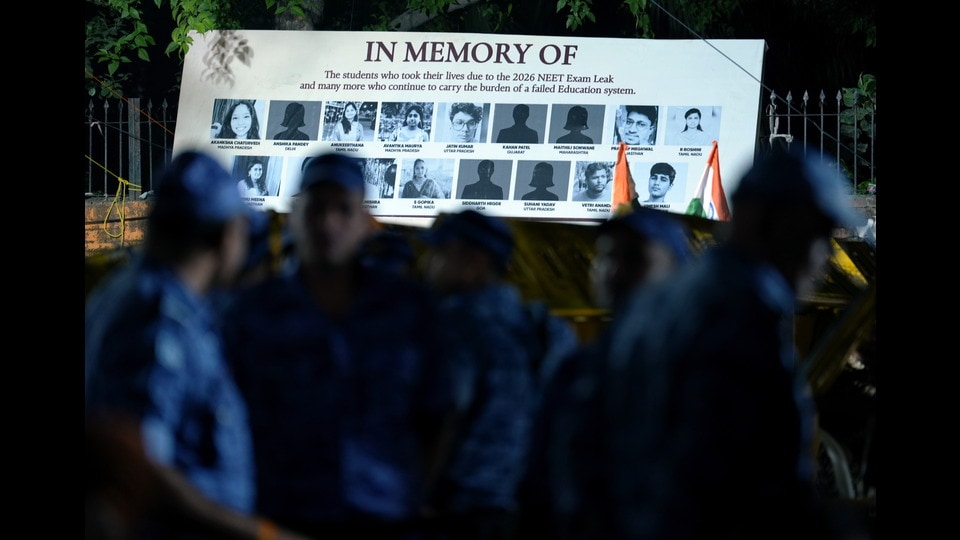
Information collected by Hindustan Times reporters from across the country indicates that existing laws have not stopped paper leaks across India -- over 150 paper leak incidents have occurred in the past decade, impacting over 7 million students. Almost all states in the Hindi heartland, where exam paper leaks are more common than in the southern states, have introduced stringent laws including jail term up to 10 years and fines of up to ₹10 crore since 2021. This is similar to what the Union government approved last week in a bid to assuage students and convince them to withdraw their protest.
Several cases have been lodged under these stringent state laws in the past five years in connection with paper leaks and other examination malpractices, including impersonation; hundreds of suspects are named in these FIRs. The pace of investigation and trial, however, have been slow leading to many suspects coming out of jail to resume criminal activities. Trial has not started in many cases and in the concluded ones, there were no convictions because of shoddy investigation.
There is no better example of allegedly poor investigation is the high-profile case involving 52-year-old Bihar resident, Sanjiv Kumar Singh alias Sanjiv Mukhiya, who, as per police, ran a nation-wide examination crime syndicate. Last week, the Central Bureau of Investigation (CBI) gave him a clean chit in the 2024 NEET-UG paper leak case, stating no evidence was found to link him directly to the paper leak.
However, Bihar police’s Economic Offences Unit (EOU), which booked him first on May 2, 2024, claimed to have technical evidence, which showed he was present in the town of Lavana in Gujarat when the paper was allegedly leaked from a printing press. A charge-sheet has also been filed against him in this case. The Bihar police officers said the CBI’s ‘clean chit’ was a “setback” to the case.
At least five cases are pending against Mukhiya including one for the 2017 NEET-UG paper leak. All the cases are at the trial stage, police said. “There were over 140 hearings but the cases are still dragging,” said a senior Bihar police officer not willing to be quoted.
He, however, pointed out that the fast-track special courts that Prime Minister Narendra Modi announced last week may help in securing early convictions.
According to government data, around 862 fast track courts (FTC) and 775 fast track special courts (FSTC) operate across states and union territories. On average, a FSTC clears about 9.5 cases every month, three times the case disposal rate of a regular criminal court.
Most of the FSTCs, set up through the Central government’s Nirbhaya Fund, deal with the POCSO cases, whose pendency is rising. As per Law ministry’s submission in Parliament on July 24, 2026, around 2.45 lakh cases were pending with FSTCs. In 2024, the backlog was 2.02 lakh cases. Situation with FTCs is worse, according to the government data.
The fast-track special courts designated for 2026 NEET-UG paper leak in Maharashtra, from where the paper was leaked, may ensure a quick conclusion in this case. But the same cannot be said about thousands of other examination malpractice cases pending before local courts across India.
Paper leaks and examination malpractices have penetrated almost every examination. Last week, two subject papers of Uttarakhand Technical University were leaked. In 2025, examination paper for admission to the Sainik (Army) Schools was leaked from Rajasthan. Several higher educational institutes reported paper leaks though officially many of them denied it.
“Paper leak and examination malpractice is a cottage industry,” said former Himachal Director General of Police, Sanjay Kundu, in a recent podcast. “Many parents want their children to succeed at any cost and that is an incentive for the examination syndicates,” he said, explaining why the industry is flush with money.
The case in point could be Mukhiya, who started as a technical assistant in a Nalanda college about 30 years ago. In 2025, according to Bihar police estimate, his net assets were worth ₹50 crore, including several land holdings and flats.
Experts say a way to check paper leaks is to reduce total dependence on entrance exams for admissions and jobs. “Entrance exams is an easy way out. A more holistic approach is needed where a student gets admission based on his or her calibre and not just entrance exam result, which can be rigged,” said former NCERT director Krishna Kumar.
Prime Minister Modi’s announcement of a special task force headed by Nandan Nilekani on exam reforms could possibly find answers to some of these nagging concerns.


