
 E-Paper



210 Maoists, including senior leaders, surrender in Chhattisgarh
Chhattisgarh chief minister Vishnu Deo Sai called it “a historic day not only for Bastar but for Chhattisgarh and the entire nation” after 210 Maoist cadres surrendered

 Prefer HTon Google


Bastar: More than 200 Maoist cadres, including a Central Committee (CC) member, carrying a total bounty of ₹9.18 crore, surrendered on Friday before authorities in Jagdalpur, the police headquarters of Chhattisgarh’s Bastar district, police said.
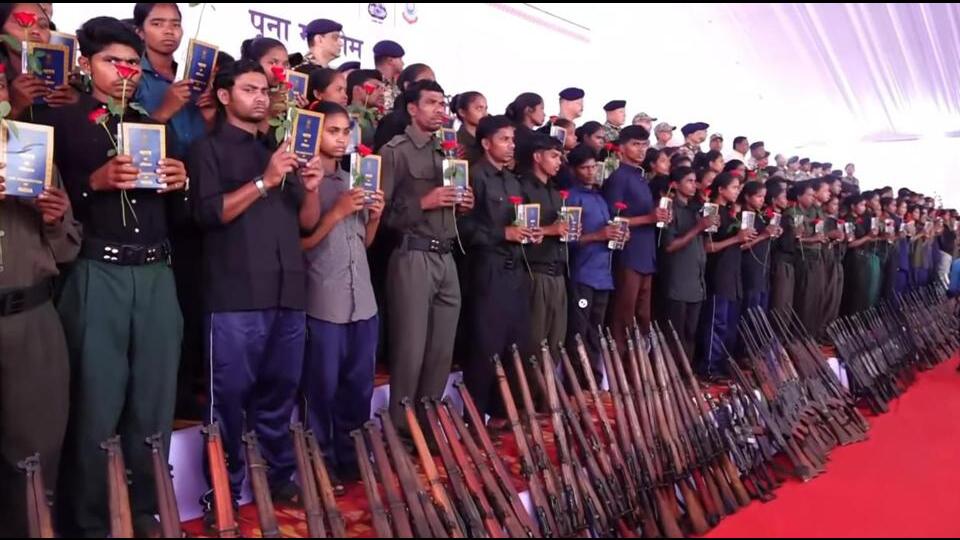
Chhattisgarh chief minister Vishnu Deo Sai called it “a historic day not only for Bastar but for Chhattisgarh and the entire nation” after 210 Maoist cadres surrendered before senior police and paramilitary officers at the police lines in Jagdalpur.
Among the senior leaders who surrendered are central committee member Rupesh alias Satish; Bhaskar alias Rajman Mandavi, Ranita, Raju Salam, and Dhannu Vetti alias Santu, all four members of the Dandakaranya Special Zonal Committee (DKSZC); and Ratan Elam, a regional committee member.
According to police officers, this was the largest mass surrender in the state. With this, a total of 238 Maoists have abandoned violence and joined the mainstream in the past three days. Around 28 cadres had surrendered on Wednesday.
Maoist spokesperson Rupesh said that the decision to suspend the armed struggle was the outcome of intense internal debate and self-reflection within the organisation. “Our strategy to counter the state’s offensive was not sufficient… we got badly trapped. We should have changed our approach according to the changes taking place in the country and the world, but we failed to do that,” Rupesh said.
He said several central committee members, including the late Raju Dada, had written candid “self-criticisms acknowledging where they went wrong and why their efforts fell short.” But the decision to halt the armed campaign, he clarified, was not taken in any collective meeting of the leadership. “It happened under the direct guidance of the general secretary and through the initiative of leaders like Sonu Dada,” Rupesh added.
Within the organisation, Rupesh said, ideological divides had also deepened, particularly over identifying the principal contradiction in Indian society. “This ideological divide affected our entire political strategy,” he said.
Criticising the rehabilitation policy of Chhattisgarh, Rupesh said, “You have to help in anti-Maoist operations, only then will the authorities even think about closing your cases.” He said such coercive conditions do not exist in states such as Telangana. “There, rehabilitation doesn’t mean being forced to act against your own people,” he added.
Rupesh said that their decision to return to democratic engagement was made after certain assurances were sought from the Chhattisgarh government. “Our first condition is clear, we will not be recruited into the District Reserve Guard (DRG), and we will not be part of anti-Maoist operations. Deputy Chief Minister Vijay Sharma had accepted this demand,” he said.
“We want the ban on organisations like Moolvasi Bachao Manch to be removed,” Rupesh said, adding, “The government has agreed that such restrictions will not be imposed again.”
Another demand is the release of imprisoned cadres who share their new outlook and wish to work through democratic means. “The government has assured us that it will help secure their bail,” Rupesh said.
Post the surrender, CM Sai said, “This moment symbolises the foundation of a peaceful future for Chhattisgarh. Our government is fully committed to ensuring a dignified and secure future for the surrendered cadres.”
The state’s surrender and rehabilitation policy includes provisions for financial aid, land benefits, industrial policy incentives, and livelihood opportunities for surrendered cadres, he added.
Deputy CM Vijay Sharma said that members of the entire Maad division and formations of the North Bastar Division are among those who laid down arms. “With this, North-West Bastar has now been completely freed from Maoist presence,” he said.
Sharma said that the CM has decided that the ban on the Moolvasi Bachao Manch, an organisation previously banned under the Chhattisgarh Special Public Security Act, 2005, will remain in force until October 30 and will not be extended further.
Sharma also clarified that there has never been, nor will there be, any compulsion for rehabilitated Maoists to join the DRG. “Out of the total DRG strength, only about 10% are former cadres,” he said.
Addressing concerns about Maoist in jail, Sharma said that those in jail who wish to change their status from “arrested” to “rehabilitated” would be considered under the same policy framework.
The surrendered cadres handed over 153 weapons, including 19 AK-47 rifles, 17 SLRs, 23 INSAS rifles, one INSAS LMG, 36 .303 rifles, four carbines, 11 BGLs, 41 single-shot/12-bore guns, and one pistol, police said.
Union Home Minister Amit Shah, who reiterated the government’s resolve to eradicate Maoists by March 31, 2026, declared Abujhmad and North Bastar as free from Maoists on Thursday. “Those who surrender are welcome, but those who continue violence will face firm action,” Shah said.
-kW0H-U20214218012MgB-250x250%40HT-Web.jpg)


