
 E-Paper



35% increase in private vehicles on Bengaluru roads: Officials
The joint commissioner also added that the increased traffic along with various civic works continuing across the city, the job of traffic policemen has increased exponentially.


Bengaluru: The Bengaluru city police is grappling to control vehicular traffic as the city continues to witness a steady rise in the usage of private vehicles. According to an informal survey conducted by the Bengaluru police, there is a 35% increase in the number of private vehicles on the road post lockdown, said joint commissioner of police(traffic) BR Ravikante Gowda on Thursday.
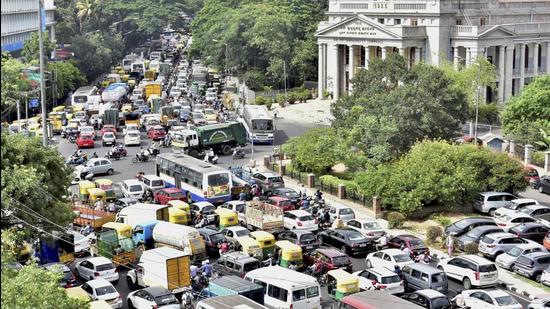
The joint commissioner also added that the increased traffic along with various civic works continuing across the city, the job of traffic policemen has increased exponentially.
“Except for east Bengaluru, in all divisions, the traffic is back to normal. Our officers are reporting that there is a considerable increase in the number of private vehicles. Although we did not conduct a formal study, an informal survey conducted across the city showed an increase of 35% in the number of vehicles on the road. There is a huge increase in the number of two-wheelers,” said Gowda.
Gowda added that during their recent interaction with commuters, many had expressed concerns over using public transport. “Because of the pandemic, people are hesitant to use public transport. The Metro and BMTC are yet to pick up numbers. In Bengaluru, commute is already dominated by private transport and the pandemic has increased those numbers. We are trying to spread awareness,” he said.
The data shared by the state transport department shows that the total number of vehicles registered in Bengaluru has nearly breached the 10 million mark as of January 2021, despite the pandemic and lockdown. Out of these, 6.4 million are two-wheelers, and 2.3 million are private cars. Bengaluru which added about 600,000 new vehicles each year since 2018, added nearly over 1.1million vehicles in 2020-21, which is double the number.
Despite this increase in vehicular population, the number of traffic policemen in the city remains understaffed. The number of traffic police in Bengaluru has been below its sanctioned strength and according to a study by the Bureau of Police Reforms and Development (BPR&D), the sanctioned strength of traffic police in several cities in the country, including Bengaluru, should be much higher than the current numbers.
According to official records, the Bengaluru traffic police have a sanctioned strength of 5,262 personnel to regulate traffic across 44,000 intersections and they are 600 men short of the sanctioned strength. The joint commissioner said that there was indeed a shortage of staff in the department and the government is trying to fill the gap at the earliest. “...but over the years we have increased the use of the technology in our enforcement, which has been a boon for us. The various cameras across the city have been instrumental in capturing more than 50% of the city’s traffic violations,” Gowda said.
While the top brass relies on technology, traffic policemen in the city say technology has its shortfalls, especially in traffic management. “There are around 44,000 intersections in the city. Out of this, there are only 388 junctions with signals and only around 500 have policemen manning them. Deployment is stretched in the outskirts of the city, and it becomes difficult to manage all major roads. We believe if we are able to regulate traffic on more roads and intersections the traffic situation can be improved,” said a senior officer in the traffic department.
Meanwhile, civic experts say there is a need to create a new system in Bengaluru rather than going back to the old days of traffic jams. V Ravichandar, a civic expert said that the city should and will have a ‘5 km city’ in the coming days. “The work from home culture will enable people to work and live in a 5km radius. Such a system will make Bengaluru a pandemic-proof city to some extent. One thing this pandemic has taught us is that cases happen in bubbles and travel results in the spread,” he added.
He said that a combination of hybrid work culture (combination of work from home and office) and removal of the need for cross-city travel would not only decongest Bengaluru but also improve reliance on public transport. “Once the need for long-distance travel within the city is limited, we will see people walking or using cycles more in the 5 km hubs,” Ravichandar added. Such a move, however, requires a change in the government’s thought process. Ravichandar has urged that the city’s master plan be relooked with a new outlook.


