
 E-Paper



Covid-19: 3rd wave limited to big cities, but has started to spread beyond
The seven-day average of Covid daily cases has increased every day for the past 10 days: from 6,780 on December 27 to 40,459 on January 5, the highest since September 7 last year


The third wave of Covid-19 is upon India.

The seven-day rolling average of daily cases has increased every day for the past ten days: from 6,780 on December 27 to 40,459 on January 5, the highest since September 7 last year. This is at the national level but what do the disaggregated numbers show.
The surge started in the most urban districts a little earlier
It’s understandable that the current surge is happening in big cities, where people arrive from abroad, since the Omicron variant was first detected outside the country. This is confirmed by data. How India Lives (HIL) has compiled district-level cases up to January 5. HT has classified these districts into five categories on the basis of how rural they are. The entirely urban districts, mostly metros and a few capital cities, have a rural population share of less than 20% (this is based on the 2011 census) and the entirely rural districts have less than 20% urban population, with other categories in between at similar 20% intervals. Disaggregating cases across categories shows that in the entirely urban districts, the 7-day rolling average of new cases was increasing before a consistent surge was seen at the national level. Here, the average increased daily for 16 days up to January 5. In all other categories of districts, this had happened for 9 days or 7 days.
There are outlier districts in rural-urban categories
To be sure, even the above categorization hides some district-level peculiarities. For instance, in Delhi and Mumbai, which are in the most urban category, the 7-day average had been rising for 21 and 20 days, longer than for the category as a whole. Such outliers are also present in other categories. Of the 125 districts where the average has increased for at least 7 days, only six are of the same urban-level as Delhi and Mumbai. 17 of them are from the largely urban category (20%-40% rural population), such as Surat in Gujarat, Indore in Madhya Pradesh, and Palghar in Maharashtra. 34 such districts with consistent upward trajectory for a week are also ones where rural population share is over 80%. These include Raigarh in Chhattisgarh, Gaya in Bihar, and Kangra in Himachal Pradesh.
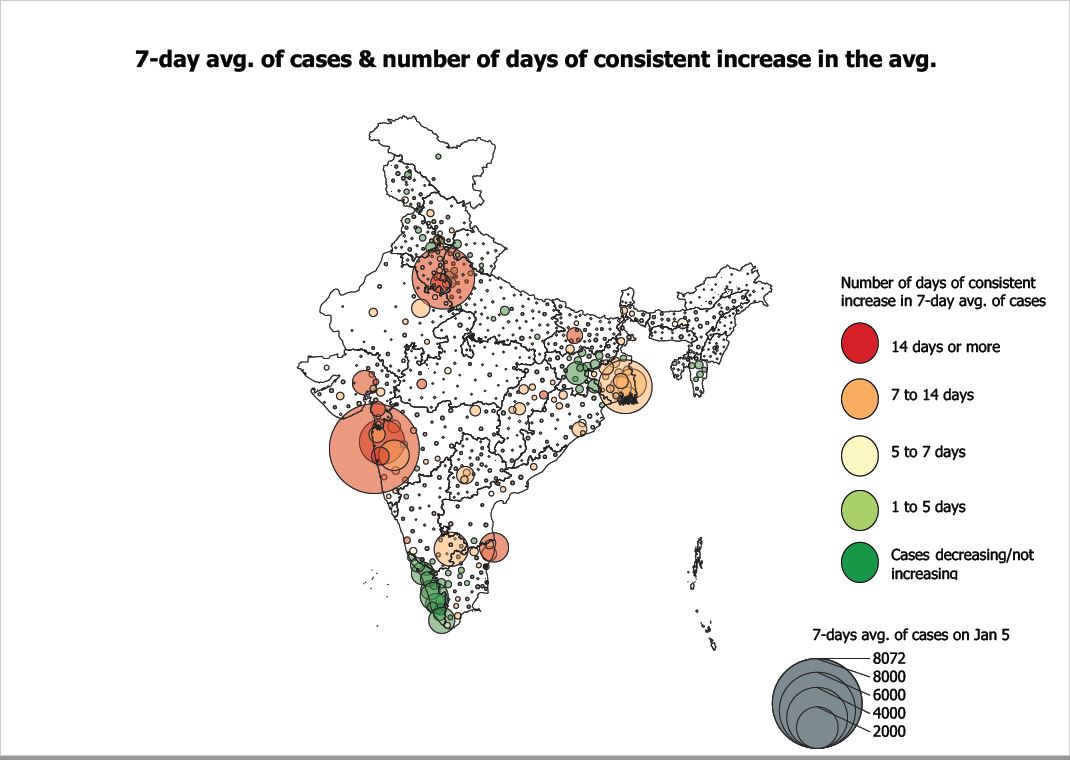
Cases are high only in the most urban areas, but spreading to most parts
The two arguments made above highlight two things. One, that the current surge is largely led by metros. Two, that a high case load in the metros does not mean people in other districts should go about their lives without masks and social distancing. Another set of statistics makes this even clearer. The 7-day average of cases in 135 of 707 districts for which data has been compiled by HIL was zero on January 5. In another 354 districts, this average was lower than 10. In only 85 districts was the average above 50. Just seven districts – Mumbai, Delhi, Kolkata, Thane, Bangalore, Pune and North 24 Parganas – accounted for 50% of cases by 7-day average. However, the number of districts with zero cases has decreased rapidly from the last week of December, suggesting that cases are now also reaching districts which were Covid-free.
Testing, vaccinating remains the key
As the first chart shows, the increase in cases in the metros has been rapid and the case load in these districts is also high now. Given the infectivity of the Omicron variant, it is important to use existing testing capacity. The best testing capacity utilization in any state is only 79%. This is not in Delhi or Maharashtra, but in Odisha, where average tests in the week ending January 5 was 79% of its peak testing. Most states were conducting less than 50% of their peak weekly average of tests in that week. Soon, however, states will feel the pressure to enhance testing capacity. They should stock up and distribute self-administered kits to encourage people to test at home. As HT has previously suggested, it is also important to track symptomatic positivity rates and hospitalisation rates and tailor policy responses on the basis of these.
Another way in which the impact of this wave can be possibly reduced is by fully vaccinating the entire eligible population. Two-dose vaccinations appear to reduce the severity of Covid-19 infections from the Omicron variant. In states like Bihar, West Bengal, Uttar Pradesh, Jharkhand, Punjab and north-eastern states (excluding Assam), some of the most populous states in the country that also have poor health infrastructure, the share of fully vaccinated adults is not even 60%. They need to catch up with other states if they don’t want to be overwhelmed by hospitalisations.


