E-Paper



4 dead, 100 injured in violent Ladakh clash, curfew imposed in Leh
The Union home ministry said, “It is clear that the mob was incited by Shri Sonam Wangchuk through his provocative statements.”

 Prefer HTon Google


At least four people were killed and around 100 injured in Ladakh on Wednesday after sweeping protests, demanding full statehood for the Union territory and protections for jobs and land, turned violent, the latest in a string of disturbances roiling the restive region.
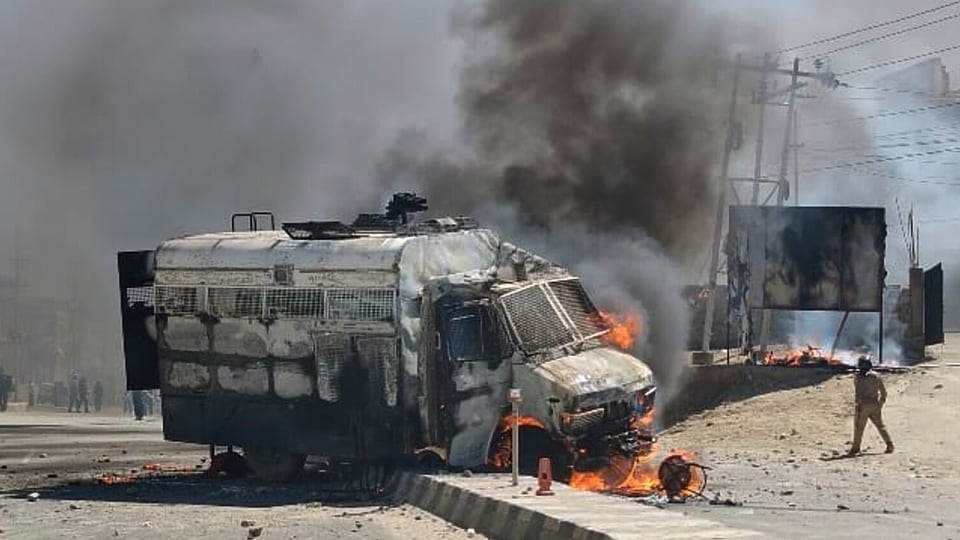
Authorities clamped a curfew in parts of Leh, the capital of Ladakh, even as the Centre rushed paramilitary forces to the remote region and blamed agitation leader, activist Sonam Wangchuk, for provoking the protesters.
Eyewitnesses said young protesters in their hundreds pelted stones, vandalised buildings and set the Bharatiya Janata Party (BJP) office and a police vehicle ablaze. Police said it had to resort to lathi charge and tear gas shells to disperse the protesters but Sonam Wangchuk, an activist who is one of the leading figures in the Ladakh statehood movement, said that the police used lethal weapons.
Also Read | How Ladakh protest turned into mob violence: Govt sees sinister plot in 'references to Gen Z'
“Four protesters have died while 30 have been injured. There have been injuries to 60-70 police personnel as well,” said additional superintendent of police in Leh, Rigzin Sangdup.
The Union home ministry said violence broke out at 11.30am and was brought under control by 4pm. “It is clear that the mob was incited by Shri Sonam Wangchuk through his provocative statements,” it added.
The statement highlighted that negotiations were ongoing between the government and representatives in Ladakh and Kargil, which had yielded results in the form of higher reservations, language rights and the beginning of a recruitment process. It also said that the next meeting was scheduled on October 6 and smaller informal meets were planned later this week. “However, certain politically motivated individuals were not happy with the progress made...has been trying to sabotage the dialogue process,” the government said.
“A mob instigated by his [Wangchuk’s] provocative speeches left the venue of the hunger strike and attacked a political party office as well as government office of the CEC Leh. They also put these offices on fire, attacked the security personnel, and torched police vehicle. The unruly mob attacked the police personnel in which more than 30 police/CRPF personnel were injured. The mob continued to destroy the public property and attack the police personnel. In self-defence, police had to resort to firing in which unfortunately some casualties are reported,” the Union home ministry said in a statement.
Sonam Wangchuk called off his 15-day hunger strike and denounced the violence but said that the frustration among young people was piling up against the central government’s unfulfilled promises.
“Varying accounts say 2,000-5,000 youth had come and unfortunately we are being told that 3-5 people have been killed because there was police firing. We don’t have a count of the injured but we have heard that many lost their limbs,” he said.
The Union Territory of Ladakh was created on August 5, 2019 after the Centre effectively abrogated Article 370, which used to bestow special status to Jammu and Kashmir, and split the erstwhile state into two UTs – J&K with a legislative assembly and Ladakh without one.
Since then, a string of protests have rocked Ladakh and had echoes in Delhi. In February 2024, thousands protested in Delhi, Leh and other parts of Ladakh demanding statehood and safeguards under the Sixth Schedule of the Constitution.
In 2023, the Union home ministry formed a high-powered committee under minister of state for home, Nityanand Rai, to discuss ways to protect Ladakh’s unique culture and language, considering its location and strategic importance. The panel, which included the members of the Leh Apex Body and Kargil Democratic Alliance — a collective of trade unions, tourist bodies, and religious and political groups — deliberated on protections for land and employment, and the empowerment of the Ladakh Autonomous Hill Development Councils of Leh and Kargil, and other constitutional safeguards.
Last year, the UT was roiled by protracted agitations across 66 days, over sixth schedule protections, statehood, an additional Lok Sabha constituency, unemployment and a separate public service commission The agitation intensified on March 6, with Leh observing a complete shutdown followed by a 66-day hunger strike that was suspended three days ago in view of the Lok Sabha elections. The agitations saw BJP dropping its incumbent MP Jamyang Tsering Namgyal ahead of the general elections.
Then, in June this year, the Union government notified a raft of landmark rules for Ladakh, allowing reservation up to 85%, a 15-year residency requirement for domicile status, setting aside one-third of seats in hill councils for women, and recognising five official languages. The rules – part of efforts to safeguard the region’s interests – represented the most significant change to the region’s administrative architecture since it was made into a Union Territory and hived off from Jammu and Kashmir in 2019.
But as the protests on Wednesday showed, anger was simmering in the mountainous region over the denial of statehood. “ Four days ago, the Centre informed us that the next level of talks would be held on October 6. We had requested the Centre to prepone the date of the talks as people in Ladakh have been protesting. The onus is on the government to resume dialogue, act sensibly and fulfil Ladakh’s demand for statehood and sixth schedule without delay,” said Sajjad Kargili, a KDA member who is part of the delegation holding the talks.
Wangchuk and 34 other protesters had begun the hunger strike on September 10, demanding statehood and protection under the sixth schedule of the Constitution to safeguard land, language, employment and cultural rights. The protests were called after two activists had to be hospitalised on Tuesday.
LAB co-chairman Chering Dorjay said that after the health of the two activists deteriorated on Tuesday, the protesters were very angry.
Lieutenant governor Kavinder Gupta said that the protesters attempted to burn paramilitary personnel sitting inside a vehicle and pelted stones on the vehicle of the director general of police, hinting at a conspiracy. “The Centre agreed to resume talks and the names were decided by them. We didn’t decide the names and the date (October 6) was also fixed. Despite this, a group comes at the site of hunger strike and soon moves out, indulges in stone pelting, arson and setting places on fire…Those who are behind this will be investigated and they are the ones responsible for the loss of lives today,” he said.
Wangchuk said that there was frustration among young people over unemployment, lack of representation and no protection under the sixth schedule. “I understand their frustration piling up for five years but this was not the right way. I condemn this path, although I understand their emotions,” he said.
The Central Reserve Police Force will move eight additional companies to Leh on Thursday, to add to the seven companies already deployed. The Indo Tibetan Border Police, which guards the Indo-China frontier, too, has moved its personnel towards Leh. “The ITBP deployment is not from outside but has been moved internally. Meanwhile the CRPF companies are being moved from outside. Depending on the situation, more personnel could be flown to Leh,” an official aware of the matter said.
One CRPF company has a sanctioned capacity of 120-130 personnel, of which at least a minimum of 80 are posted on the ground at any given time.
In Delhi, the BJP blamed the Congress for the protests. “.Attempts were made to portray some protests as being led by Gen Z. However, when investigated, it was discovered that these protests were not led by Gen Z, but by Congress. Congress councillor Stanzing Tsepang is the councillor from the Upper Leh ward. He can be seen marching towards the BJP office with a weapon in his hand,” said senior leader Sambit Patra.