
 E-Paper



8 incidents in 6 years: Experts highlight need for rules for airport buildings
Currently there are no civil aviation rules that give the aviation security wing — the BCAS — or the sector regulator— the DGCA — the authority to audit airport buildings.

 Prefer HTon Google


A fatal roof collapse at Delhi’s Indira Gandhi International Airport last month has thrown a spotlight on the vulnerability of India’s airport infrastructure, with experts flagging the lack of adequate oversight.
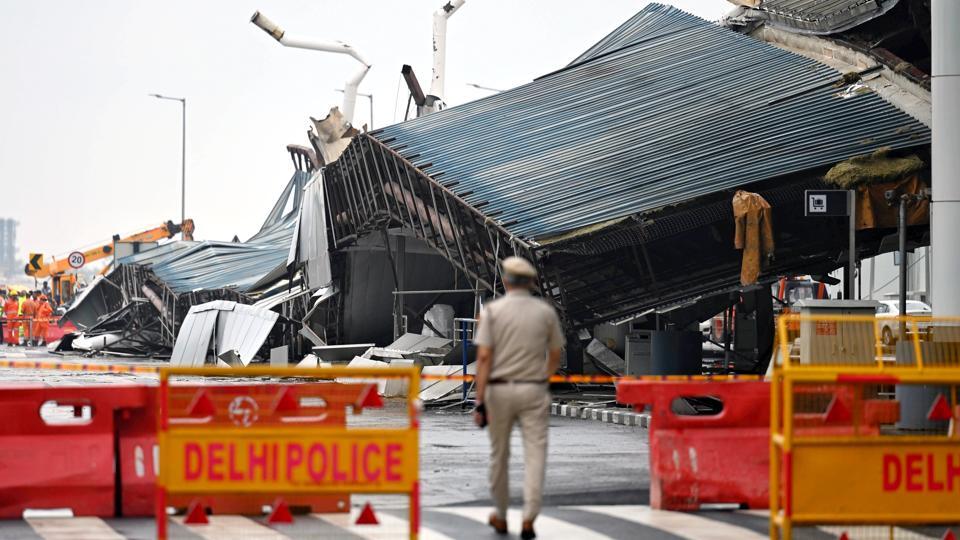
At least eight similar incidents reported nationwide in the past six years, with the latest being the rain-triggered collapse of the massive canopy covering the driveway at the Delhi airport’s Terminal 1’s departure, where a cab driver fatally crushed under debris. Eight others were injured that morning.
At least three government officials said that currently there are no civil aviation rules (CAR) that give the aviation security wing — the Bureau of Civil Aviation Security (BCAS) — or the sector regulator— Directorate General of Civil Aviation (DGCA) — the authority to audit airport buildings, which can be either privately maintained or by the government-run Airports Authority of India (AAI).
“Airport operators, be it private or AAI, must have their own structural audits. Airport buildings, due to monsoons, have been seen facing issues across the country. The issue is that there is no one to certify the building fit for use. There is no accountability,” said aviation safety expert Mohan Ranganathan.
The civil aviation ministry did not respond to requests for a comment.
In addition to the June 28 incident at Delhi, similar accident happened at other airports. On June 27, a portion of the roof of the new terminal building at Jabalpur airport collapsed, crushing a car but sparing any injuries to any person. On June 29, the canopy outside Rajkot airport terminal in Gujarat collapsed amid heavy rain, with no reported injuries.
On June 30, moderate rain caused water to leak from roof of Lucknow airport’s Terminal 3, raising concerns about construction quality of a facility inaugurated in March. Earlier, in May, Bengaluru airport’s T2 too had a water leak due to downpour. This terminal too was new.
The Delhi airport’s Terminal 1, which handled 80 flights a day, has now had to shift operations to the other terminals and is expected to open only in a month.
A former DGCA official, who asked not to be named, said: “DGCA’s primary focus has always been safety on the air side of the terminal and hence there is no specific rule on maintaining or inspecting the terminal building. Having said that, there are some minuscule rules that are taken care of by the local fire department.”
Industry experts are calling for amended civil aviation rules to mandate regular structural audits of airport buildings.
A former Airports Authority of India official, speaking on condition of anonymity, highlighted the challenge of designing infrastructure for increasingly severe weather events. “The increasing frequency and severity of natural calamities due to climate change necessitate a focus on building more resilient infrastructure,” the official said.
A former official deployed at an airport, who too asked not to be named, said that incorporating advanced materials, technologies, and design practices can help mitigate the impact of future calamities on the buildings.
The passengers are the ultimate sufferers in such cases, be it water leaks or terminal shutdown after a roof collapse, hence they should be adequately compensated in such a scenario, which does not happen in India, Ranganathan added.


