E-Paper



8 more firms added to India AI Mission: Vaishnaw
The announcement comes as the government ramps up its artificial intelligence capabilities,

 Prefer HTon Google


The government has selected eight more companies to develop large language models (LLMs) under the India AI Mission, bringing the total number of participants to 12, IT minister Ashwini Vaishnaw announced in New Delhi on Thursday.
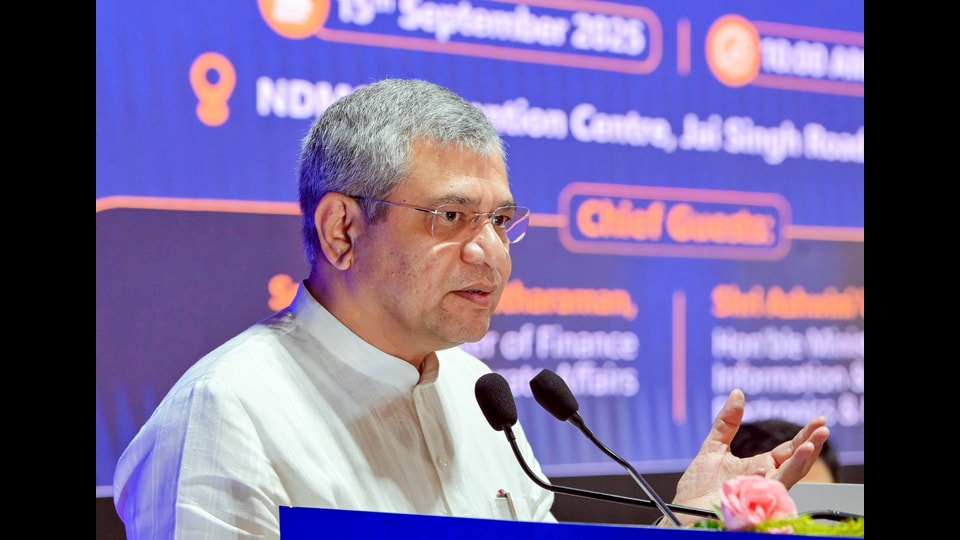
Speaking at a pre-event for the AI Impact Summit scheduled for February 2026, Vaishnaw revealed that IIT Bombay Consortium-BharatGen, Fractal Analytics, Tech Mahindra, Avataar AI, Zeinteiq Aitech Innovations, Genloop Intelligence, NeuroDX (Intellihealth), and Shodh AI have been selected to join the programme.
The announcement comes as the government ramps up its artificial intelligence capabilities, with the new entrants joining four previously selected firms—Sarvam AI, Gnani AI, Soket AI, and Gan AI.
“The models which were selected earlier are also progressing very well. I think we are on track to unveil our models by the time the Impact Summit comes,” Vaishnaw said.
The government has committed substantial funding across the selected companies, with IIT Bombay Consortium-BharatGen receiving the largest allocation of ₹988.6 crore. The consortium will develop a foundational model with one trillion parameters, focusing on Indic use cases for government applications in agriculture, finance, legal, health, and education sectors.
Fractal Analytics has received ₹34.58 crore to build foundational and tool-integrated reasoning LLMs through large-scale reinforcement learning, with applications in healthcare, national security, and policy making. Tech Mahindra, meanwhile, has been granted ₹1.06 crore to develop an 8-billion-parameter foundational LLM catering to all Hindi dialects.
To support these initiatives, the government has deployed approximately 38,000 graphics processing units (GPUs) and plans to add 10,000 more. An IT ministry official told HT that the total is expected to reach 50,000 GPUs by the end of 2025.
However, the rollout has faced some delays. According to the India AI Mission website, only Sarvam AI and Gnani AI have received subsidised GPU access so far, while the remaining companies are still completing required paperwork.
Confirming an HT report from July 24, the ministry also announced plans to develop over 500 AI data labs to boost talent and infrastructure. The expansion will see 200 labs established by March 2026, reaching a total of 570 labs within the next two years.
Governance framework imminent
In a separate development, Vaishnaw announced that an AI governance framework will be released within the next 10 days, hopefully before September 28. The framework, developed by Principal Scientific Advisor Ajay Kumar Sood in collaboration with the IT ministry, follows more than 3,000 consultations held over an extended period.
The framework addresses three critical areas: defining boundaries for AI safety-related issues, outlining response mechanisms if AI causes harm to individuals, and establishing checks and balances for responsible development and rapid adoption of AI applications.
Crucially, the framework will not be prescriptive or legally binding but will provide guiding principles for responsible and ethical AI development and deployment in India.
“As we have maintained, over a period of time, whatever is required for the safety of our citizens, we will convert those portions (of the framework) into law. Other portions will continue to operate as frameworks,” Vaishnaw said.
The minister indicated that necessary safety measures may be converted into law in the future, suggesting a flexible approach that balances innovation with regulation.