
 E-Paper



9 Maoists including 6 women surrender in Chhattisgarh’s Gariaband
The group, which included six women, belonged to the Sinapali and Sonabeda–Dharambandha–Kholibatar (SDK) area committees.

 Prefer HTon Google


RAIPUR: Nine Maoist cadres, carrying a cumulative reward of ₹45 lakh, surrendered before the Chhattisgarh police in Gariaband district on Monday.
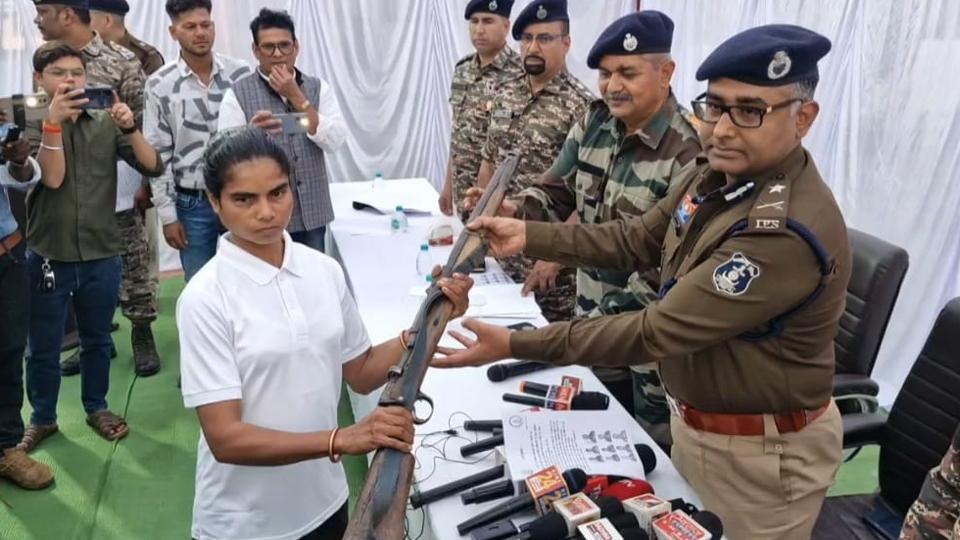
The group, which included six women, belonged to the Sinapali and Sonabeda–Dharambandha–Kholibatar (SDK) area committees. Amresh Mishra, inspector general of police, Raipur Range, said they turned themselves in, citing disillusionment with Maoist ideology and the hardships of living in a forest.
Among those who surrendered were Anju alias Kavita (40), a divisional committee member and SDK area committee secretary; Baldev alias Wamanwatti, in-charge of the Sinapali area committee; Damru alias Mahadev (35), another divisional committee member; and Soni alias Budri (37), Sinapali area committee secretary. All of them carried a reward of ₹8 lakh each. Another key cadre, Ranjit alias Govind, a Sinapali area committee member, carried a reward of ₹5 lakh.
The five cadres also handed over three AK-47 rifles and two self-loading rifles, police said.
Parvati alias Sukki Karam (37), an area committee member carrying a reward of ₹5 lakh, and three others with bounties of ₹1 lakh each also surrendered.
Police said Anju, associated with the outlawed outfit since 2004 and a resident of Sukma district, was wanted in 19 cases in Gariaband district. Baldev, from Bastar district, was wanted in 29 cases.
Mishra said sustained efforts are being made to persuade the remaining Maoist area committees in Gariaband to surrender under the rehabilitation policy.
This year, 180 Maoists have already surrendered in Chhattisgarh. On January 15, 52 Maoists, 49 of them carrying a combined bounty of over ₹1.41 crore, surrendered in Bijapur district.
More than 1,500 Maoists surrendered across Chhattisgarh in 2025.
-kW0H-U20214218012MgB-250x250%40HT-Web.jpg)


