
 E-Paper



A Nobel Prize for an already revered figure in economics
Anybody who has been to the Delhi School of Economics (DSE) located in Delhi University would have noticed that the main gate of what is India’s pre-eminent centre of graduate learning of economics is never open


Anybody who has been to the Delhi School of Economics (DSE) located in Delhi University would have noticed that the main gate of what is India’s pre-eminent centre of graduate learning of economics is never open. Campus gossip has it that the gates will be opened only when a serving DSE faculty wins the Nobel Prize in economics. While another graduate school in economics, often famous for its ideological rivalry with DSE, Centre for Economic Studies and Planning at Jawaharlal Nehru University can now boast of a Nobel laureate – Abhijit Banerjee who is currently a professor of economics at MIT was a co-winner in 2019 – India’s first Nobel Prize winner in economics did have a DSE connection. Amartya Sen, awarded the prize in 1998,taught economics at DSE in his early days.
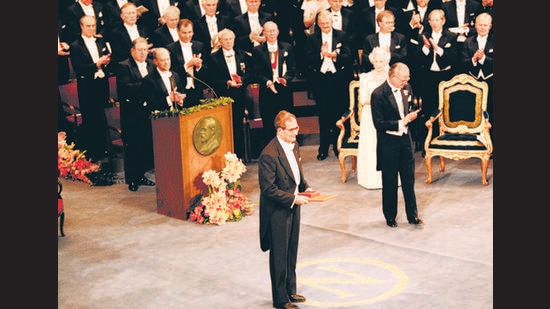
As is often the case with the Nobel Prizes, Amartya Sen’s award added more to his popularity outside the discipline than among his peers. Among professional economists, Sen was already a revered figure thanks to his path-breaking and diverse body of work. This included an abstract and highly technical discussion on social choice theory, deeply political insights derived from economic history such as famines or his New York Review of Books essay on the missing women in India, which triggered a global discussion on India’s skewed gender ratio.
Sen’s Nobel Prize in economics came at a time when the debate on India’s economic reforms was still very shrill. While India was beginning to realise the reform-driven tailwinds to growth, global discontent against globalisation was beginning to gather momentum. Joseph Stieglitz , who was awarded the Nobel Prize in economics in 2001, three years after Sen would write his bestseller book Globalisation and its Discontents four years later (a very short time horizon for academics). Sen’s ideas on the impact of economic reforms in India are now well known and often portrayed in contrast with the views of Jagdish Bhagwati, another Indian economist of Sen’s vintage. The Sen-Bhagwati debate is often a subject of political polemics (often by people who know nothing about economics) in popular discourse today.
Amartya Sen’s extremely short speech – it is just 450 words – at the Nobel Banquet on this day 24 years ago is perhaps the best lesson to students of economics, and in fact, all thinking beings on how not to conduct a debate.
“I believe that Chandrasekhar, the astrophysicist, who also originated in India, when he received his Nobel Prize in Physics, quoted a poem of Tagore, in praise of freedom of the mind: “where the clear stream of reason has not lost its way into the dreary desert sand of dead habit.” Let me praise Chandrasekhar’s praising of Tagore’s praising the freedom of the mind.”
“Now a seriously silly thought. From this focus on open-minded reasoning, there is much that economists too can learn. The subject stands to lose a lot from dogmatic beliefs of one kind or another (for example, we are constantly asked: “Are you against or in favour of the market? Against or in favour of state action? Just answer the question – no qualifications, no ‘ifs’ and ‘buts,’ please!”). This is an invitation to replace analysis by slogans – to be guided by grand dogma, either of one kind, or of another. We do need “the clear stream of reason.” What Tagore, the poet, and Chandrasekhar, the physicist, demanded, we need in economics too – for much the same reason. That is the last silly thought I inflict on you tonight.”
Sometimes, brevity and greatness do go together -- even among economists.


