E-Paper



AAP trying to set poll agenda as it looks to make impact in Gujarat
The AAP has been vociferously attacking Gujarat’s education system and claiming that it lacks proper infrastructure for government schools.

 Prefer HTon Google


Ahmedabad: If the influence of a party can be gauged from its ability to set a political narrative during election time, the Aam Aadmi Party (AAP) has occupied the space that was taken by Congress in 2017 by raising issues on governance, inflation, education, paper leaks, and health care, among others.
Five years ago, the ruling Bharatiya Janata Party (BJP) avoided any direct response to Congress that raised issues such as reservation for Patidars, farmers’ income, GST, demonetisation. But this time, the ruling party leadership appears to be indirectly countering the AAP’s attacks and even some of its poll promises.
The AAP has been vociferously attacking Gujarat’s education system and claiming that it lacks proper infrastructure for government schools. The party has made a poll promise to change the government schools on the lines of Delhi, where it has developed over 800 “model schools”.
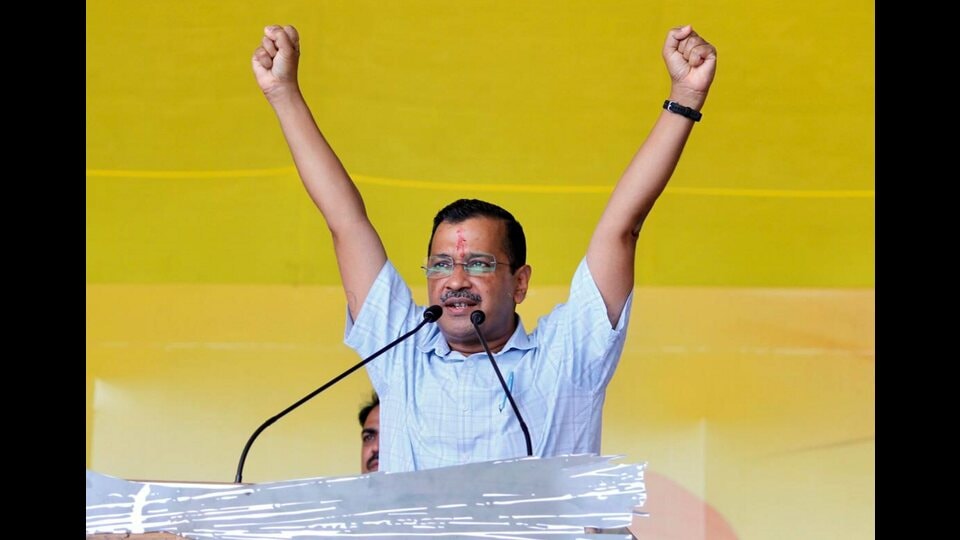
In a video message late on Thursday, Kejriwal declared that his party would “definitely win”, and followed it up with a one-minute “message with love”, in Gujarati.
“Am I not part of your family?” he asked, promising to provide free electricity, build good schools, high quality hospitals and provide employment to youth.
Also read: 'Kyuki Rahul ko hai bachana': BJP's swipe at Cong's '3 monkey' reaction on Gujarat poll
“I have delivered in Delhi and will deliver in Gujarat also,” he added.
Prime Minister Narendra Modi, during his Gujarat visit on October 19, launched the “Mission Schools of Excellence” scheme, conceived with a total outlay of ₹10,000 crore to set up new classrooms, smart classrooms, computer labs, and for the overall upgradation of infrastructure in schools in the state.
Another big AAP poll promise is free electricity up to 300 units for every household. Modi on October 9 declared Modhera village, which houses the famous Sun Temple, as India’s first solar powered village, and added that not are people here getting free electricity, they even make money by selling the extra power they managed to generate.
Experts said the difference from five years ago on this front is palpable. “One cannot say what will be the impact on the vote but the AAP is certainly setting the political narrative and making the BJP respond,” said Ghanshyam Shah, a political expert.
To be sure, the AAP, which has decided to field candidates in all 182 assembly seats, has a huge mountain to climb.
In 2017, it enrolled about 400,000 supporters in its membership drive but decided not to contest the elections as it thought that the timing was not right then. Few AAP leaders went ahead and contested in their individual capacities. They fared poorly, most of them losing their security deposits.
Also read: Drug kingpin leased land from Gujarat government, paid ₹84 lakh
The party is buoyed by its performance in Punjab, where it toppled the ruling Congress in a landslide victory, and by its performance in the local body elections. In January 2021, when elections were held in six out of eight municipalities of Gujarat, AAP won 27 seats in Surat municipal corporation, replacing Congress as the main opposition party in the civic body with a vote share of 28%. In the district panchayat elections in Surat, held at the same time, the AAP won 40 seats. On September 21, AAP managed to bag just one seat in the Gandhinagar civic body elections but garnered a vote share of about 21.7%, shrinking the Congress vote share from 46.93% in 2016 to 27.97% in 2022.
There are concerns among Congress leaders that the AAP could cut their votes and ultimately increase the BJP’s seat tally. But the AAP leaders contend their time has come -- not just to become the principal Opposition but to topple the party that has been in the helm for 24 years.