
 E-Paper



Aditya-L1 completes key orbit manoeuvre
India's Aditya-L1 solar mission has completed its first Earth-bound manoeuvre and is "performing optimally," according to the Indian Space Research Organisation

 Prefer HTon Google


Aditya-L1 has successfully performed its first Earth-bound manoeuvre, indicating it is healthy and “performing optimally”, the Indian Space Research Organisation (Isro) said on Sunday — a day after India’s first solar mission embarked on a 125-day journey before it is placed in a halo orbit about 1.5 million kilometres from Earth.
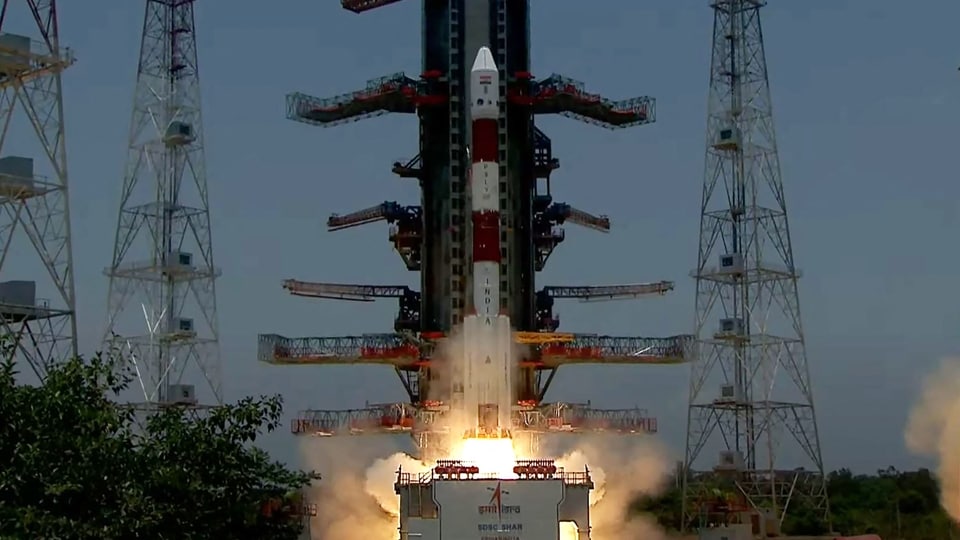
The process for the satellite’s final placement at L1 point will require a series of intricate manoeuvres, the first of which was performed at 11.45am on Sunday.
“The satellite is healthy and operating nominally. The first Earth-bound maneuver (EBN#1) is performed successfully from ISTRAC, Bengaluru. The new orbit attained is 245km x 22,459 km,” the space agency said in a post on X, formerly Twitter.
“The next manoeuvre (EBN#2) is scheduled for September 5, 2023, around 03:00,” it added.
Four other such manoeuvres are scheduled, during which the space agency will raise the satellite’s orbit near Earth for a fortnight, so that it gathers enough momentum to be launched into its 1.5 million kilometre journey.
Earth-bound manoeuvres involve the firing of rockets and some adjustments to angles, as required. How this will work can perhaps be understood by taking the example of when a person is on a swing — to make the swing go higher, a pressure (by shifting body weight) is applied in the phase when the swing is coming down towards the ground. In Aditya-L1’s case, once it gains enough velocity, it will slingshot around to its intended path towards L1.
The L1 point refers to Lagrange Point 1, where gravitational forces of celestial objects work in such a way that the spacecraft can be parked in what is known as a halo orbit – an oval that shifts on three axes. Once Aditya-L1 arrives at the L1 point, another manoeuvre will be performed to bind the craft to the orbit, the space agency said.
“The satellite spends its whole mission life orbiting around L1 in an irregularly shaped orbit in a plane roughly perpendicular to the line joining the Earth and the Sun,” an Isro document read.

The strategic placement will ensure that Aditya-L1 can continuously monitor the Sun. “This location also allows the satellite to access solar radiation and magnetic storms before they are influenced by Earth’s magnetic field and atmosphere,” the document said.
The gravitational stability at this point will also minimise the need for frequent orbital maintenance, it added.
Aditya-L1 is equipped with seven payloads to study the Sun’s corona, chromosphere, photosphere and solar wind. From L1, the spacecraft will be able to see the effect of particles and radiation from heightened solar activity, while also studying the outer surface of the star in close detail — something that is normally not possible from the Earth, or even its orbit.
Scientists said that after 125-day period, the seven scientific instruments will draw readings and the first of the data is expected in February or March next year. While the mission is designed to provide data for the next five years, experts said that there is a possibility of it going on till 10 or even 15 years.
The space agency has in the last fortnight successfully conducted two significant missions that have cemented its place among the world’s foremost space programmes.
On August 23, Chandrayaan-3, India’s lunar exploration project, made a historic landing near the south pole of the Moon — hitherto unexplored by any other country’s probe.


