
 E-Paper



Aircraft carrier INS Vikramaditya to start sailing end-January
With India’s two aircraft carriers operational by end of this year, the mission objectives of these two warships will have to defined in the Indo-Pacific which goes beyond projecting maritime dominance and gun-diplomacy.

 Prefer HTon Google


India’s first aircraft carrier INS Vikramaditya is expected to come out of major refitment at Karwar Naval base end of this month and will be at the center of events when Prime Minister Narendra Modi addresses the Combined Commanders Conference in March. The battleship is expected to start sailing around January 30 and sea trials will commence soon.
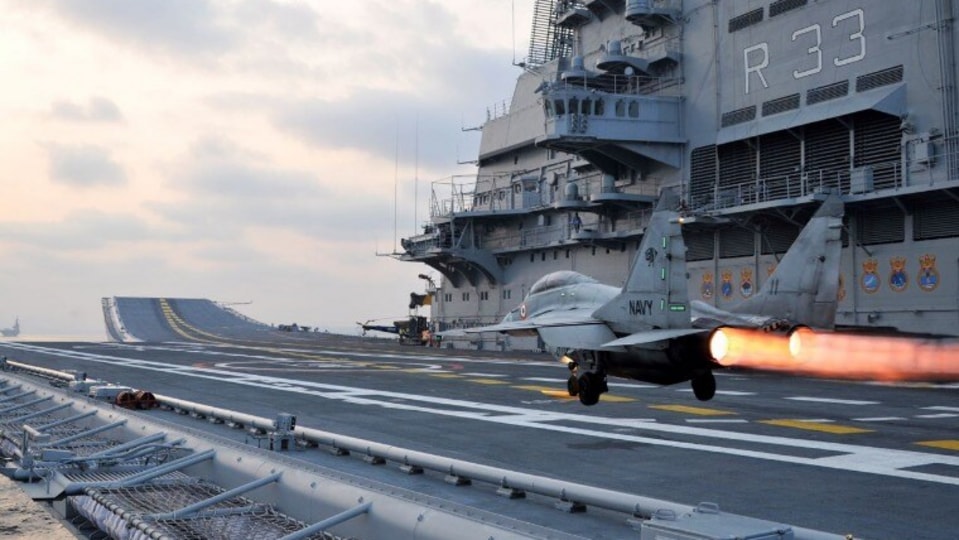
While the Indian Navy expects flight trials on both INS Vikramaditya and its successor INS Vikrant to take place before monsoon, the two operational aircraft carriers will add heft to India’s naval footprint in the Indo-Pacific. A decision on the procurement of 26 maritime strike fighters including eight trainers for INS Vikrant will also be taken soon with French Rafale-M and US F-18 being the two principal contenders.
It is understood that the Indian Navy has already submitted the trial reports of the two fighters to the Defence Ministry and based on the performance of the fighters the decision will be taken by the Modi government. The INS Vikramaditya has Russian MiG-29K fighters as main weapon on board, while a landing of maritime LCA is also being considered on INS Vikrant as a test case scenario this year.
Both the aircraft carriers will be based on India’s western coast till a jetty to handle the huge war machines is ready at Vishakhapatnam on India’s eastern seaboard. In the meantime, the Indian Navy is considering leasing a jetty at Kattupalli Port in north Chennai to dock the aircraft carriers with another carrier jetty being considered at Campbell Bay in Island territory of Andamans and Nicobar Islands.
With two operational aircraft carriers at the end of this year, Indian national security planners will have to evolve a doctrine that defines the objectives or missions of these two carrier-based strike forces beyond the Bay of Bengal and Arabian Sea. Simply put, India does not need two aircraft carriers for maritime dominance in Arabian Sea or Bay of Bengal but to project power in the Indo-Pacific and beyond.
Given that Chinese Navy’s armadas with three aircraft carriers are expected to patrol in the Indian Ocean by 2025, the Indian carrier-based forces will counter the PLA Navy while deepening naval cooperation with QUAD navies in the Indo-Pacific.
Already PLA strategic surveillance vessels are mapping the Indian Ocean including the 90 degree ridge and the five ingress straits to South China Sea for future maritime operations. Beijing has offered naval cooperation to Indian Ocean littoral states by gifting them off-shore patrol vessels like the one presently being offered to Seychelles. The Indo-Pacific scenario is warming up with Japan getting ready to meet the Chinese challenge with US support and Australia contesting Beijing in far Pacific. India with its two aircraft carriers will have to do the heavy lifting in the Indian Ocean from Africa’s eastern seaboard to the west coast of Australia.


