E-Paper



Red Fort blast: Despite probe into Al Falah University, students sign up for seats to study medicine
Seats were allotted in the stray round with scores dipping to 155 under NRI quota while officials said student interests will guide any regulatory step.

 Prefer HTon Google


On November 13, even as investigators had identified the connection between Faridabad’s Al Falah Medical College and the November 10 blast near Delhi’s Red Fort that claimed at least 12 lives, the last round of counselling for filling up 15 seats in the college’s undergraduate medical degree (MBBS) programme was going on.
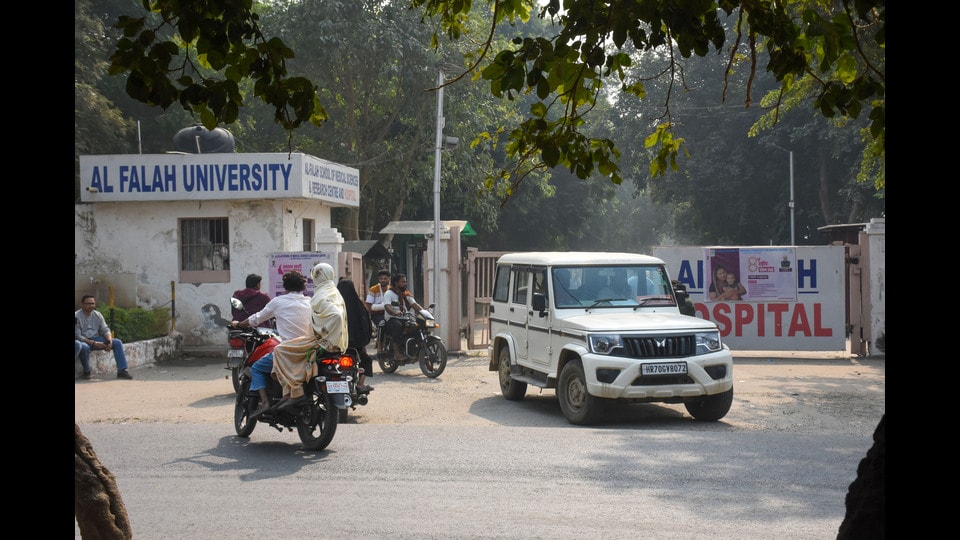
It has filled all 150 MBBS seats for the 2025-26 academic session, college officials said on Wednesday even as a cloud hangs over it. The National Medical Commission (NMC) officials said that the apex medical regulator will provide its required inputs to the investigating agencies after they examine everything related to the incident and decide the next course of action based on their findings.
ALSO READ | After Red Fort blast, 200 doctors, staff at Al Falah University under probe agencies' lens
Al-Falah School of Medical Sciences & Research Centre under Al-Falah University received National Medical Commission (NMC) approval to admit its first batch of MBBS students in 2019. The college offers 150 MBBS seats. The first-year fee is ₹16,37,500 for Indian nationals and $32,900 for NRI students.
Haryana’s department of medical education and research conducts NEET-UG-based counselling for MBBS admissions to all medical colleges in the state, including Al-Falah. The verification of students’ documents after getting their names in the provisional allotment list based on their choice of colleges, takes place at Pandit Bhagwat Dayal Sharma University of Health Sciences Rohtak, a state-run government medical college. After three regular counselling rounds held between August 8 and October 22 left 15 seats vacant, the college filled all remaining seats in the so-called stray round on November 13, as per the provisional allotment list released on November 17. The newly admitted students are scheduled to join on Thursday.
ALSO READ | ED gets 13 day custody of Al Falah chief over alleged ₹415 crore fraud
Students with NEET-UG scores as low as 155 – just 11 marks above the qualifying cutoff of 144 – secured admission under the NRI quota in Round 3. In the stray round, the lowest scores admitted under the minority and management quotas were 250 and 231, respectively.
“During counselling, students often opt for upgrades to secure admission in colleges better aligned with their NEET-UG scores. Many who initially joined us in the first round later upgraded to other colleges as they got government colleges, while some upgraded into our college from elsewhere. After three rounds, we were left with 15 vacant seats, but the counselling authorities allotted all of them in the stray round to students who had chosen our college during the choice-filling process of the counselling,” said a faculty member from the admission committee of Al-Falah Medical College.
ALSO READ | Red Fort blast: ‘Traces’ of ammonium nitrate found in Dr Umar's Al Falah room as probe goes on
Dr Vivek Singh Malik, professor at PGIMS Rohtak and vice-president of the Haryana State Medical Teachers Association (HSMTA), said a single incident cannot define a college’s reputation. “Al-Falah may be a private college, but it must follow government norms set by NMC and other regulators. Students are opting for it largely because its fees are lower than other private medical colleges in the state, which charge over ₹25 lakh a year. Many students simply do not want to lose a year and choose any college available within their rank. They also trust that if the government continues to permit the college to run its courses, their degrees will remain valid.”
On the possibility of withdrawing approval or scrapping affiliation, a senior NMC official said it was too early to speculate. “If required, the government can even take over the institution. The college has hundreds of students from diverse backgrounds, and their interests must be protected. Whatever action is taken, it will be in consultation with the state authorities. Our priority is clear — we cannot compromise the education of students already enrolled.”
On November 14, NMC removed the names of four doctors associated the terror module – Muzaffar Ahmad, Adeel Ahmad Rather, Muzammil Ahmad Ganaie and Shaheen Shahid – from its medical register, disallowing them from practising medicine after they were booked under the Unlawful Activities Prevention Act for their involvement in Delhi blast.
ALSO READ | Faridabad police search 1,300 Al Falah student rooms after Red Fort blast probe
Earlier, on November 12, university vice-chancellor Bhupinder Kaur in a statement said that the institution has no connection to the arrested doctors “apart from them working in their official capacity”.
Al-Falah University is under scrutiny for its finances as well as alleged misuse of its infrastructure. The Enforcement Directorate (ED) on Tuesday arrested Jawad Ahmed Siddiqui, chairman of the Al-Falah group and said that the university misrepresented itself as NAAC-accredited and falsely claimed eligibility under Section 12(B) of the UGC Act. The Association of Indian Universities (AIU) has already revoked the university’s membership.