E-Paper



Another toxic day as sun can’t snap Delhi’s severe-plus streak
Delhi's air quality remains "severe-plus" for the fourth consecutive day, with an AQI of 460, worsened by farm fires and weather conditions.

 Prefer HTon Google


A fourth straight day of “severe” air held Delhi in an unrelenting stranglehold on Tuesday, with residents forced to breath lungfuls of toxins as a bleak sun failed to neutralise the cocktail of slow winds, dipping temperatures and the effect of farm fires in Punjab that kept the Capital sheathed in a grey haze.
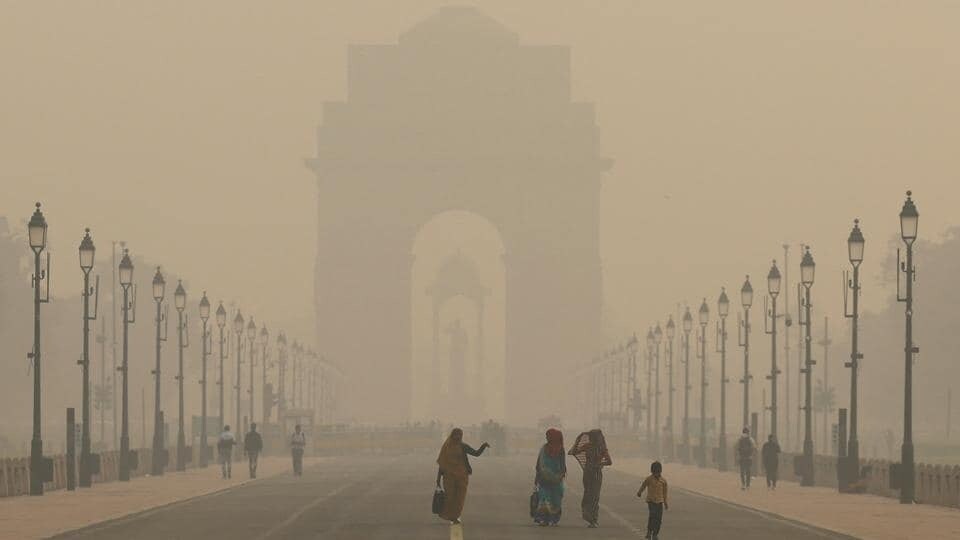
Delhi logged a 24-hour average air quality index (AQI) of 460 at 4pm on Tuesday, lower than the record 494 clocked on Monday, but still in the “severe-plus” classification. An AQI between 401 and 450 is classified as “severe” and 451 and 500 as “severe-plus”. The scale is capped at 500.
Experts stressed that such levels of pollutants expose people of all ages to a range of short- and long-term ailments, adding that minor variations within the “severe-plus” range are unlikely to offset any of these dangers.
The city’s AQI has been severe on six of the past seven days, shows data from the Central Pollution Control Board (CPCB). It was 441 on Sunday, 417 on Monday, 396 on November 15, 424 on November 14 and 418 on November 13.
The Capital’s last such four-day streak of unbroken “severe” air was between November 3 and 6 last year.
Weather forecasters said there would be little respite for the city over at least the next three days, with surface-level winds unlikely to get stronger and disperse any of the accumulated pollutants that have gripped Delhi’s air for days now.
“Delhi’s air quality is likely to be in the ‘severe’ category from November 20 till November 22,” said the Centre’s Early Warning System for Delhi (EWS), adding that the AQI may oscillate between severe and very poor in the days thereafter.
Read more: Gurugram administration advises companies to allow work-from-home to 50% staff
Experts pointed out that only swift winds or a dramatic change in weather conditions would help sweep away these pollutants.
“What we are witnessing is a combination of unfavourable meteorological conditions like low temperature, fog and calm winds. The winds are picking up gradually during the day, but we need strong and consistent winds to blow away this smog. A strong spell of rain can also settle pollutants,” said Sunil Dahiya, lead analyst at the think-tank Envirocatalysts.
The pollution persisted on Tuesday despite a relatively bright sun shining on Delhi after an overcast few days. The sun did marginally pull the AQI down from its record levels on Monday, which was the city’s second-most polluted day ever and the worst since November 2019.
Delhi’s average AQI was at 488 till 10am on Tuesday and began dipping under the sunlight. However, a coat of smog lathered the city again in the evening, with experts warning it may push the AQI back up.
The AQI was also worsened by the residual impact of smoke from Punjab’s burning farm fields. Punjab, according to records from the state’s pollution control body, clocked just 270 fires on Tuesday. However, experts pointed out that plumes from these fires take roughly several hours to travel hundreds of kilometres towards Delhi and the National Capital Region (NCR). So, Delhi’s AQI on Tuesday, the experts added, was impacted by Monday’s fires – of which there was an annual high of 1,251 in Punjab.
The Decision Support System (DSS) for Delhi did not release the percentage contribution of farm fires on the city’s air for either Monday or Tuesday.
LS Kurinji, programme associate at the Council on Energy, Environment and Water (CEEW) said that while farm fires generally subside by mid-November, there has been a noted delay this year, which has coincided with a persistent spell of fog.
“This could be attributed to the delayed harvest, due to the procurement challenges in Punjab,” she said, asking for state governments to undertake an ex-post policy analysis to assess the reasons for continued burning despite preventive measures.
Delhi’s minimum temperature, meanwhile, plunged to a season’s low of 12.3°C, far lower than 16.2°C a day ago and around normal for this time of year. Tuesday was the first day this winter that Delhi’s minimum has not been above normal.
Meanwhile, a shallow fog was reported across the Capital on Tuesday, with the visibility dipping to 600m at Safdarjung.
The India Meteorological Department (IMD) issued a yellow alert for Wednesday, warning of moderate to dense fog in the early hours, followed by smog. IMD classifies a fog when the visibility is lower than 1,000 metres and relative humidity over 75%.
Though no diversions or cancellations were reported at Delhi’s Indira Gandhi International (IGI) Airport, over 350 flights were delayed, data from the flight-tracking website Flightradar24 showed. Meanwhile, Northern Railways said at least 22 trains were late due to the fog.