E-Paper



Are SIR deletions mostly about double counting?
When Uttar Pradesh released its draft rolls after the enumeration phase of the SIR exercise on January 6 this asymmetry only became more stark

 Prefer HTon Google


The Election Commission of India’s (ECI) Special Intensive Revision (SIR) exercise has been mired in controversies from day one. There have been controversies about procedural overreach, lapses and alleged political conspiracies to disenfranchise voters. Some of the controversies are still being adjudicated upon in courts.
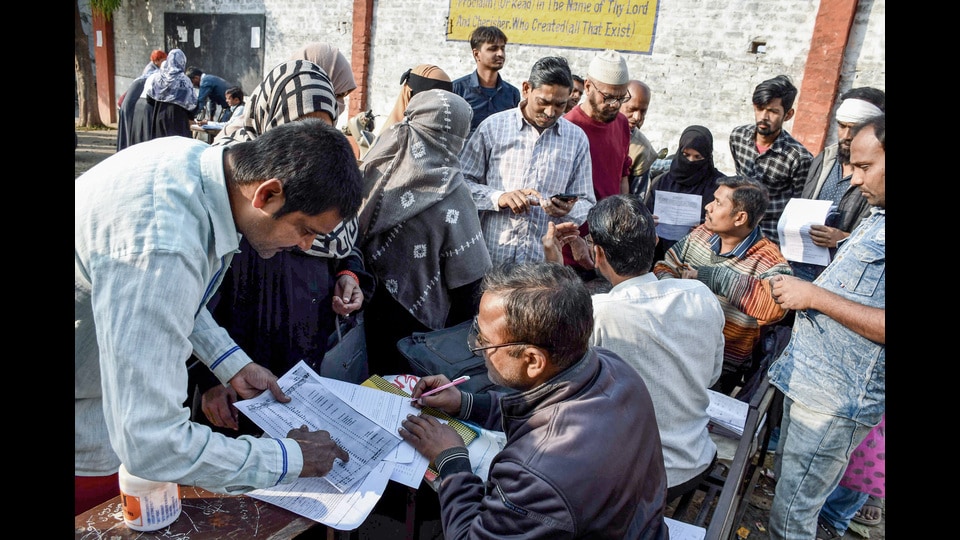
However, what is more surprising is the lack of organic traction from deleted voters. When Uttar Pradesh released its draft rolls after the enumeration phase of the SIR exercise on January 6 this asymmetry only became more stark. Among the 10 large states that have been subjected to the process, Uttar Pradesh tops the list in terms of proportion of deletions compared to the pre-SIR base by a distance. Uttar Pradesh has seen a deletion of 18.7% electors between the electoral roll as on October 27, 2025 (latest before SIR) and the one published on January 6. In absolute terms the deletion is of 28.9 million people, which as we pointed out in these pages, is almost the same as the number of people who voted in the 2024 UK elections. The cumulative deletion of voters in the enumeration phase of SIR exercise in 13 states and union territories aggregates 72.2 million, roughly the same as the 74.7 million electors in Bihar in the 2025 elections. If such a large number of voters have been wrongfully excluded because of SIR, as is often claimed, why are there no large scale protests in the country? What explains this asymmetry between deletions and protests?
It is a provocative question to ask because we still do not have exhaustive machine-readable data on pre- and post- enumeration phase rolls, something which opposition parties have been asking for (and justifiably so). However, an HT analysis of the data available in the public realm suggests a pretty benign explanation for the extent of deletions under SIR and the muted response to them on the ground. Most of the deletions are likely to have been of voters who were probably registered in more than one place thanks to migration and the exercise has mostly purged the migrants from the rolls in places of migration but retained them in their birth places.
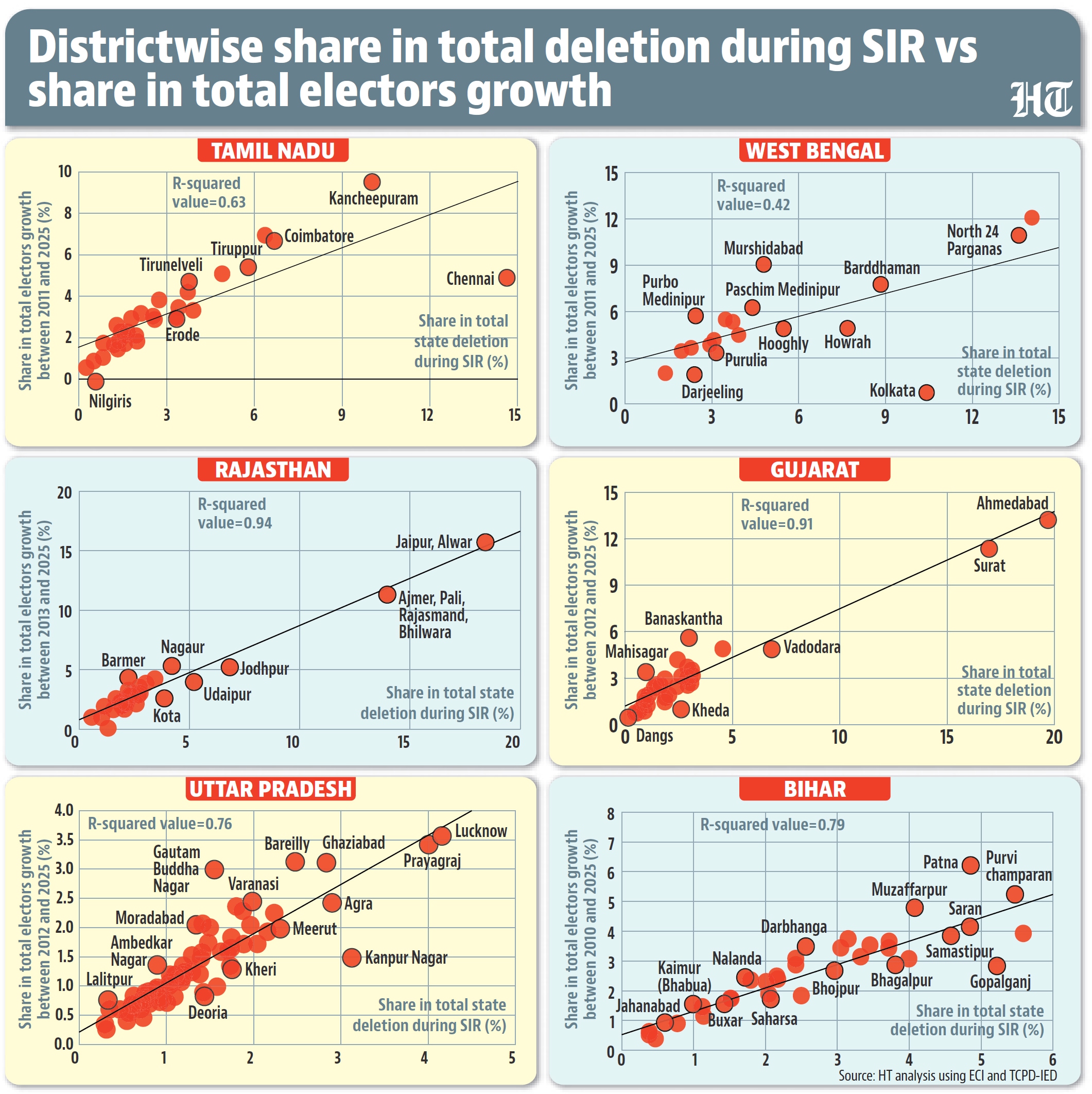
What explains this theory? In the 226 districts for which we have SIR data (some districts were merged with older parent districts to track deletions along with past growth in electors), there is a strong positive correlation between those which saw the highest share in growth of electors between 2012 and 2025 and the ones which have the highest share in deletions in the state. The pattern holds strongly for almost all large states except West Bengal where it is relatively weak rather than non-existent. The argument is best understood through some examples.
Uttar Pradesh has seen an 18.7% deletion in its voter count between the pre-and post-enumeration phase roll. There is a large district-wise variation here. Districts such as Lucknow and Ghaziabad have seen deletions which are as high as 30% and 28%. That is between every fourth to third voter being deleted. What is happening here?
The pieces of the puzzle begin to fall in place once we compare districts by their state-wise share in deleted voters and voters added between the assembly election which was held after the 2008 delimitation exercise. Districts which had the highest contribution to growth in number of electors in their state between the immediate post-delimitation election and 2025 are most likely to have seen the highest share in total deletions in the state. The correlation seen between the two indicators is as good as perfect for Gujarat and Rajasthan; pretty strong for Uttar Pradesh, Bihar, and Tamil Nadu; and far from non-existent for West Bengal. In a lot of cases, although not always, these districts are also major urban/economic activity centers in the state such as Lucknow in Uttar Pradesh, Patna in Bihar, Ahmedabad in Gujarat, Tiruppur in Tamil Nadu etc. For analysing Bihar, we have taken the draft roll after SIR rather than the final roll to maintain comparability with the second round of SIR where voters can still get their names added.
Anecdotally speaking, and one will need much more data to prove this conclusively, there is a simple theory that can explain this trend. Migrants tend to move from less urban/economically dynamic districts to the more urban/economically dynamic ones even within states and end up getting a voter card there. This is what explains the higher contribution of the more urban/economically dynamic districts in the state-wise growth of electors. Some of them never remained in the same place or moved places rendering the earlier entries liable to be struck off. Some of them might have chosen to retain their voter cards in their place of birth rather than places of migration. This is what explains the higher share of deletions in more urban places and the lower share in what are more likely to be migrant exporting rather than migrant importing districts.
This is the only logical explanation for lack of protests against such large-scale deletion of voters under SIR. And it does leave a large philosophical question unanswered vis-à-vis Indian democracy. Should people vote in their place of birth or places where they work and make a living, often as a short-term migrant? This has implications for structures and drivers of political accountability, not just the sanctity of electoral rolls. It is also a dilemma which has been forced on India because of the centrality of migration in our political economy rather than conspiratorial efforts to vitiate electoral rolls.