
Sign in

Ashoka University launches school of advanced computing

The Ashoka School of Advanced Computing (ASAC) will redefine computational thinking, enabling its integration across the sciences, social sciences, humanities, and arts

Published on: Mar 21, 2025, 12:58:25 IST
Share
Share via
  • facebook
  • twitter
  • linkedin
  • whatsapp
Copy link
  • copy link

Ashoka University on Friday launched the Ashoka School of Advanced Computing (ASAC) intending to transform computer science research and education in India.
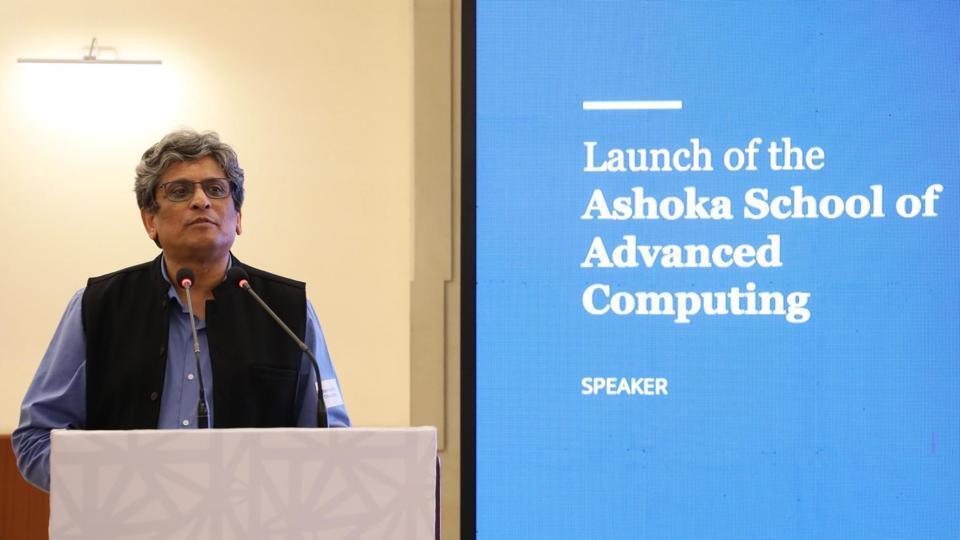
Professor Somak Raychaudhury, Vice-Chancellor of Ashoka University, speaking at the launch. (HT photo | Sourced)

The ASAC will redefine computational thinking, enabling its integration across the sciences, social sciences, humanities, and arts, said the private research university located in Sonipat, Haryana in a statement.

Over the next five years, the university will raise 250 crore to support the expansion of the new school, fund pioneering research, and attract top-tier faculty, students, and researchers from across the world.

“Under ASAC, we will integrate computational sciences with the humanities, social sciences, and natural sciences to address the global challenges of our times. Students doing majors in various subjects like economics, psychology, biology, etc. would be able to apply the tools of computing to their subjects to solve global problems,” Prof Somak Raychaudhury, vice chancellor of Ashoka University told HT.

Also Read: Ashoka University announces new School of Management and Leadership

Pramath Sinha, founder, and chairman, the board of trustees of Ashoka University said that the ASAC is the latest in the formal structure of Ashoka University with schools having departments and centres under them.

“The department of computer science was there from the very beginning of Ashoka University. Over time we realized that data and data science was going to be very big at Ashoka because all our departments were using data and data analysis a lot regardless of discipline. This is the proper structure on which we want to build the next 10 years of Ashoka University,” he said.

Sinha said that the long-term goal of ASAC is to make it a center of excellence in the country.

“We would like to be known as one of the best of the best places for computer science education and research in the country, and particularly this more holistic computer science, integrative, holistic, interdisciplinary computer science,” he said.

  • Sanjay Maurya
    ABOUT THE AUTHOR
    Sanjay Maurya

    Sanjay Maurya is a Principal Correspondent with Hindustan Times, where he covers education, with a focus on school and higher education, competitive examinations, education policy and governance. Working as part of the National Bureau, he is based in New Delhi and reports on the Ministry of Education and covers various statutory bodies like UGC, AICTE and NCTE and autonomous bodies like CBSE and NCERT. His reporting also tracks the implementation of key government reforms and policies from school education to higher education including in IITs, NITs, IIMs, central and state universities, and their impact on students and educational institutions. His reporting on the irregularities and rushed implementation of CBSE's On-Screen Marking (OSM) system for evaluation of Class 12 board exams 2026, triggered administrative action, leading to the transfer of the board's two senior-most officials and the constitution of a committee to probe alleged irregularities in procurement process of the system. He joined Hindustan Times in December 2024. Prior to that, he had a three-year stint at Careers360, where he reported on school and higher education, entrance examinations, admissions, rankings and various education policies involving universities and professional education bodies. Over the years, Maurya has reported extensively on major developments in India's education sector, including the implementation of the National Education Policy (NEP) 2020, reforms in the National Testing Agency (NTA) following the NEET-UG 2024 controversy, changes in school education, higher education regulation, and the evolution of entrance examinations such as NEET, JEE and CUET. He regularly produces data-driven and explanatory stories based on government documents, parliamentary proceedings, court records and official data. His focus remains on helping readers understand how education policies and institutional decisions affect millions of students, teachers and educational institutions across the country.Read More

Get the latest India News, breaking headlines and real-time updates from across the country. Stay informed about politics, government policies, crime, weather major national developments and Karnataka Bandh LIVE.